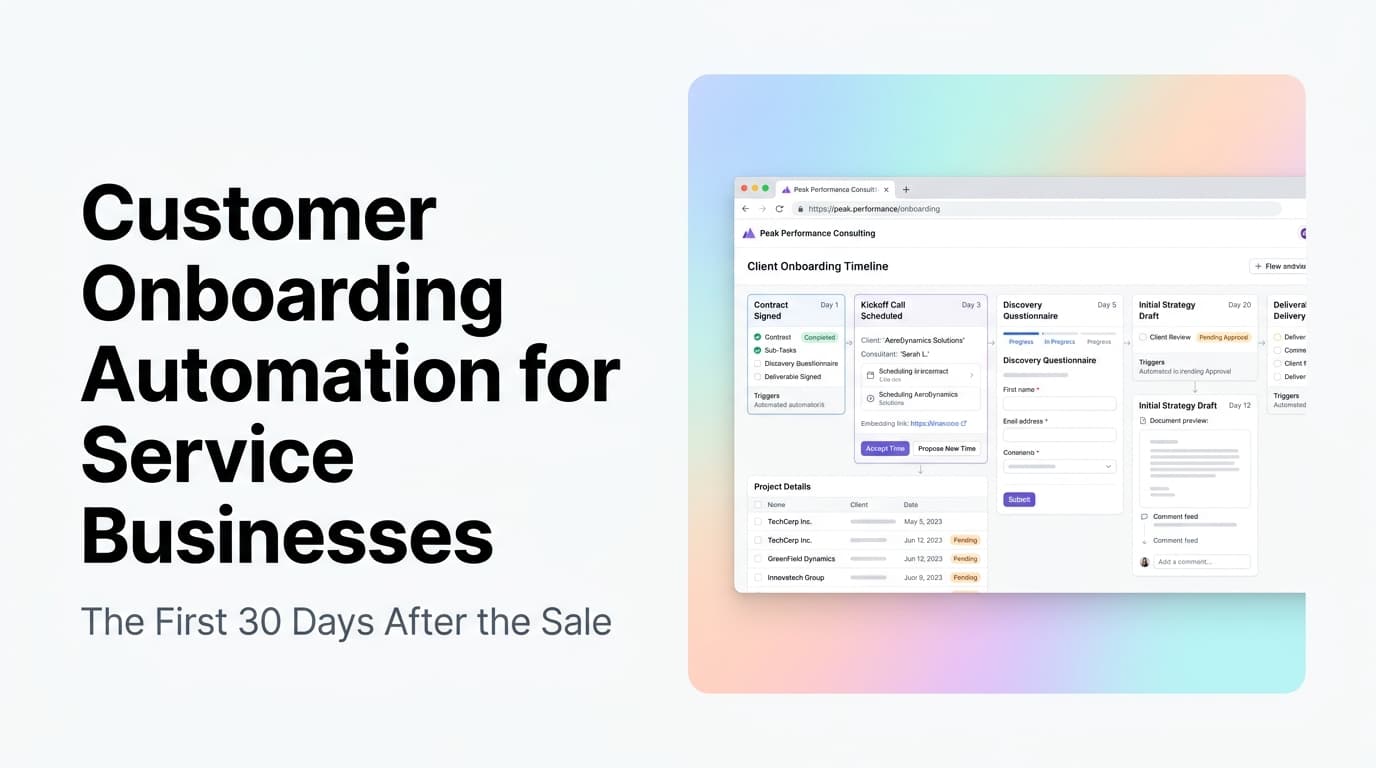
Quick answer: Customer onboarding automation is a system that guides every new customer from signed contract to first delivered service through the same set of steps, in the same order, with the same owner, and with the same visibility for the team. For most service businesses, it covers welcome communications, document and access collection, scheduling, internal kickoff, milestones, and a feedback checkpoint, all wired into the CRM so no step slips and no customer goes quiet.
Why the First 30 Days Decide the Lifetime Value
Most service businesses obsess over winning the deal and then walk away from the customer for two to six weeks. The sale is celebrated. The handoff is informal. A welcome email goes out from a personal address nobody monitors. Documents are exchanged over a chain of replies. The first service appointment lands on a calendar that the customer does not yet have access to.
By the time the team re-engages, the customer has either lost confidence, felt ignored, or started Googling competitors.
That gap is where AI automation earns its keep. Not by sending a fancier welcome email. By making the handoff from sales to operations feel like the same company, with the same attention, every single time.
The economics are well established. Industry studies cited repeatedly since the early 2020s show that improving onboarding completion rates by even a small margin has a much larger effect on lifetime value than equivalent gains in new customer acquisition. For service businesses that depend on renewals, retainers, and referrals, the first 30 days are not a soft beginning. They are the foundation under every future dollar that customer will spend.
A Decision Table for Setting Up Onboarding Automation
Before you pick a tool, decide what the system is responsible for. Most failed onboarding rollouts try to automate too much and measure too little. The table below is the decision framework AnovaGrowth uses with clients when we scope a first onboarding build.
| Question | Best answer | Why it matters |
|---|---|---|
| How many stages belong in onboarding? | Five to eight. Welcome, intake, kickoff, first delivery, milestone check, handoff to renewals. | Anything longer than that becomes a project, not a process. Anything shorter hides the steps that actually decide retention. |
| Who owns the customer during onboarding? | One named owner. Not a shared inbox, not a team rotation. | Generic ownership turns into no ownership within a month. The handoff goes quiet and the customer goes cold. |
| Where does the source of truth live? | The CRM, not email, not a project tool, not a spreadsheet. | If the team cannot answer "where is this customer in onboarding" in five seconds, the system is failing. |
| What must a human do? | Anything that requires judgement, pricing decisions, scope changes, or emotional sensitivity. | Onboarding is where customers decide if they trust you. The human moments are not where you save money. |
| When is onboarding officially complete? | When the customer has hit the first defined milestone and the handoff to ongoing service is logged. | Without a finish line, onboarding quietly turns into "support" and the team loses the ability to measure. |
| What gets measured weekly? | Stage-to-stage conversion, time in stage, drop-off reasons, and referral activity. | Vanity metrics like "welcome email open rate" do not predict retention. Stage movement does. |
Proof/example: A regional home services company built a five-stage onboarding flow for new maintenance plan customers. The CRM moved each account from "contracted" to "welcome sent," "intake complete," "first service scheduled," "first service delivered," and "milestone reached." Owners had to close each stage with a reason. In the first quarter, the team cut average onboarding time from 38 days to 19, lifted the percentage of customers who reached the first service milestone from roughly 6 in 10 to 8 in 10, and caught the document collection bottleneck that had been quietly costing them renewals.
The Five Stages Most Service Businesses Should Build First
Onboarding only works if the stages are clear and action-based. Vague labels like "in progress" or "active onboarding" tell the system nothing.
A workable first version usually looks like this:
- Contract or work order signed
- Welcome sent, with the right documents, calendar links, and a single point of contact
- Intake complete, including access, preferences, billing, and any required forms
- Internal kickoff, where the operations team confirms the schedule and reviews the scope
- First service delivered, with the customer logged in the system as "active"
- 30-day check-in, which routes to renewals, expansion, or service recovery
These stages give the team something to measure, something to assign, and something to escalate. A customer stuck at "intake complete" for more than three business days should trigger an owner task. A customer who never reaches "first service delivered" within the agreed window is a recovery case, not a marketing lead.
This is exactly where workflow automation earns its keep over a basic email sequence. The system has to understand status, owner, document state, scheduling reality, and exceptions. A flat drip campaign cannot do any of that.
Where AI Helps and Where It Should Stay Out
Onboarding is full of small tasks that quietly eat hours. AI is a good fit for the repetitive and the predictable. It is a poor fit for the moments that define whether the customer stays.
Good AI tasks include:
- Drafting the welcome message in the customer's preferred tone
- Chasing missing documents with polite, time-staged reminders
- Summarizing intake forms so the operations team can prepare
- Detecting replies that signal frustration, confusion, or escalation
- Suggesting the right internal owner based on the customer's service mix
- Logging each onboarding stage with a structured reason
Tasks that should usually stay with a human:
- Conducting the kickoff call or welcome meeting
- Handling billing disputes or scope changes
- Approving exceptions to the standard onboarding path
- Responding to emotional or high-stakes messages
- Deciding whether a customer gets a discount, a credit, or an extra service
- Updating the onboarding script when the business model changes
The simplest pattern that works for most service businesses is "AI runs the timing and the paperwork, humans run the relationship." Fully automated reminders, document collection, and stage logging are fine. Kickoff conversations and recovery calls are not.
If onboarding automation is going to touch a CRM, the CRM has to be ready for it. Our guide to CRM data cleanup before AI automation walks through the field-level decisions that make automation safer.
First-Hand Operating Insight From AnovaGrowth
When AnovaGrowth scopes customer onboarding automation, we look at three things before we look at tools.
First, the handoff. If the salesperson closes a deal and a different person owns onboarding, the customer will get two different experiences unless the system enforces consistency. The first build almost always starts with a single source of truth in the CRM and a named owner for every account.
Second, the documents and access. Service businesses lose days chasing the same things: signed agreements, payment details, site access, decision-maker contacts, and utility or system information. Most of that can be standardized into a checklist that fires the moment a contract is signed.
Third, the milestone. Without a clear definition of onboarding "done," the team cannot tell whether onboarding is healthy or stuck. We push clients to pick one milestone that matters to the customer and the business, then measure how many accounts reach it on time.
The biggest wins usually come from three small changes:
- Move from "welcome email" to a structured welcome stage with required fields
- Move from "we'll be in touch" to a scheduled kickoff with a named owner
- Move from "check in sometime" to a defined 30-day milestone with a required outcome
Those three changes alone usually lift milestone completion by 15 to 25 percent within a quarter, without changing the actual service the team delivers.
What to Build First
Do not start with a customer success platform. Start with the smallest path that protects the first 30 days.
For most service businesses, that first build looks like this:
- Contract signed in the source system triggers a CRM stage change
- Welcome message and document request go out within the same business day
- Each missing document creates an owner task and a polite reminder schedule
- Intake completion moves the account into the internal kickoff stage
- The kickoff owner confirms the schedule, scope, and access
- First service delivered moves the account to "active"
- A 30-day check-in task fires with a structured question set
- The final outcome is logged with a reason and a next step
That workflow is not flashy. It works because it closes the gap between "we signed the deal" and "the customer has the result we promised."
Proof/example: A 30-day check-in works best when it is tied to a defined outcome, not a generic "How are things going?" email. A concrete check-in like "Has your first service been completed, scheduled, or postponed?" with three buttons routes the account into the right next stage automatically, and surfaces stuck customers to the owner before they churn.
Related Questions Business Owners Should Ask
How long should onboarding take?
It depends on the service, but most service businesses should be able to move a customer from "contract signed" to "first service delivered" inside two to four weeks. Anything longer usually means documents, scheduling, or ownership is leaking.
Should the salesperson stay involved during onboarding?
Light touch, not full ownership. The salesperson should be visible in the welcome stage and available for the 30-day check-in, but the day-to-day owner should be an operations or customer success person whose job is delivery, not selling.
What if the customer goes silent during intake?
Pause the sequence, escalate to the owner, and switch from automated reminders to a personal message. Silent customers are usually confused, busy, or stalled on a missing piece of information. A human follow-up recovers most of them.
Can onboarding automation replace a kickoff call?
No. Automation can schedule the call, send the agenda, collect the prep, and confirm attendance. It cannot run the call. The first conversation after the sale is the highest-trust moment in the relationship, and it should still happen with a person.
How do we know onboarding is healthy?
Watch stage-to-stage conversion, time in each stage, and the percentage of customers who reach the defined milestone on time. Those numbers tell you whether the process works. Email open rates do not.
What if our services vary widely in scope?
Use the same five-stage skeleton, but tune the intake and milestone for each service line. The structure stays the same. The fields, documents, and timing windows change. That is why custom software often comes in once the workflow is proven.
When Custom Software Makes Sense
Off-the-shelf CRMs handle simple welcome sequences and task reminders. Custom software makes sense when onboarding has rules your current tools cannot express cleanly.
That may include:
- Service-specific intake forms that change the onboarding path
- Multi-location routing with different owners and milestones per region
- Document collection that requires approval before an account can move forward
- Custom stage-to-stage reporting tied to revenue, margin, or service recovery
- Integration with field service, scheduling, or job-costing software
- Regulatory or compliance checkpoints that vary by service line
If the workflow has to match how the business actually delivers, custom logic is usually cheaper than fighting a generic tool.
Key Takeaways
- Customer onboarding automation protects the value of every sale the team already made.
- Five to eight action-based stages, one named owner, and a clear finish line beat vague "in progress" labels.
- AI is useful for timing, document chasing, intake summarization, and stage logging. Humans should own the kickoff call, scope changes, and recovery.
- Stage-to-stage conversion and milestone completion are the metrics that matter. Email metrics do not.
- The goal is not faster onboarding. The goal is consistent onboarding that produces more customers who reach their first delivered service and stay.
Next Step
If onboarding feels slow, inconsistent, or invisible to the leadership team, start by mapping the path from "contract signed" to "first service delivered." Find where ownership breaks, where documents pile up, and where customers quietly disappear.
Then build the smallest automation that fixes that gap.
Ready to make the first 30 days repeatable? Contact AnovaGrowth to plan an onboarding workflow that fits your CRM, service team, and customer mix.