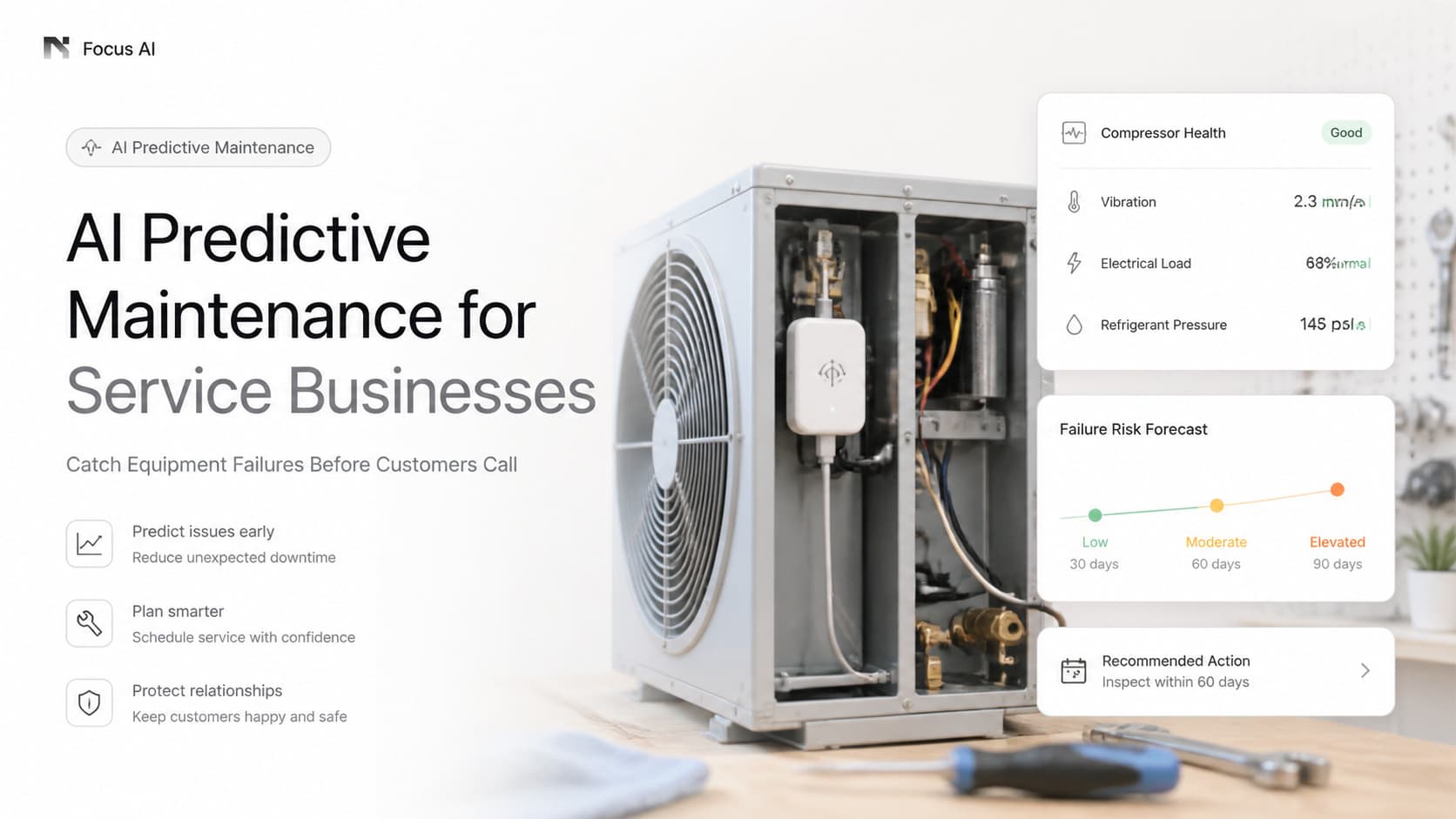
Quick answer: AI predictive maintenance combines runtime hours, sensor readings, service history, and usage patterns to forecast equipment failure 30 to 90 days before it happens. Service businesses that switch from reactive break-fix to AI-driven predictive cut emergency service calls by 25 to 40 percent, extend equipment life 15 to 25 percent, and turn vague annual maintenance contracts into a recurring revenue stream tied to real condition data.
The 2 a.m. Phone Call That Keeps Owners Up
Every service business owner knows the call. The one where the restaurant manager says the walk-in cooler just died, or the property manager says the elevator is making a noise, or the homeowner says the AC stopped on a 95-degree night and they have a newborn.
You dispatch a tech. You eat the labor cost. The customer is upset. The technician who would have been on a profitable job is now bleeding money on an emergency run.
Most of those calls were predictable. The compressor had been short-cycling for weeks. The blower motor was drawing 18 percent more amperage than last quarter. The refrigerant pressure was drifting outside spec. None of it triggered a work order, because nothing was "broken" yet.
Predictive maintenance is the discipline of catching that drift before it becomes a failure. AI is what makes it possible at scale, on a service truck, without a data scientist in your office.
Predictive vs Preventive vs Reactive: What's Actually Different
The three words get used interchangeably, and they are not the same thing. Most service businesses run mostly reactive, with some preventive layered on top. Predictive is the next step, and it changes the economics.
| Approach | Trigger | When the visit happens | Typical cost per failure |
|---|---|---|---|
| Reactive | Equipment fails | After downtime, often off-hours | 2x to 4x normal call rate |
| Preventive | Calendar or run-hours | On a fixed schedule, regardless of condition | Full visit cost, even when nothing is wrong |
| Predictive | AI risk score crosses threshold | Only when the model says failure is likely | Visit cost only when there is a real issue |
The math is simple. If you visit 100 rooftop units twice a year preventively, you make 200 trips and find maybe 15 real problems. If you visit only the 18 the model flags as high-risk, you make 18 trips and catch 14 real problems, with margin to spend more time on each one.
What Data a Predictive Model Actually Uses
You do not need IoT sensors on every asset to start. Most service businesses already have the data they need in three places that never talk to each other.
Service history. Every work order, every part replaced, every customer complaint for the last 3 to 5 years. A compressor that has had three refrigerant top-offs in 18 months is a different risk profile than one that has had zero.
Runtime and usage data. Thermostat logs, run-hour meters on commercial equipment, SCADA outputs from building management systems, refrigeration controller logs, generator exercise reports. If your equipment has a controller, it almost certainly has the data sitting in a vendor portal nobody is reading.
Customer and environmental context. Square footage, occupancy, age of building, climate zone, filter change history, last inspection notes. A 12-year-old blower motor on a coastal restaurant is not the same risk as a 12-year-old blower motor in a climate-controlled office.
AI ties these streams together. It scores every asset every night on a 0-100 failure-risk scale. When a score crosses the threshold your team sets, the system creates a work order, drafts a customer email, and suggests the technician, parts, and timing.
Where the ROI Actually Comes From
Predictive maintenance gets pitched as a "save money on repairs" play. That undersells it. The real returns come from four places, and the last one is the biggest.
1. Fewer emergency dispatches. Industry data and internal benchmarks on HVAC, refrigeration, and generator service contracts show 25 to 40 percent reductions in after-hours calls once a predictive system is tuned. Each avoided emergency call saves $200 to $800 in overtime labor and lost productivity.
2. Longer asset life. Components that are caught at the failing stage get replaced instead of running until they damage adjacent systems. Compressors that pull refrigerant charge back into the line set last longer. Motors that get rebalanced instead of seizing protect bearings and belts.
3. Better parts planning. When you know 12 compressors will fail in the next quarter, you buy 12 compressors. When you are guessing, you stock 18 and end up with 6 dead-on-arrival returns after six months. The inventory carrying cost goes down.
4. A real maintenance contract pitch. "Pay us $300 a year and we will change your filter" is a weak sale. "Pay us $600 a year and our system will tell us, and you, when your compressor is at risk, then we replace it before it dies" is a different conversation. Predictive data turns a commodity service into a value-priced one, and it gives your sales team something concrete to walk a customer through.
How It Works in Different Trades
Predictive maintenance looks different across service industries, but the pattern is the same: pull existing data, score risk, route the right tech.
HVAC and refrigeration. Compressor amp draw, superheat and subcool values, delta-T across the coil, and filter delta-P all drift predictably before failure. Most modern units already log amp draw in the controller. The model reads the trend, not the snapshot.
Plumbing and water systems. Booster pump cycle counts, pressure variance, water heater anode rod replacement intervals, and backflow test history. The pattern that predicts a leak next month is in the data, but only if you aggregate it.
Electrical and generators. Generator exercise reports, battery impedance trends, breaker trip history, and load profile. AI catches the slow degradation that the human eye reads as "fine" for two years running.
Commercial kitchen and food service. Walk-in cooler door cycle counts, defrost cycle duration, evaporator fan amperage, and gasket condition notes. Restaurant equipment failure is almost always predicted days in advance by data nobody is currently tracking.
Pools, irrigation, and outdoor service. Pump pressure decay, filter runtime curves, and seasonal usage shifts. Often the easiest wins because the data is already in a controller log.
Building a Predictive Maintenance System: The 6-Step Sequence
This is the order we have seen work across service businesses ranging from a single HVAC company with 800 maintenance agreements to a regional refrigeration contractor with 40 technicians.
- Pull the last 3 years of work orders into one place. Most service businesses have this split across three systems. Consolidation comes first.
- Connect the equipment controllers to a data pipeline. Modbus, BACnet, and vendor cloud APIs (Carrier, Trane, Lennox, Daikin, Honeywell) all export the runtime data you need. A small gateway device handles most of them.
- Score every asset on failure risk nightly. Use an existing model to start. You do not need to train your own.
- Set thresholds your team trusts. If everything is "critical," nothing is. Calibrate against last year's actual failures.
- Auto-generate the customer outreach. Email, SMS, or phone call, with the specific finding and recommended action. Generic maintenance pitches lose. Specific ones close.
- Track which predictions turned into real work orders. This is the feedback loop that improves the model. Six months in, the precision of the predictions should be visibly better.
Most implementations are live in 6 to 10 weeks. The first month is data cleanup. The second month is scoring and threshold tuning. By month three, you should be seeing prevented failures on the schedule.
What Most Service Businesses Get Wrong
They wait for perfect data. The first model will be 60 percent accurate. That is fine. It is still better than the human gut, and it improves every month.
They buy IoT sensors before they need them. Many controllers already export the data. Spend money on integration before instrumentation.
They treat it as an equipment play instead of a service play. Predictive maintenance does not just save breakdowns. It is the foundation for selling higher-margin contracts, justifying price increases, and differentiating from the competitor who only shows up when something is broken.
They do not loop the data back into sales. When your model flags 40 commercial accounts whose equipment is aging into a high-risk window, that is a list. Hand it to sales. A renewal conversation grounded in actual asset risk closes at a very different rate than a generic "time to renew" reminder.
Key Takeaways
- AI predictive maintenance is not science fiction. Most service businesses already have 70 percent of the data they need in work orders, controller logs, and CRM notes.
- The shift from reactive to predictive cuts emergency calls 25 to 40 percent and changes the economics of every service contract.
- The biggest ROI is not fewer breakdowns, it is selling higher-margin maintenance contracts based on real condition data instead of calendar guesswork.
- Implementations run 6 to 10 weeks, not 6 to 10 months. The hard part is data cleanup, not the AI.
- Feedback loops matter. Every prediction that turns into a real work order makes the next prediction more accurate.
- Predictive maintenance unlocks every adjacent workflow, from parts inventory to sales renewal motion to technician routing.
Where to Go From Here
If your service business is sitting on years of work order data and equipment you cannot see until it fails, predictive maintenance is one of the highest-return AI moves you can make this year. It pays back through fewer emergency calls, longer asset life, smarter parts inventory, and a maintenance contract that is worth more than your competitor's.
AI automation plus a workflow automation layer is the foundation. Asset tracking and inventory management extend the same data pipeline into parts and tools, so the predictive layer talks to the rest of the operation instead of living in another silo.
Ready to see what your service data would predict? Contact us and we will map out which equipment categories are worth scoring first and what data you already have on hand.