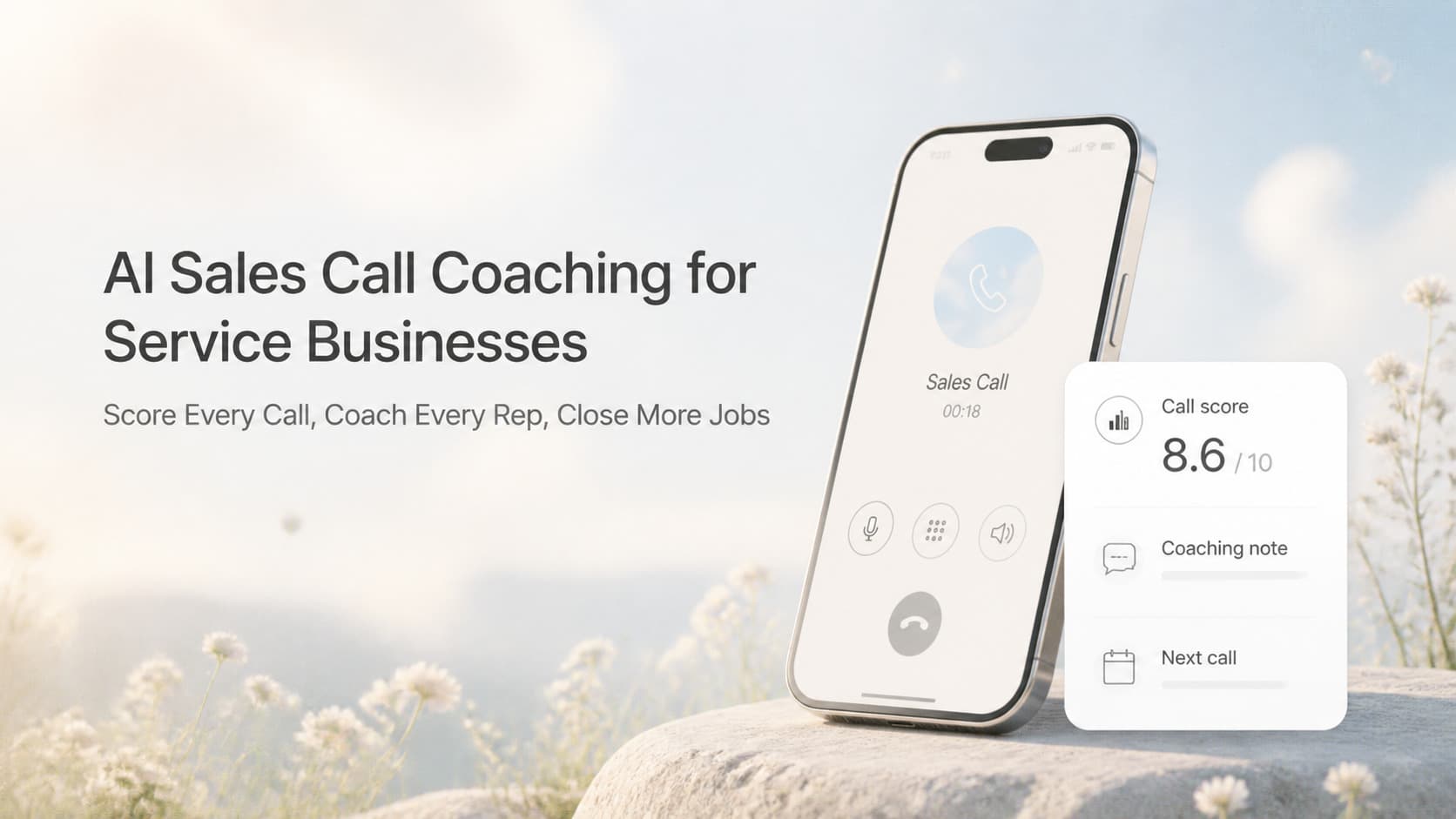
Quick answer: AI sales call coaching is a system that listens to every inbound and outbound sales call your service business runs, scores it against a 10-point rubric (opening, qualification, objection handling, pricing clarity, next steps), and routes coaching notes to the right person before the next call. The score sits next to the call recording in the CRM. The rubric gets reviewed every Monday. Reps see their own trends. Managers see team trends. Service businesses that run this system typically lift close rates 15-30% inside 90 days because the call behavior changes inside two weeks, not because the AI does something magical. The work is in the rubric, the rhythm, and the willingness to coach.
The Problem With Sales Calls at Most Service Businesses
You hired a sales rep. They answer the phone, talk to the homeowner, give a price, and either book the job or lose it. You have no idea which calls went well, which calls blew up, and which calls could have been saved. You listen to a call when a customer complains. You never listen when the customer says yes.
This is the standard operating model for almost every service business with 2 to 50 employees. The owner assumes the calls are fine because jobs are getting booked. The numbers quietly drift. Close rate drops from 40% to 32%. Nobody notices because revenue is still up. The marketing team spends more to fill the gap. The rep leaves. The new rep starts from scratch.
AI sales call coaching fixes this. It does not replace your reps. It does not listen in to spy on them. It scores every call against a consistent rubric, surfaces the calls that need coaching, and turns the sales call from a black box into a measurable workflow.
What AI Sales Call Coaching Actually Does
Three things, in order of how a service business usually rolls them out.
1. Transcribes every call and tags the rubric categories. The AI listens to the call, writes it down, and labels the parts of the conversation that match your rubric. Did the rep confirm the customer's name in the first 30 seconds. Did they ask about the property type. Did they explain why the price was what it was. Did they set a clear next step. Each labeled moment becomes a data point.
2. Scores the call against a 10-point rubric. The score is two numbers: a rubric score (how well the rep followed the playbook) and a conversion likelihood (how likely the call ends in a booked job based on what was said). Both are surfaced in the CRM next to the call recording.
3. Routes coaching notes to the manager before the next call. If a rep lost a deal because they never asked about decision timing, the manager sees that note before the rep's next call. If a rep had three calls in a row where they skipped the next-step close, the manager sees a pattern. The coaching happens while the rep is still in the field, not at the next quarterly review.
The technology is mostly off the shelf. The work is the rubric, the workflow, and the rhythm. Most service businesses skip that part and wonder why the AI tool did not move the needle.
The 10-Point Sales Call Rubric
You need a rubric before the AI does anything useful. The rubric is your definition of a good sales call. The AI scores against it. The rubric below works for most inbound service calls (HVAC, plumbing, roofing, electrical, pest, cleaning, landscaping, restoration). Adjust the weight on categories to match your business.
| # | Rubric Category | What to Listen For | Weight |
|---|---|---|---|
| 1 | Opening | Greet by name, state company, confirm caller intent within 30 seconds | 5% |
| 2 | Build rapport | One personal moment (how long in the home, kids, pets, neighborhood) | 5% |
| 3 | Discovery | Asked about problem, history, what they have already tried | 15% |
| 4 | Property context | Asked square footage, age, system type, or property layout | 10% |
| 5 | Qualification | Asked about budget, timeline, and decision-maker | 10% |
| 6 | Diagnosis and authority | Explained what likely caused the problem, showed expertise | 10% |
| 7 | Solution framing | Recommended a specific plan, not a menu of options | 15% |
| 8 | Objection handling | Acknowledged the concern, rephrased it, answered with proof | 10% |
| 9 | Pricing clarity | Gave a price or range, explained what was in and out of scope | 10% |
| 10 | Next steps | Booked a specific appointment or set a specific follow-up | 10% |
The rubric is not a script. It is a measurement. A rep can hit category 7 without sounding robotic. The score rewards the behavior, not the words.
A 0-100 score falls out of the weighted rubric. Anything above 80 is a strong call. Anything below 50 is a coaching call. Anything below 30 is a fire-able pattern.
How to Build the Coaching Workflow
The workflow is what turns the score into revenue. Without a workflow, you have a dashboard. With a workflow, you have a coaching system.
Step 1: Pick the Call Recording Source
Most service businesses use one of three phone systems: a hosted PBX, a cloud-based VoIP, or a softphone running through a CRM. Each one of them has a recording API.
Connect the call recording source to the transcription service. Most modern AI call coaching tools plug into the dialer directly. If your phone system does not have an integration, route the calls through a tool that does and use that as the recording source.
Step 2: Apply the Rubric in the AI Tool
Most call coaching tools come with a generic rubric out of the box. Replace it with your 10-point rubric. The wording matters. The AI scores against the categories you define. If your category is "ask about decision-maker," the AI listens for that exact moment.
Step 3: Push the Score and Notes Into the CRM
The score and the coaching notes belong in the CRM next to the call recording, the contact, and the deal. Use a field on the contact record (e.g., last_call_score) and a related record for the call itself (score, rubric breakdown, top coaching moment, manager note).
If the CRM does not support custom fields, push the data to a Google Sheet that mirrors the CRM. The team has to see the score when they look at the contact.
Step 4: Run a Monday Coaching Meeting
Once a week, the sales manager (or the owner) reviews the lowest-scoring calls from the previous week and the highest-scoring calls. The goal is to find two or three specific coaching moments to share with the team.
The Monday meeting should take 30-45 minutes. Bring three calls: one to celebrate, one to dissect, one to use as a coaching example. The team learns what good sounds like and what bad sounds like.
Step 5: Send 1:1 Coaching Notes Within 24 Hours
The AI surfaces the calls that need coaching. The manager listens to the call, watches the rubric breakdown, and writes one or two specific notes. The notes go to the rep within 24 hours of the call.
The note is not "your call was bad." The note is "you skipped the budget question on the Johnson call at 11:42am. The customer brought up price themselves at 14:08 and you had no anchor. Listen to the Davis call from Tuesday at 9:15am for a clean example." The note is specific, timely, and actionable.
Step 6: Track the Trend, Not the Snapshot
A single 35-score call is not a coaching failure. A four-week trend of sub-50 scores is. The dashboard should show the rep's rolling average and the team average. The trend is what the manager watches.
What the AI Does Not Do
The AI does not replace the manager. It does not replace the rep. It does not write the rubric. It does not decide who needs coaching. It does not make hiring decisions.
What the AI does well: it listens to every call, scores it consistently, and surfaces the moments that matter. A human manager cannot listen to 200 calls a week. The AI can. The manager's job is to listen to the calls the AI flagged, write the coaching note, and run the Monday meeting.
This is the part where most service businesses fail. They buy the AI tool. They run it for a month. They look at the dashboard. Nothing changes. The AI is a dashboard because nobody turned it into a workflow. The workflow is the work.
AnovaGrowth Operating Insight
The sales call coaching system we set up most often for service businesses has four moving parts: a call recording source, a call coaching AI with a custom rubric, a CRM field for the score, and a Monday coaching meeting. The technology is usually 20% of the project. The rubric, the meeting cadence, and the manager's willingness to coach on specific moments is the other 80%.
In one HVAC client in northwest Georgia, the owner was convinced his sales team was underperforming. Close rate was 28%. Revenue was flat. He assumed the marketing was bad. We put the AI call coaching system on top of his existing dialer. The first week of scoring showed the issue was not marketing. It was the opening. Six out of eight reps skipped the company intro. Five out of eight never asked about decision timing. Three out of eight gave a price without explaining what was in scope. The owner had been listening to maybe one call a month. The AI was listening to every call.
The owner ran the Monday meeting for 90 days. He coached the specific moments the AI flagged. By week 4, the team average was up 9 points. By week 8, the close rate was 34%. By week 12, the close rate was 41%. The marketing team did not change. The dialer did not change. The leads did not change. The calls changed.
The biggest unlock was not the score. It was the Monday meeting. The reps started preparing for the meeting. They started listening to their own calls. They started asking each other for tips. The score was a mirror. The meeting was the room where the mirror got used.
How This Connects to Your Other Systems
If the sales call coaching system is in place but the follow-up after the call is manual, AI Sales Follow-Up Automation covers the workflow that turns a booked call into a closed deal.
If the rep is strong on the call but the proposal is slow or weak, AI Proposal Generation for Service Businesses covers how to turn the call notes into a polished proposal inside an hour.
If the calls are being recorded but not transcribed or summarized, AI Call Transcription and Summarization for Service Businesses covers the first step in the call coaching stack.
If the team is missing calls or routing them poorly, AI Phone Answering for Service Businesses covers the front door before the coaching begins.
If the team is taking the calls but losing them on follow-up, Missed Call Text Back for Service Businesses covers the recovery step for the calls that did not get answered at all.
Related Questions and Subtopics
- What is AI sales call coaching for a service business? A system that listens to every sales call, scores it against a 10-point rubric (opening, discovery, qualification, objection handling, next steps), surfaces coaching moments to the manager, and feeds a weekly coaching meeting. The goal is to lift close rates 15-30% by changing call behavior, not by replacing the rep with AI.
- How much does AI call coaching cost for a service business? Most call coaching tools price per call or per seat. A typical service business with 4 to 10 reps pays $300 to $1,200 a month for the tooling, plus 4 to 8 hours a month of manager time to run the coaching meeting and write the notes. The ROI typically lands in the first month once close rate moves.
- Do reps resist AI call coaching? The reps who resist are the reps who already know they are missing the rubric. The reps who welcome it are the reps who want to get better. Frame the rollout around coaching, not surveillance. The score is a tool for the rep, not a tool for the manager. If the manager uses it as a surveillance tool, the team will game it or leave.
- How long before close rates improve? Inside 2 weeks for the rep-level behavior change. Inside 4 to 6 weeks for the trend on the team dashboard. Inside 90 days for the close rate to settle at the new baseline. The lift is usually 15-30% on close rate, depending on the starting point and the consistency of the coaching meeting.
- What is the difference between call transcription and AI call coaching? Transcription turns speech into text. AI call coaching scores the call against a rubric and surfaces coaching moments. Transcription is a feature. Coaching is the workflow. Most service businesses start with transcription and stop there. They get searchable notes but no behavior change. The behavior change comes from the coaching layer.
- Can a small service business run call coaching without a manager? Yes, if the owner runs the Monday meeting themselves. The owner-as-coach model works for service businesses with 2 to 6 reps. Above 6 reps, the manager layer matters because the owner cannot listen to every call the AI flags.
- How do I measure the ROI of AI call coaching? Track close rate (jobs booked divided by qualified calls), average ticket (revenue per closed call), and ramp time (how long until a new rep hits the team average). Close rate is the cleanest number. A 5-point lift on close rate for a business doing 200 calls a month is meaningful revenue.
- What is the biggest mistake when rolling out AI call coaching? Buying the tool and skipping the rubric. The rubric is what makes the score meaningful. Without a rubric, the AI is guessing. With a rubric, the AI is measuring. The rubric takes a half-day to write and a week to refine. It is the single most valuable hour in the project.
Key Takeaways
- AI sales call coaching scores every call against a 10-point rubric and surfaces coaching moments before the next call.
- The 10-point rubric covers opening, rapport, discovery, property context, qualification, authority, solution, objection handling, pricing clarity, and next steps.
- The score is two numbers: rubric score (how the rep did) and conversion likelihood (how the call ended).
- The Monday coaching meeting is where the score turns into behavior change. Without the meeting, the score is a dashboard.
- Coaching notes go to the rep within 24 hours. The note is specific, timely, and actionable.
- Service businesses running this system typically lift close rates 15-30% inside 90 days.
- An HVAC client moved close rate from 28% to 41% in 12 weeks with the same leads and the same dialer.
- The biggest unlock is the meeting, not the tool. The tool listens to every call. The meeting is where the listening gets used.
- Frame the rollout around coaching, not surveillance. Reps who feel coached get better. Reps who feel monitored leave.
- Track the trend, not the snapshot. A single low score is a moment. A four-week trend is a pattern.
Next Steps
The fastest way to start is to pick a call recording source you already have, write the 10-point rubric for your business, and run the AI scoring for two weeks without sharing scores with the team. Use those two weeks to refine the rubric and confirm the categories map to your real calls. Then turn the scores on for the team, schedule the Monday meeting, and commit to 90 days of weekly coaching. Track close rate, average ticket, and ramp time. Adjust the rubric weights based on what actually predicts wins in your business.
If you want help writing the 10-point rubric for your sales calls, wiring the AI scoring tool into your dialer and CRM, setting up the Monday coaching meeting agenda, and building the dashboard that tracks close rate and rep trends, contact us for a 30-minute sales call coaching review. We will audit one of your recent calls, draft the rubric and weights, and outline the weekly operating rhythm that turns the AI score into a measurable lift in close rate.
Ready to score every call and coach every rep? Contact us and we will set up the AI call coaching system, the Monday meeting cadence, and the dashboard that turns your sales calls into a measurable, improvable workflow.