Claude Mythos 5 and Fable 5: What Businesses Should Know
Claude Fable 5 is a guarded Mythos-Class model available on paid plans through June 22. Here's what businesses should know.

Anthropic just made its first public Mythos-Class model available, and the naming is easy to misunderstand.
Quick answer: Claude Fable 5 is the public, guarded version of Anthropic's new Mythos-Class capability. Claude Mythos 5 is the same underlying model, but with some safeguards lifted for vetted programs such as Glasswing. If you have access through Pro, Max, Team, or seat-based Enterprise, Fable 5 is included at no extra cost through June 22, 2026. On June 23, using it requires usage credits unless Anthropic extends the included window.
Sources: Anthropic's launch announcement, Claude Fable 5, and Claude Mythos 5.
What "Mythos-Class" Means
"Mythos-Class" is not a separate product by itself. It is a capability tier.
Think of it the way people describe a ship class. The USS Missouri was an Iowa-class battleship. "Iowa-class" tells you the design family and capability level; "USS Missouri" is the specific ship. In the same way, Fable 5 is a specific Claude model, and Mythos-Class tells you it sits above Opus-class in capability.
That is why this launch matters. Anthropic is not saying Fable 5 is a small Opus update. It is saying the public now has access to a model from a higher capability class, with guardrails added so regular users can work with it safely.
Claude Mythos 5 vs. Claude Fable 5
| Question | Claude Fable 5 | Claude Mythos 5 |
|---|---|---|
| Who can use it? | Pro, Max, Team, and seat-based Enterprise users through June 22; API and consumption-based Enterprise access from launch | Restricted to Glasswing partners and select biology researchers until Anthropic expands trusted access |
| What is it for? | Everyday business use, coding, research, agents, analysis, and workflow automation | Specialized work where some Fable 5 safeguards would block legitimate security or biosecurity research |
| Is it the same model? | Anthropic says Fable 5 and Mythos 5 share the same underlying model | Same underlying model, with a different safeguard posture |
| Why the different name? | Fable is the guarded public variant | Mythos is the restricted variant with some safeguards lifted |
| What should startups care about? | This is the one to evaluate for real business workflows now | Watch the capability signal, but do not plan around general access |
| Main caution | Higher capability increases the need for better approval rules, monitoring, and data boundaries | Access is limited and should not be treated as a normal business tool |
That distinction matters for search intent. If you are looking for "Claude Mythos 5," you probably want to know whether it is public, how it compares to Fable 5, and whether it changes your AI roadmap. The short version: use Fable 5 as the business-ready path, and treat Mythos 5 as the restricted version behind the benchmark headline.
Anthropic lists both Fable 5 and Mythos 5 at $10 per million input tokens and $50 per million output tokens. Developers can use claude-fable-5 through the Claude API, which makes Fable 5 the model most startups should test first.
There is also a short access window worth noting. Fable 5 is included in Pro, Max, Team, and seat-based Enterprise plans through June 22. On June 23, Anthropic says it will require usage credits unless capacity allows an extension. In plain English: if it shows up in your plan, use it, test it, and enjoy the included access while it lasts.
The Benchmark Picture Anthropic Posted
Anthropic's benchmark table shows the new model family leading or staying near the top across agentic coding, knowledge work, vision, spatial reasoning, tool use, legal, cybersecurity, health, and multidisciplinary reasoning.
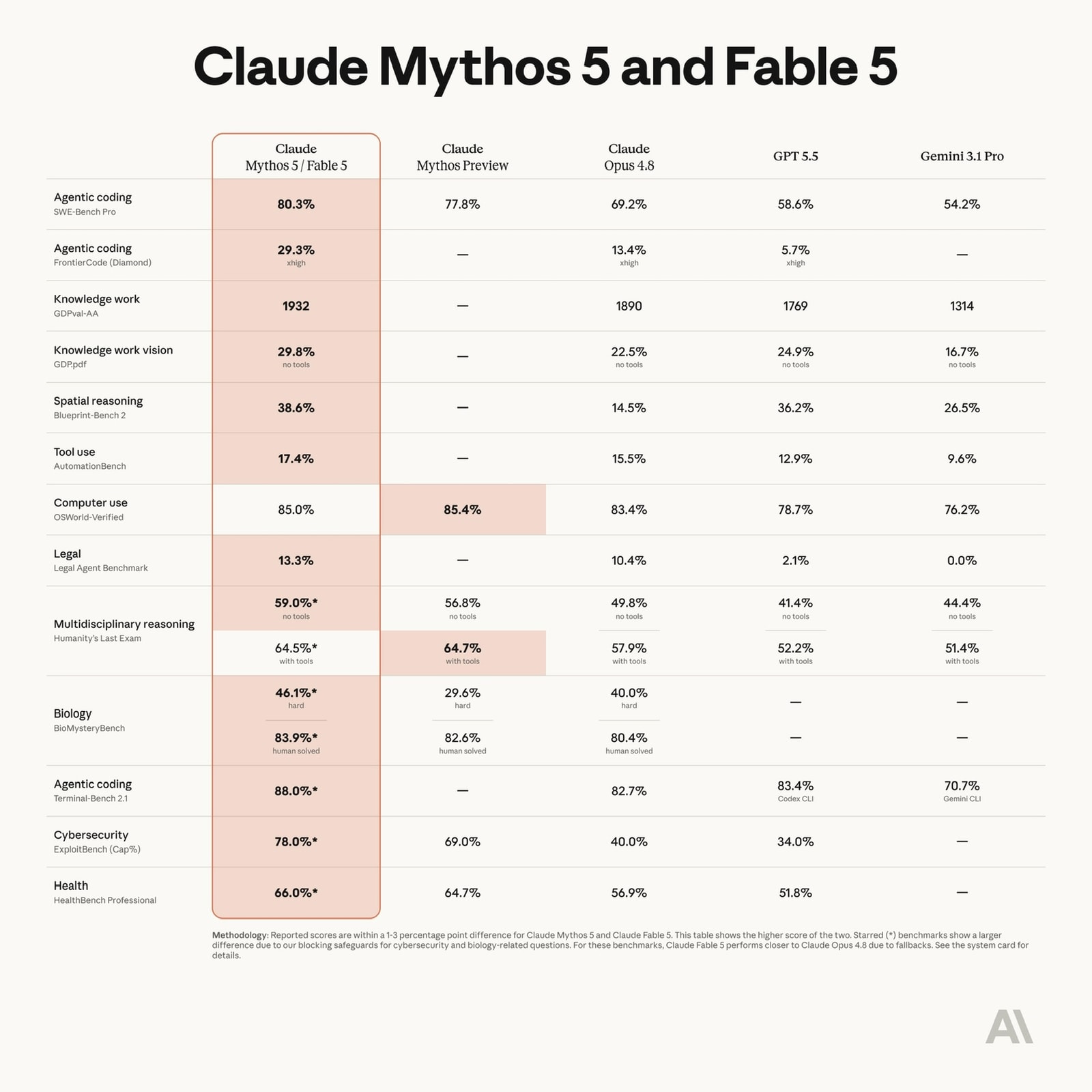
The numbers that matter most for business teams are not just the headline wins. Fable 5 posts an 80.3% score on SWE-bench Pro, 85.0% on OSWorld-Verified computer use, 88.0% on Terminal-Bench 2.1, and strong results on document and spatial tasks. That points to a model built for real work across code, screens, files, and tools.
Benchmarks are not your operating plan. They are a signal. The useful question is: where does better model reliability remove a bottleneck that already costs your team time?
What This Means for Startups
Startups should not read this launch as "buy the newest model and rebuild everything." That is how teams create expensive demos that never become operations.
Read it as a permission slip to push one level deeper into agentic work.
1. Coding agents get more useful for small teams
Fable 5's coding scores matter because startups are usually short on engineering time. A stronger coding model can help with migrations, bug triage, test generation, documentation cleanup, and internal tooling.
The right workflow is not "let AI rewrite the app." It is narrower:
- give the model a clean issue,
- constrain the files it should touch,
- require tests or a local build,
- review the diff before shipping.
That is also why custom software and AI implementation are starting to overlap. The value is not a clever prompt. The value is a repeatable build-review-release loop.
2. Agents become more practical for messy back-office work
Most business automation fails because the inputs are messy: emails, PDFs, call notes, support tickets, screenshots, invoices, form responses, and CRM records with inconsistent fields.
Fable 5's strength across knowledge work, vision, and computer use makes it more realistic to build agents that can read the messy input, decide what should happen next, and hand the action to the right system.
Good first targets:
- qualify leads and summarize context before a sales call,
- turn support tickets into structured issue records,
- review long documents and flag action items,
- prepare weekly operator reports from scattered sources,
- clean CRM records before a campaign.
If you are new to the concept, start with our plain-English guide: What Are AI Agents and Why Every Business Will Use One.
3. The "AI front door" gets stronger
More capable models change how customers and employees start work. A customer may ask an AI assistant to compare providers. A team member may ask a chat interface to update a CRM record. A founder may ask an agent to inspect a competitor launch and produce next steps.
That means your website, CRM, documentation, and workflows need to be understandable by AI systems. Vague service pages and messy internal records become a real growth problem.
We covered this broader shift in Why Your Business Needs AI Entry Points, Not Another Dashboard. Fable 5 adds more fuel to that point: AI is becoming an entry point for work, not just a side tool.
What Business Owners Should Do First
Do not start by asking which model is "best." Start by choosing a workflow where a better model can reduce time, errors, or handoffs.
| Business workflow | Why Fable 5 may help | What to measure |
|---|---|---|
| Sales intake | It can read messy lead context and prepare structured next steps | Speed to response, qualification accuracy, booked calls |
| Customer support | It can summarize issues, inspect screenshots, and draft resolutions | First-response time, escalation rate, customer satisfaction |
| Operations reporting | It can connect narrative, tables, and documents into a usable brief | Hours saved, decision speed, missing-data rate |
| Software delivery | It can assist with coding, test creation, and migration planning | Build pass rate, review time, reopened bugs |
| Knowledge search | It can turn long docs and internal notes into specific answers | Answer accuracy, time to find information, repeat questions |
At AnovaGrowth, the model is rarely the only blocker. The blockers are usually process shape, data cleanliness, system access, and approval rules. That is where AI automation services make the difference between a demo and a workflow your team actually trusts.
The Safeguard Difference Matters
Anthropic says Fable 5 uses routing and fallback behavior for some high-risk cybersecurity and biology requests, while Mythos 5 is available to approved users where those restrictions would interfere with legitimate work. Anthropic also describes broader safety work around AI cybersecurity use cases, containment testing, and preparing for recursive AI research.
For business teams, the lesson is simple: powerful models need boundaries.
Before you give any model access to customer data, code repositories, payment systems, or CRM actions, define what it can do without review and what must stay human-approved.
Use this basic rule:
- Low-risk drafting: let AI draft, summarize, classify, and prepare.
- Medium-risk updates: require review before changing records, sending outbound messages, or touching production workflows.
- High-risk actions: keep money movement, legal commitments, sensitive customer decisions, and production deployments behind clear human approval.
The model can be stronger and the workflow can still be conservative. That combination is usually what businesses need.
Four Questions People Are Asking About Mythos 5
Is Claude Mythos 5 public?
No. Based on Anthropic's announcement, Claude Mythos 5 is restricted to approved programs. If you are a normal business user, the practical model to evaluate is Claude Fable 5.
Is Claude Fable 5 the same as Mythos 5?
Anthropic describes them as the same underlying model with different safeguard treatment. Fable 5 is the public variant because the safeguards are what make the Mythos-Class capability acceptable for general use. That is also why benchmark charts often label the column "Claude Mythos 5 / Fable 5."
Should startups switch immediately?
Not blindly. If your current workflows are working, run a small evaluation first. Test Fable 5 on one high-value workflow against your current model. Measure accuracy, speed, cost, and review burden. If you already have it in your plan, the June 22 included-access window is a good time to run that test.
What is the best business use case?
Start with work that mixes judgment and documents: lead intake, support triage, proposal drafting, code review, research briefs, CRM cleanup, and internal reporting. These are painful enough to matter, but bounded enough to test safely.
A Practical 30-Day Plan
Week 1: Pick one workflow
Choose a workflow with clear inputs, clear outputs, and an obvious owner. Do not start with "make our whole company AI-native."
Examples:
- turn new lead forms into CRM records and call briefs,
- summarize support tickets before escalation,
- audit a codebase for a migration plan,
- convert weekly business data into an operator summary.
Week 2: Build the evaluation
Run Fable 5 against real examples, not toy prompts. Score the outputs for accuracy, usefulness, tone, missing context, and risk.
Week 3: Add system access carefully
Connect only the tools the workflow needs. A support workflow does not need billing access. A reporting workflow does not need the ability to email customers.
Week 4: Create the approval path
Decide what the model can draft, what it can update, and what it can only recommend. Then write that into the workflow so your team does not have to remember it manually.
Bottom Line
Claude Fable 5 is the launch business owners should pay attention to now. Claude Mythos 5 is important because it shows where the underlying capability is headed, but it is not the normal business access path.
The winning move is not chasing the name. It is using the new capability to build cleaner workflows: better intake, faster research, stronger coding support, safer automation, and clearer approval paths.
If Fable 5 is available in your Claude plan today, use it for a real task before the included window closes. Ask it to review a workflow, inspect a codebase, summarize a messy document set, or plan a business process. You will learn more from one serious test than from a week of model discourse.
That is what separates a useful AI system from another chat window your team forgets to open.
Want to test Claude Fable 5 inside a real business workflow? Start with AI automation services, explore custom software, or contact AnovaGrowth to map the first workflow worth shipping.
Related articles

AI Warranty and Work Order Tracking for Service Businesses: Stop Losing Money on Claims You Already Earned
Service businesses lose 15-30% of valid warranty claims to paperwork lag and missed follow-up. AI warranty tracking turns every completed job into revenue you actually collect.
Read the article: AI Warranty and Work Order Tracking for Service Businesses: Stop Losing Money on Claims You Already Earned
The New AI Job Is Not Prompt Engineer. It Is Workflow Builder.
Large companies are hiring AI workflow builders because tools alone do not change how teams work. Here is what that means for your business.
Read the article: The New AI Job Is Not Prompt Engineer. It Is Workflow Builder.
AI Needs a Control Plane Now: What This Week's Launches Mean for Your Business
This week’s launches show the real AI bottleneck is no longer model quality. It is deployment ownership, orchestration, and security operations.
Read the article: AI Needs a Control Plane Now: What This Week's Launches Mean for Your Business
