For most teams, AI is not blocked by ideas anymore. It is blocked by operations.
That has changed the conversation in a big way over the past week. The strongest launches were not about a dramatic new benchmark. They were about deployment ownership, multi-agent orchestration, and security response. In plain terms: how AI work gets shipped, controlled, and kept reliable after it goes live.
If you run a business, this matters more than model rankings.
A smarter model can improve output quality. But it will not fix unclear approvals, disconnected systems, weak audit trails, or broken rollout processes. Those are control-plane problems, and they are now the real reason AI projects stall.
The Five Signals From This Week
Here are the five announcements that made the pattern obvious.
1) OpenAI launched a dedicated deployment company
On May 11, OpenAI announced the OpenAI Deployment Company, with embedded forward deployed engineers focused on shipping production systems inside real operations. That launch emphasizes a shift from generic implementation advice to hands-on workflow redesign and durable deployment patterns.
Source: OpenAI launches the OpenAI Deployment Company
Why this matters: business owners have been told to “adopt AI” for two years. This move acknowledges that adoption only sticks when execution teams own integration, controls, and day-to-day outcomes.
2) OpenAI published an incident response tied to supply-chain risk
On May 13, OpenAI published a response to the TanStack npm supply-chain attack and required macOS users to update applications by June 12, 2026 to support certificate changes.
Source: Our response to the TanStack npm supply chain attack
Why this matters: even when user data is not exposed, operational resilience still matters. Incident communication, trust updates, and clear remediation deadlines are part of AI production readiness, not side tasks.
3) Salesforce announced Summer ’26 with multi-agent orchestration
On May 11, Salesforce announced Summer ’26 updates designed to connect human teams and AI agents across sales, service, and operations. A headline capability was multi-agent orchestration plus Slack-first workflows and trust-layered analytics access.
Source: Summer ’26 Release announcement
Why this matters: most companies do not need one “super agent.” They need specialized agents that coordinate, share context, and hand off reliably without creating process chaos.
4) SAP launched a Business AI Platform centered on governance and process context
At Sapphire, SAP described a platform approach for autonomous-enterprise workflows with an emphasis on business process data, governance, and accurate outcomes at scale.
Source: SAP Sapphire keynote on Business AI Platform
Why this matters: AI quality in business workflows depends on process context, not just model power. If agents cannot read the workflow state correctly, they cannot make dependable decisions.
5) SAP and Anthropic expanded collaboration to embed Claude in enterprise workflows
On May 12, SAP and Anthropic announced expanded collaboration to embed Claude as a key reasoning and agentic capability across SAP’s AI-enabled portfolio.
Source: SAP and Anthropic collaboration announcement
Why this matters: enterprises are standardizing how models plug into governed systems. This is less about “which model won” and more about how model capabilities are operationalized inside trusted platforms.
The Shared Angle: AI Is Becoming an Operating Discipline
These stories come from different companies, but they point to the same strategic shift.
The AI project is no longer the center of gravity. The operating model is.
Teams that win now are building repeatable systems around AI work:
- Clear ownership of deployment
- Defined boundaries for autonomous actions
- Practical orchestration between humans and agents
- Security and incident response built into rollout plans
- KPI tracking tied to cycle time, quality, and revenue impact
This is exactly why many businesses feel “stuck” despite strong tools. The model layer improved quickly, but the operating layer was left behind.
What Business Owners Should Do Next
You do not need to copy big-enterprise architecture. You do need a smaller version of the same discipline.
Step 1: Pick one workflow where delay costs money
Good candidates include lead follow-up, quoting, invoice operations, dispatch routing, and support triage. Tie the workflow to one business metric before you touch tooling.
If you are deciding where to start, use this guide first: Small Business Automation: Where to Start.
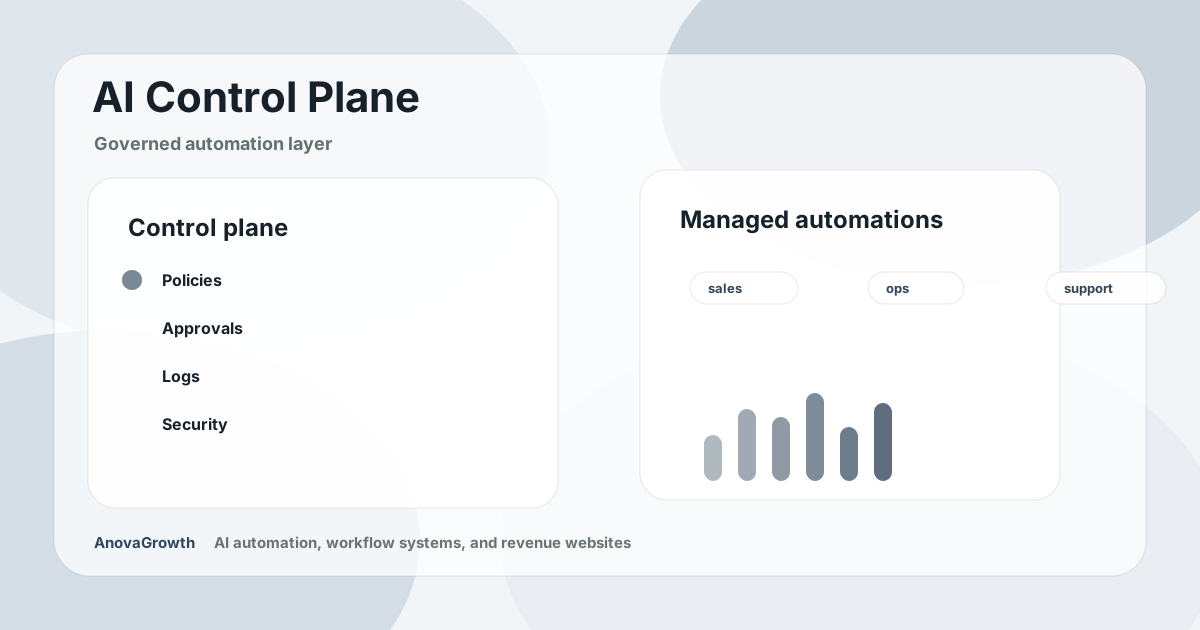
Step 2: Define your control plane in writing
Before rollout, document:
- Which tasks run automatically
- Which tasks require human approval
- Which systems the agent can read or write
- What logs are retained
- Who owns failure handling
Most teams skip this and pay for it later.
Step 3: Design orchestration before prompt engineering
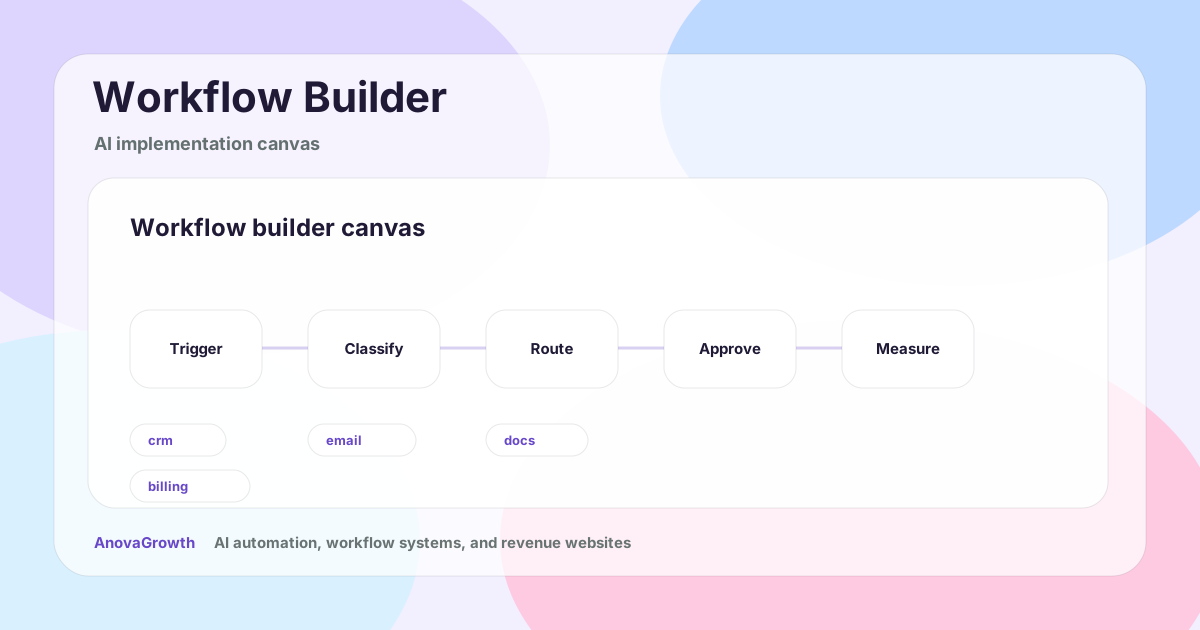
Treat your agent setup like process design, not chatbot configuration. Clarify handoffs between intake, qualification, routing, execution, and escalation. One precise workflow usually beats a broad assistant with vague responsibilities.
For foundation context, this article helps frame the architecture: What Are AI Agents and Why Every Business Will Use One.
Step 4: Add operational resilience from day one
Assume a dependency will fail at some point.
Set up:
- Fallback paths for critical actions
- Clear outage behavior for users
- Rollback triggers
- Communication templates for incidents
AI that works only on a perfect day is not production AI.
Step 5: Measure business outcomes weekly
Do not track only usage metrics. Track outcome metrics:
- Lead response time
- Quote turnaround time
- Reopen or error rate
- Cost per resolved ticket
- Time recovered per employee
If outcomes are flat after 30 days, the problem is likely workflow design, not model choice.
Three Mistakes to Avoid Right Now
Mistake 1: Buying one more tool without ownership
Adding new tools feels like progress, but it can increase fragmentation when nobody owns deployment outcomes.
Fix: assign one responsible owner for each AI-enabled workflow.
Mistake 2: Treating security as a compliance checkbox
Security events are operational events. They affect trust, continuity, and customer confidence.
Fix: include update policies, dependency monitoring, and incident playbooks in your AI plan.
Mistake 3: Scaling before one workflow is stable
Expanding too early creates more moving parts and hides root causes.
Fix: stabilize one workflow with measurable results, then replicate the pattern.
A Practical 30-Day Plan
Week 1:
- Select one workflow
- Baseline timing, cost, and quality metrics
- Draft your approval and escalation boundaries
Week 2:
- Integrate AI into existing systems (CRM, helpdesk, inbox, scheduling)
- Launch a limited pilot with explicit guardrails
Week 3:
- Tune orchestration, handoffs, and approval logic
- Document fallback behavior and failure ownership
Week 4:
- Compare metrics against baseline
- Keep, kill, or expand based on business results
The point is not to look advanced. The point is to produce repeatable gains.
Bottom Line
This week’s announcements made one thing clear: AI leadership is moving from model announcements to operational accountability.
For business owners, that is good news. You do not need a giant AI lab to compete. You need a working control plane for the workflows that actually drive your revenue and service quality.
Start small. Govern it. Measure it. Then scale what works.
Want help building a practical AI control plane for your team? Explore our AI automation services or contact us to map one production workflow this month.