Why Your Business Needs AI Entry Points, Not Another Dashboard
This week's AI news shows a bigger shift: customers and teams are starting work through AI, not through the old dashboard-and-tab routine.

Most business owners are still treating AI like a tool you open when you need help.
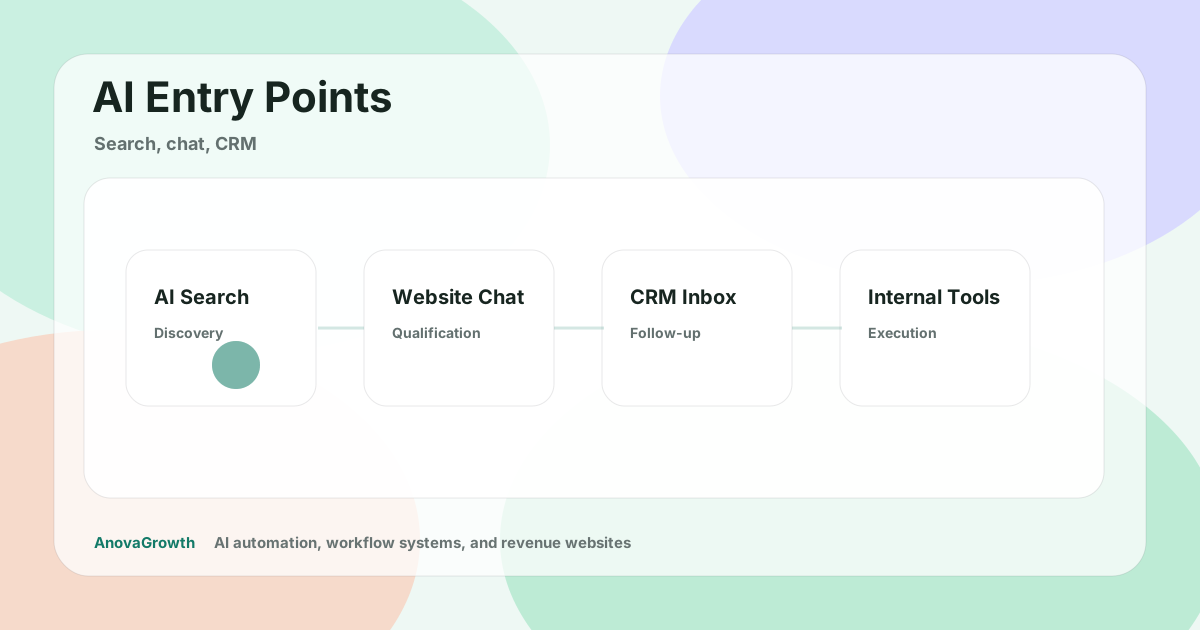
This week's news suggests a bigger change. AI is starting to become the place where work begins. Customers are discovering products through AI search. Teams are updating CRM records from chat. Admins are wiring secure apps into data systems without building a custom stack from scratch.
Quick answer: if AI becomes the new entry point for discovery and execution, your business needs cleaner content, tighter system connections, and clearer approval rules. The companies that win this shift will not be the ones with the most dashboards. They will be the ones whose websites, CRM data, and workflows are easy for AI systems to understand and act on.
Five Signals From the Last 7 Days
1) OpenAI moved frontier models and Codex into AWS
OpenAI announced that its frontier models and Codex are now generally available on AWS, with adoption flowing through existing security, compliance, procurement, billing, and governance workflows.
Source: OpenAI frontier models and Codex are now available on AWS
2) OpenAI added guided app templates for business systems
ChatGPT Business added app templates for GitHub Enterprise, Snowflake, and Databricks, including setup for OAuth, managed MCP server URLs, webhooks, workspace access, and action controls.
Source: ChatGPT Business release notes
3) Anthropic pushed reliability for longer-running agent workflows
Anthropic launched Claude Opus 4.8 with stronger reliability on agentic tasks and introduced dynamic workflows that can run hundreds of parallel subagents and verify outputs before reporting back.
Source: Introducing Claude Opus 4.8
4) Slack made conversation a control layer for CRM work
Slack's May release turned Slackbot into a more action-oriented interface. Teams can now create and update Salesforce records, summarize external links, create charts, and pull report insights without leaving Slack.
Source: Slack Feature Drop: May the Productivity Be With You
5) Shopify showed AI search is now a real demand channel
Shopify reported that orders from AI search are up 13x year over year, with 49% higher conversion than traditional search and 14% higher average order values.
Source: AI unlocks future-proof entrepreneurs. Bad regulation crushes them.
The Shared Angle
The common thread is not "AI got smarter."
The common thread is that AI is becoming an entry point:
- an entry point for how customers discover offers,
- an entry point for how staff trigger work,
- an entry point for how data systems get queried and updated,
- an entry point for how teams build and ship software.
That is a different operating model from the old one. Instead of forcing people through forms, tabs, menus, and dashboards, software is moving toward conversational starts with structured actions underneath.
At AnovaGrowth, this is already where real implementation work gets clearer. The hard part is usually not choosing a model. It is deciding which systems the AI can touch, what context it can trust, and where the human approval step lives when the workflow reaches a money, service, or customer-data decision.
What Changes for Business Owners
| Area | Old entry point | New AI entry point | What to fix now |
|---|---|---|---|
| Customer discovery | Google search + site navigation | AI search, AI shopping, chat-based comparison | Tighten service pages, FAQs, reviews, and structured content |
| Sales operations | CRM forms and manual updates | Chat-based record updates and summaries | Clean CRM fields, ownership rules, and approval paths |
| Internal reporting | Static dashboards | Conversational reporting and instant summaries | Standardize source data and define key metrics clearly |
| Software delivery | Ticket -> handoff -> build queue | AI-assisted planning, coding, review, and ops | Improve specs, test coverage, and workflow boundaries |
If you have not already addressed the acquisition side of this shift, start with AI Search Visibility for Small Businesses: What to Fix Now.
If you have not addressed the operations side, Small Business Automation: Where to Start is the better first move.
A Simple Example
A customer asks an AI assistant which local provider can solve a specific problem. The AI cites your service page. The customer lands on your site, fills out a short form, and your team gets the lead in Slack. Slackbot drafts the CRM record, attaches the intake notes, and prompts a rep to approve the next action. That is one continuous entry-point chain, not five disconnected tools.
That is the standard more businesses are moving toward now.
Five Questions to Answer This Quarter
- Can an AI system understand what you sell from your current website without guessing?
- If a lead arrives through an AI-driven surface, does it land in the right workflow immediately?
- Are your CRM fields clean enough for an AI assistant to update them safely?
- Do you know which actions should stay human-approved even if the rest of the workflow is automated?
- If a team member asks an AI for status, pricing, or pipeline context, is the answer grounded in current data?
These are better planning questions than "Which model should we buy?"
What to Do in the Next 30 Days
1) Identify your three highest-value entry points
Most businesses should start with one discovery entry point, one sales or service entry point, and one internal execution entry point.
Examples:
- AI search -> service page -> consultation request
- Chat or form intake -> CRM -> follow-up workflow
- Team question in Slack -> report or record update -> approval
2) Clean the underlying systems before adding more AI
If your offer pages are vague, your CRM fields are inconsistent, or your reporting definitions keep changing, AI will only surface those weaknesses faster.
3) Add action boundaries
Set the rule for what AI can:
- draft,
- recommend,
- update,
- escalate,
- never do without review.
That is where AI automation services and custom software work increasingly overlap. The value is not just automation. The value is a usable control layer around automation.
4) Measure entry-point performance, not just tool usage
Track:
- AI-driven discovery volume
- lead-to-response time
- CRM completion accuracy
- quote or proposal turnaround time
- exception rate that still needs human review
If you only measure logins or message counts, you will miss the real business impact.
Bottom Line
This week's AI news points to a practical shift for business owners: AI is becoming the new front door for both customer discovery and internal work.
That means your next advantage will come less from buying one more standalone AI tool and more from making your business easy to discover, easy to understand, and safe to act on through AI-powered entry points.
That is a website problem. A CRM problem. A workflow problem. And, if handled well, a growth advantage.
Want help mapping the right AI entry points for your business? Review our AI automation services or contact us to plan the first workflow worth shipping.
Related articles
AI Customer Onboarding for Service Businesses: From First Hello to Raving Fan
Most service businesses onboard with a phone call and a form. AI turns that into a guided digital experience from first hello to review request.
Read the article: AI Customer Onboarding for Service Businesses: From First Hello to Raving Fan
AI Upsell and Cross-Sell for Service Businesses: Turn Every Job Into a Complete Solution
Most service businesses leave 20-40% of revenue on the table by not asking the right questions at the right time. AI makes upsells and cross-sells feel like help instead of a sales pitch.
Read the article: AI Upsell and Cross-Sell for Service Businesses: Turn Every Job Into a Complete Solution
AI Customer Reactivation for Service Businesses: Win Back Lost Revenue Without Spending on New Leads
Learn how AI customer reactivation uses CRM data, customer segments, and follow-up sequences to reconnect with past service customers.
Read the article: AI Customer Reactivation for Service Businesses: Win Back Lost Revenue Without Spending on New Leads
