Updated June 2026
Last week, Alibaba launched an AI platform called Wukong. It doesn't answer questions, it executes tasks. Agents coordinate across document editing, spreadsheet updates, and meeting scheduling with no human typing a single instruction. The company moved so fast with a related coupon campaign that its chatbot briefly crashed from demand.
This isn't a research project. It's a preview of what AI looks like when it stops being a smart assistant and starts being a digital worker.
For business owners, this is the most consequential shift since chatbots went mainstream. Here's what's actually changing, what's actually at stake, and what you should do about it right now.
The Difference Between an AI That Answers and an AI That Acts
Most AI tools you've used, chatbots on websites, AI writing helpers, ChatGPT itself, work the same way: you ask, it responds. The value is in the answer.
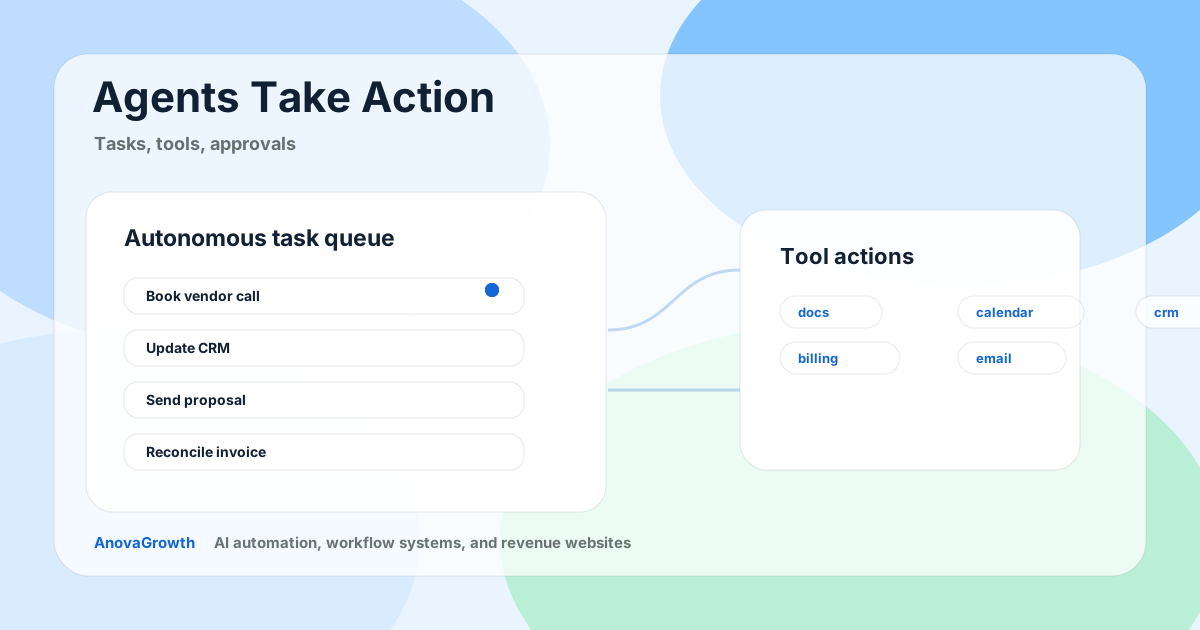
Agentic AI is different. The value is in the action. An agent takes a goal, breaks it into steps, and runs the steps. That means it can:
- Pull data from your CRM and draft a follow-up email sequence
- Update your inventory spreadsheet when a purchase order comes in
- Book a vendor call, add it to your calendar, and log it in your project tracker
- Route a support ticket, escalate it if needed, and close it when resolved
The chatbot answers the question. The agent completes the task. That's a fundamentally different relationship with your software stack, and with your time.
What Alibaba's Wukong Actually Signals
Alibaba's Wukong platform, launched March 18, is one of the clearest examples of this shift at scale. It's enterprise-focused. It coordinates multiple AI agents across complex business workflows. And it's running inside one of the world's largest e-commerce ecosystems, handling document editing, financial updates, and scheduling that previously required a person.
The detail that should get every business owner's attention: Wukong launched as part of a restructuring that separated Alibaba's AI business into a new Token Hub group. That kind of reorganization at a $325 billion company doesn't happen for a science project. It happens because leadership sees the revenue path clearly.
The comparable moment in the West was OpenAI's launch of operator-style features in ChatGPT, and more recently, its shift away from direct checkout integration in favor of retailer apps within the ChatGPT ecosystem. AI platforms are building integration layers, not replacing your tools. The businesses that connect their workflows to AI agents first will have a structural advantage.
Why This Hits Small and Mid-Size Businesses Hardest
Enterprise companies have teams of people whose job is to manage software, run processes, and handle exceptions. AI agents replace some of that work, and they replace it consistently, 24/7, without errors from fatigue.
But here's the counterintuitive part: AI agents don't just threaten big companies' labor costs. They threaten the competitive advantage of small companies that have been operating lean.
A 10-person business running on willpower and late nights can't afford a dedicated ops person. AI agents change that equation. For the first time, a lean team can run workflows that used to require headcount.
The question isn't whether AI agents will be part of your business eventually. It's whether you'll be the business that builds those workflows, or the one that gets outcompeted by someone who does.
What This Means for Your Existing AI Tools
If you've already deployed a chatbot, you have infrastructure. The shift now is upgrading its role.
A chatbot that answers FAQs is table stakes. The same technology, connected to your CRM, your scheduling tool, and your task management system, becomes an agent that can act on the conversations it handles. That doesn't require a full rebuild. It requires connecting the pieces.
This is the gap between AI automation and AI agents: automation handles a trigger-action sequence you predefine. An agent handles a goal and figures out the steps itself. For a business owner, the practical difference is that agents handle exceptions without you needing to plan for every exception in advance.
How to Start Thinking About AI Agents for Your Business
You don't need to overhaul everything at once. The practical starting point is identifying one workflow that:
- Happens frequently
- Follows a repeatable pattern
- Currently requires human time to move between software systems
That might be lead follow-up, where a website form submission triggers a CRM entry, an email sequence, and a calendar invite. It might be customer onboarding, where a new signup creates an account, sends a welcome sequence, and flags your team in Slack.
Once you've identified that workflow, the question becomes: what does the agent version of this look like? What decisions does a person currently make within it? Those decisions are what you need to define and hand off.
If that feels like a technical conversation, it is, but it doesn't have to be a technical person leading it. Business owners understand their workflows better than anyone. That understanding is the prerequisite.
The SEO Reality Check (Yes, This Affects Your Website Too)
There's a related shift happening in search that business owners need to understand. Google launched AI Mode, a search experience that removes the traditional 10 blue links entirely. Either your business gets cited in the AI response, or it doesn't appear.
AI Overviews, which preceded AI Mode, already reduced click-through rates by an average of 34.5%. AI Mode amplifies that. The implication is that your digital presence needs to be structured for AI citation, not just traditional search ranking.
This means content quality, entity clarity, and structured information matter more than keyword density. It means your business information needs to be accurate and comprehensive everywhere, not just on your website. The businesses that treat AI visibility as a separate discipline from SEO will adapt faster.
The common thread between AI agents and AI search: the machines are talking to each other more, and your job is to make sure your business is worth talking about.
What This Means For You
The AI agent shift isn't coming, it's here, at scale, in production. Alibaba's Wukong launch is one signal. The HBR guidance on scaling AI agents across enterprises is another. The trajectory is clear: AI is moving from answering your questions to doing your work.
The businesses that will pull ahead in the next 18 months aren't necessarily the biggest. They're the ones that figure out how to connect AI agents to their actual workflows, not just deploy a chatbot and call it done.
What to do in the next 30 days:
- Identify one high-frequency workflow that currently requires moving data between apps manually
- Map the steps a person takes within it, that's the blueprint for automation
- Talk to someone who can evaluate whether an AI agent approach fits that workflow, or whether a simpler automation does the job faster
You don't need to understand AI architecture. You need to understand what work you're doing manually that could run itself.
Ready to explore what AI agents could do for your business? Contact us to discuss how AnovaGrowth evaluates and implements AI automation for operational workflows.