A new kind of AI job is showing up inside large companies.
The titles vary. Some companies call it an AI Engineer. Others call it a Forward Deployed AI Engineer, Forward Deployed AI Accelerator, AI Solutions Engineer, AI Automation Lead, or AI Transformation Lead.
The title is less important than the function.
Companies are not paying serious money for someone who simply knows how to write better prompts. They are paying for people who can go inside a messy department, understand how work actually happens, build useful AI systems around that work, and make sure the team adopts the new process.
That is the real market signal.
AI is moving from a tool-access problem to an operations problem.
The Job Titles Are Messy, But The Role Is Clear
The new AI operator role usually sits between business teams, software systems, and model capability.
A person in this role is expected to do work like:
- Study how a team handles leads, tickets, approvals, documents, reporting, or customer requests
- Find repetitive steps that slow the team down
- Build internal AI tools, agents, or workflow automations
- Connect those tools to systems like CRM, email, spreadsheets, documents, support platforms, and databases
- Decide where human approval is still required
- Train the team on how to use the new workflow
- Measure whether the system actually gets adopted
That is a very different job than "write a clever prompt."
A prompt might be part of the solution. But the business value comes from the full system around it.
Why This Role Exists Now
Most companies already have access to AI tools.
Their employees can use ChatGPT, Claude, Gemini, Microsoft Copilot, or AI features inside the software they already pay for. The problem is not that the tool does not exist.
The problem is that the tool is disconnected from the way work actually gets done.
A sales team does not need a generic chatbot. It needs better lead routing, better follow-up, cleaner CRM notes, and faster proposal drafts.
A service business does not need an AI toy. It needs faster intake, fewer missed requests, better scheduling, and clearer handoffs.
A marketing team does not need another writing assistant. It needs campaign planning, asset production, approval workflows, reporting, and customer segmentation tied together.
That is why these new roles are appearing. Someone has to translate between:
- Business pain
- Daily workflows
- Existing software
- AI model capability
- Data access
- Security and approval rules
- Team adoption
Without that translation layer, AI stays trapped in demos and side tabs.
This Is Not Prompt Engineering
Prompt engineering is a useful skill. It is just too small of a frame for what companies actually need.
The high-value work is not asking an AI model to produce a better paragraph. The high-value work is redesigning the workflow so the model can help move real work forward.
That usually includes:
- Workflow mapping: understanding the exact steps people take today
- System integration: connecting AI to the tools where the work already lives
- Data cleanup: making sure the system has usable inputs
- Interface design: giving employees a simple way to use the workflow
- Automation logic: defining what happens automatically and what gets reviewed
- Evaluation: checking output quality, errors, cycle time, and business impact
- Training: helping people trust and use the new process
- Governance: deciding what AI is allowed to do and what it is not allowed to do
That is why "prompt engineer" faded as a serious business label.
Prompts matter, but they are not the operating model.
Big Companies Are Buying AI Adoption, Not AI Demos
The pattern is showing up across the AI market.
OpenAI launched a deployment-focused company to embed forward deployed engineers into organizations and help connect AI systems to real business processes. That is not a model announcement. It is an implementation announcement.
Anthropic has hired forward deployed engineers to build production AI applications, customer integrations, MCP servers, agent workflows, and repeatable deployment patterns. Again, the work is not just model usage. It is applied system design.
Stripe has advertised AI accelerator roles focused on embedding with business teams, coaching users, building custom tools, and transforming workflows. The interesting part is that this type of role is not limited to engineering teams. It is moving into marketing, operations, finance, support, and other departments where the work is messy and high volume.
That tells us something important.
The next wave of AI value is not about who has access to a model. Everyone has access. The advantage is in who can apply the model inside real work with enough structure for people to rely on it.
What Smaller Companies Should Learn From This
Most small and midsize businesses do not need to hire a full-time $200,000 AI operator.
But they do need the function.
You need someone who can look at your business and say:
- This task should stay human.
- This task should be automated.
- This workflow needs an AI assistant.
- This handoff is where leads are being lost.
- This data source needs to be connected.
- This approval step needs to stay in place.
- This process should be measured before it gets scaled.
That is the lesson from the large-company hiring trend.
The function matters even if the job title does not.
A local contractor, dental practice, manufacturer, accounting firm, or professional service business does not need to copy an enterprise AI org chart. But it can copy the operating principle: AI should be deployed around real workflows, not scattered across random tools.
The Wrong Way To Adopt AI
The old approach looks like this:
- Buy an AI tool.
- Tell the team to use it.
- Share a few example prompts.
- Hope behavior changes.
- Wonder why nothing meaningful improved.
That approach fails because it treats AI adoption like a software rollout.
AI adoption is not just a software rollout. It is workflow redesign.
If the old process is unclear, AI usually makes the confusion faster. If your CRM is messy, AI will not magically create clean follow-up. If your approvals are undefined, AI will not know when to act and when to wait. If nobody owns the workflow, the automation will drift or die.
The tool is not enough.
The Better Way To Think About AI Implementation
A better implementation process starts with the workflow, not the model.
Ask these questions first:
- What work happens repeatedly every week?
- Where does the team lose time?
- Where do leads, tickets, documents, or approvals get stuck?
- Which steps are rules-based?
- Which steps require judgment?
- Which systems need to share information?
- What would count as a measurable improvement?
Then decide where AI belongs.
Maybe the answer is a lead triage agent. Maybe it is an intake assistant. Maybe it is an internal reporting workflow. Maybe it is automated proposal drafting with human approval before anything goes to a customer.
The best AI systems usually do not replace the whole job. They remove the drag around the job.
A Practical Example
Take a service business that receives leads from its website, phone calls, referrals, and paid campaigns.
The common problem is not "we need AI." The common problem is that lead follow-up is inconsistent.
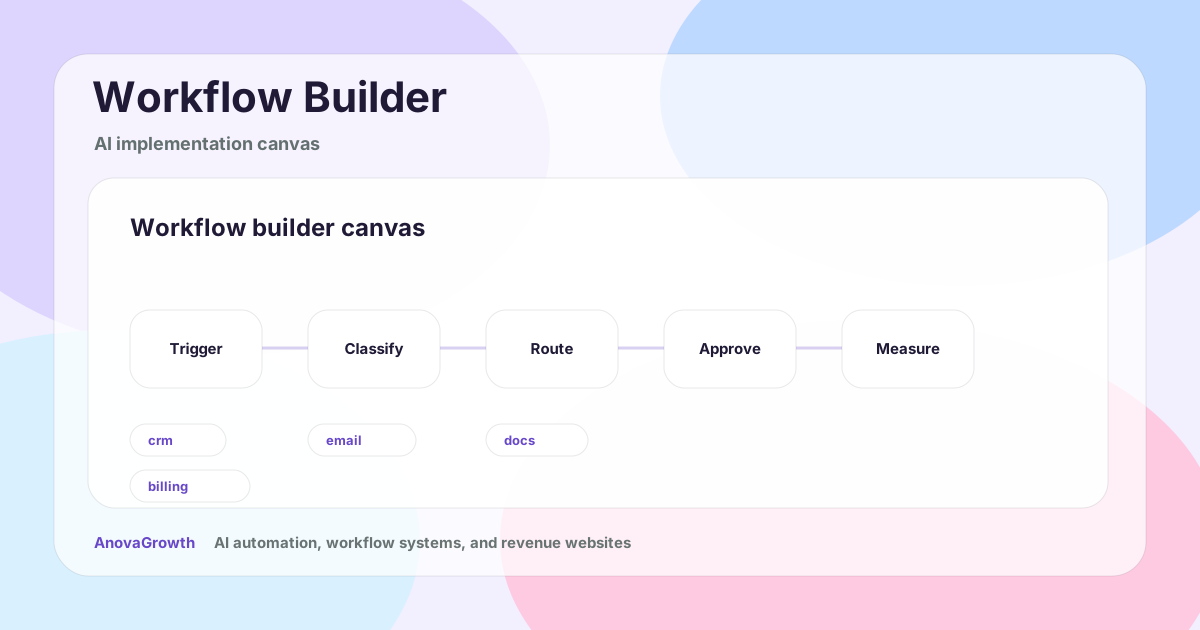
A workflow-builder approach would map the process:
- Where do leads enter?
- Who sees them first?
- What information is missing?
- How fast does the first response happen?
- Which leads are high intent?
- Which messages should be drafted automatically?
- Which actions require approval?
- How does the CRM get updated?
- What metric proves improvement?
Then AI can be applied in a specific way:
- Summarize each lead
- Score urgency
- Draft the first response
- Route the lead to the right person
- Create the CRM note
- Remind the team when follow-up is late
- Keep a human in the loop before sending sensitive messages
That is not prompt engineering. That is business process design with AI inside it.
Why This Matters For Business Owners
The companies winning with AI are not the ones with the most tools.
They are the ones redesigning how work gets done.
That is good news for smaller companies. You do not need the same budget as a large enterprise to benefit from this shift. You need a practical implementation mindset.
Start with one workflow. Make it measurable. Keep the system simple enough for the team to use. Add automation only where the process is clear. Keep human review where mistakes would be expensive.
That is how AI becomes useful instead of decorative.
The AnovaGrowth Take
AI adoption is not a model-selection problem. It is an operations problem.
The winning question is not, "Which AI tool should we buy?"
The winning question is, "Which workflow should change, who owns it, and how do we prove it worked?"
That is the work behind the new AI job titles. Large companies are hiring for it because they have learned that tools alone do not transform operations.
Small and midsize businesses should take the same lesson without copying the same headcount plan.
You may not need a full-time forward deployed AI engineer. But you do need someone thinking like one.
Want to find the highest-value AI workflow in your business? Contact AnovaGrowth and we can map the first automation opportunity before you spend money on another tool.