AI's Next Advantage Is Verifiable Operations, Not More Prompts
This week’s AI launches point to one edge that lasts: proving what your automations did, why they did it, and what changed.

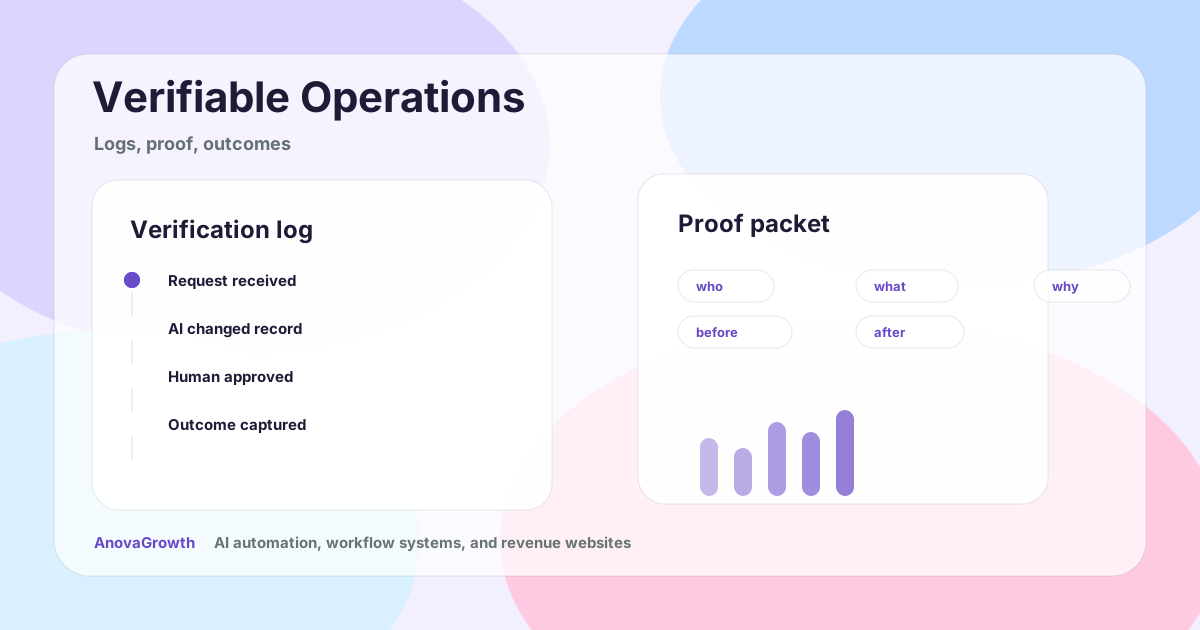
The AI story this week was not "one model got smarter."
The real shift was operational: major vendors focused on proving outcomes, hardening integrations, and scaling AI into core work. If you run a business, that changes what to prioritize next.
The near-term advantage is not adding another assistant. It is building a verification layer around the automations you already run.
Five Signals From the Last 7 Days
1) Microsoft and EY expanded execution investment
Microsoft announced that Microsoft and EY are jointly investing more than $1 billion to help organizations move from isolated AI use cases to enterprise-scale transformation.
Source: From AI pilots to enterprise impact
2) OpenAI pushed provenance into product infrastructure
OpenAI announced C2PA conformance, added SynthID watermarking for images through a Google partnership, and previewed a public verification tool.
Source: Advancing content provenance for a safer, more transparent AI ecosystem
3) Anthropic and KPMG expanded embedded AI delivery
KPMG announced a global alliance with Anthropic, including Claude access for more than 276,000 employees and deeper embedding in delivery software.
Source: KPMG integrates Claude across its core business and workforce of more than 276,000
4) Anthropic acquired Stainless for SDK and MCP tooling
Anthropic acquired Stainless to strengthen SDK generation and MCP server tooling, which directly improves how agents connect to business systems.
Source: Anthropic acquires Stainless
5) Google Search expanded agentic workflow behavior
At I/O, Google described Search updates that can monitor changes and send synthesized updates, plus upcoming custom experiences connected to Antigravity.
Source: Google Search’s I/O 2026 updates: AI agents and more
The Shared Pattern
AI platforms are moving from answer quality to system reliability.
That means business value now depends on whether you can verify three things quickly:
- What data and context the system used
- What action it took (or did not take)
- What business outcome changed after that action
If those are fuzzy, AI stays in demo mode.
What a Verification Layer Looks Like
A verification layer is not a giant new platform. For most small and midsize teams, it is a lightweight operating spec around existing tools.
1) Source traceability on every critical action
For each AI-generated email, quote draft, routing decision, or CRM update, keep a simple record of source inputs and timestamp.
2) Decision boundaries by workflow step
Write down what AI can do automatically, what needs approval, and what is blocked without human review.
3) Connector inventory and permission map
Track exactly which systems each agent can read and write. Tight scope prevents quiet drift.
4) Exception queue with owner
Every workflow needs a visible "needs review" queue and one named owner accountable for response time.
5) Weekly outcome checks
Measure impact in operational terms: response time, rework hours, conversion rate, error rate, and cycle time.
Where to Start in 30 Days
Week 1: pick one revenue-linked workflow and baseline current performance.
Week 2: add automation with explicit approval boundaries.
Week 3: implement action logs and exception handling.
Week 4: compare outcomes and decide what to scale.
If you need a starting point, use Small Business Automation: Where to Start and The 7 Workflow Bottlenecks AI Automation Should Fix First.
Bottom Line
This week’s announcements from Microsoft, OpenAI, Anthropic, and Google point to the same direction: durable AI adoption now depends on verifiable operations.
Teams that can prove what happened, why it happened, and what improved will scale faster with less risk than teams still running ad hoc prompts.
Want help designing a verification layer for one workflow this month? Review our AI automation services or contact us for a practical rollout plan.
Related articles

AI Automation for Cleaning Companies: How to Win More Bids, Keep Crews Filled, and Stop Losing Recurring Contracts
Cleaning companies lose 30 to 50 percent of bids to slow follow-up and 15 to 25 percent of accounts to sloppy inspections. AI fixes both without adding staff.
Read the article: AI Automation for Cleaning Companies: How to Win More Bids, Keep Crews Filled, and Stop Losing Recurring Contracts
AI Office Manager Replacement for Service Businesses: When Automation Beats a $55K Hire
A full-time service business office manager costs $45K to $65K plus benefits. AI automation handles scheduling, dispatch, invoicing, and follow-up for under $400 a month. Here is when to hire and when to automate.
Read the article: AI Office Manager Replacement for Service Businesses: When Automation Beats a $55K Hire
AI Automation for Electrical Contractors: How to Capture Emergency Calls, Win More Bids, and Stop Losing Recurring Revenue
Electrical contractors lose 25-45% of emergency calls to slow response and 20-40% of bids to no follow-up. AI automation fixes both without adding headcount.
Read the article: AI Automation for Electrical Contractors: How to Capture Emergency Calls, Win More Bids, and Stop Losing Recurring Revenue
