From Website Visitor to Closed Deal: The AI-Powered Funnel
Map the path from website inquiry and context capture through human review, CRM handoff, follow-up, and retention.

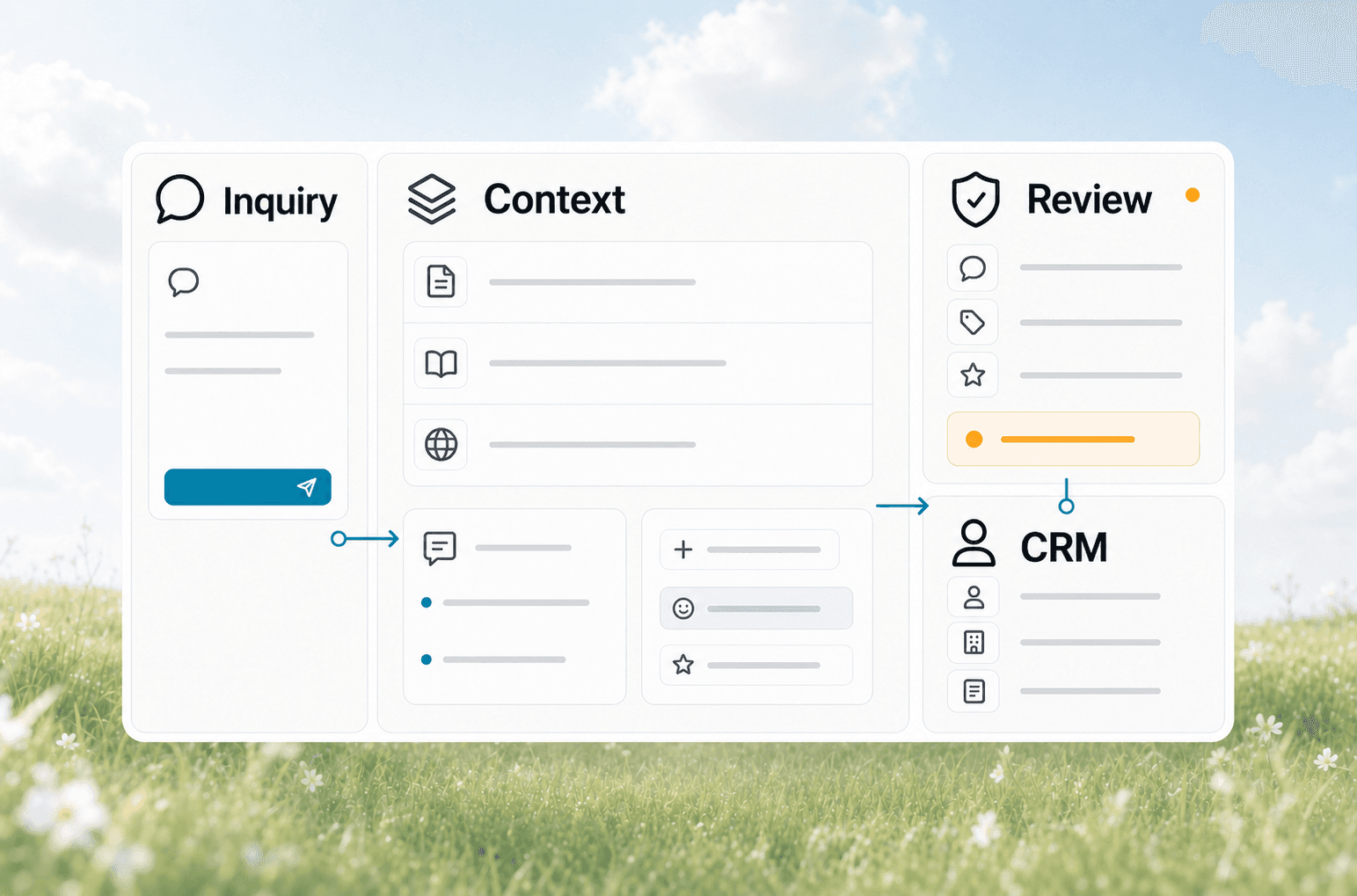
Why Your Funnel Leaks (And How AI Stops It)
You spend money on ads. You get website visitors. Some even fill out forms. But very few become paying customers. The gap between traffic and revenue feels like a black hole, and you have no idea where leads disappear.
The problem isn't your product or your offer. It's the gap between what happens and when it happens. By the time your sales team follows up, the prospect has moved on. They found a competitor. They forgot why they were interested.
This is where an AI sales funnel changes everything.
What Actually Changed in 2026
For years, marketing automation meant expensive enterprise tools and six-month implementations. Only companies with dedicated tech teams could build funnels that responded to prospect behavior in real time.
That's over now.
AI tools have dropped in cost and risen in capability. Small and mid-size businesses can now deploy the same technology that powered Fortune 500 sales teams, but at a fraction of the cost and without a team of developers.
The shift isn't about replacing your sales team. It's about removing the friction that kills deals before your team even gets a chance.
Stage 1: Attract the Right Visitors with AI Targeting
Most businesses cast a wide net and hope for the best. You buy ads, drive traffic, and pray visitors convert. This approach burns budget on people who will never buy.
AI changes who sees your message in the first place.
Look-alike audience modeling uses your existing customer data to find people with similar characteristics. Platforms like Meta Ads now let you upload your customer list and automatically build audiences most likely to convert. In tests we've run across client campaigns, look-alike targeting reduced cost-per-lead by 34% compared to interest-based targeting alone.
AI also analyzes competitor audiences: people who follow or engage with competing brands. Instead of targeting everyone who might need your service, you focus on people already in the market.
The result: your ad spend reaches prospects who actually want what you sell. You waste less on the wrong audience before they even visit your site.
Stage 2: Capture Leads Without the Follow-up Gap
When a visitor lands on your page, the clock starts ticking. Research shows response time matters more than anything else. Companies that respond within five minutes are 100 times more likely to qualify a lead than those that wait 30 minutes.
Your team can't sit at their desks 24/7. But AI can.
Chatbots and intelligent forms now handle initial capture while prospects are engaged. Instead of a static form that collects a name and email, AI-powered forms ask qualifying questions in real time.
For example, a home services company we work with replaced their contact form with an AI chat that asks: "What service do you need?" then "What's your timeline?" then "What's your zip code?" The bot scores the lead automatically. High-intent leads get a call-back request. Lower-intent leads enter a nurture sequence.
Lead quality improved by 60%. The sales team stopped wasting time on tire-kickers.
Your marketing automation funnel should include immediate response at this stage. Every minute of delay costs you a percentage of your potential conversions.
Stage 3: Nurture With Personalized Content at Scale
Not every prospect buys on day one. Most need 8-12 touchpoints before they make a decision. Your team doesn't have time to manually nurture hundreds of leads through a months-long journey.
AI handles this without generic "we haven't heard from you" emails.
Behavioral triggers determine what content each prospect receives. A visitor who downloaded a pricing guide gets different follow-up content than one who read your case study. A prospect who visited your pricing page three times receives different messaging than someone who viewed your homepage once.
Email sequences adapt based on engagement. If someone opens your email but doesn't click, AI waits 48 hours and sends a different subject line. If they click through but don't convert, they receive social proof content: a testimonial, a success story, a limited-time offer.
This is what a true marketing automation funnel looks like: every prospect receives relevant content based on their actual behavior, not a one-size-fits-all template.
Stage 4: Close Deals Faster With AI CRM Integration
Your CRM should be working for you, not against you. When your CRM and AI tools talk to each other, your sales team sees exactly what each prospect needs to move forward.
AI CRM integration pulls data from every touchpoint (website visits, email engagement, chat interactions, pricing page views) and presents it to your sales team in one view. No more digging through email threads to understand what a prospect knows.
Predictive lead scoring tells your team which deals are most likely to close. A prospect who visited your pricing page, attended a webinar, and opened your last four emails is far more likely to convert than one who opened one email and never visited again. AI scores each lead automatically, so your team focuses energy where it matters.
Automated task creation moves deals forward without manual reminders. When a prospect takes a specific action, the CRM automatically creates a follow-up task for your sales rep with suggested talking points based on that prospect's behavior.
For one client in professional services, AI CRM integration cut their average sales cycle from 47 days to 31 days. They closed the same number of deals with a smaller team.
Stage 5: Retain and Grow With Predictive Analytics
The funnel doesn't end at the close. Your best opportunities for growth live in your existing customer base. Yet most businesses treat post-sale as a different world from pre-sale.
AI changes this too.
Churn prediction models identify customers who show signs of disengagement before they leave. If a customer who used your service monthly suddenly goes quiet, AI flags them. Your team can reach out with a check-in before the contract renewal comes up.
Upsell and cross-sell recommendations come from behavioral analysis. AI looks at what similar customers purchased after their initial buy and suggests relevant additions. A restaurant supply company we work with increased average order value by 22% using AI product recommendations based on purchase history.
Referral identification finds your happiest customers automatically. Sentiment analysis on support tickets and NPS responses surfaces customers who are likely to recommend you. Your team reaches out with a referral request at the right moment.
Key Takeaways
- AI sales funnels work across all stages (from first click to closed deal to repeat purchase) without requiring a large team or enterprise budget
- Speed matters most at the top of funnel: AI chatbots and intelligent forms capture leads while prospects are engaged, not hours later
- Behavioral triggers in your marketing automation funnel ensure every prospect receives relevant content based on their actual actions, not generic templates
- AI CRM integration gives your sales team a complete picture of each prospect, so they spend time on deals most likely to close
- Post-sale AI handles retention and growth: churn prediction, upsell recommendations, and referral identification work automatically
The Bottom Line
Building an AI sales funnel isn't about replacing your team. It's about removing the friction that kills deals. The prospects who slip through today (the ones who visit your site, leave, and never come back) are leaving because you couldn't respond fast enough or follow up consistently enough.
AI handles the timing, the personalization, and the data analysis. Your team handles the relationships, the conversations, and the closings.
If you're tired of watching leads disappear, the technology is available now. The tools work. The integration is simpler than it was three years ago.
Ready to get started? Contact us to discuss how we can help your business.
Related articles

AI Lead Qualification and Follow-Up for Service Businesses: Stop Calling Everyone and Start Closing More
Most service businesses call every lead the same way. AI lead qualification scores your prospects so your team focuses time on the jobs that actually close.
Read the article: AI Lead Qualification and Follow-Up for Service Businesses: Stop Calling Everyone and Start Closing More
AI Agents for Sales Follow-Up: Stop Losing Deals to Silence
Most sales die from lack of follow-up. AI agents can change that, automating personalized outreach that actually sounds human and converts.
Read the article: AI Agents for Sales Follow-Up: Stop Losing Deals to Silence
AI Customer Feedback Loop Automation for Service Businesses: Close the Loop on Every Job
Most service businesses collect feedback once and act on it never. AI feedback loop automation routes the right response to every job and turns happy customers into review generators.
Read the article: AI Customer Feedback Loop Automation for Service Businesses: Close the Loop on Every Job
