AI Needs Scorecards Before It Needs Another Model
This week's AI news shows a clear shift: winning teams are measuring workflow quality, not just buying smarter models.

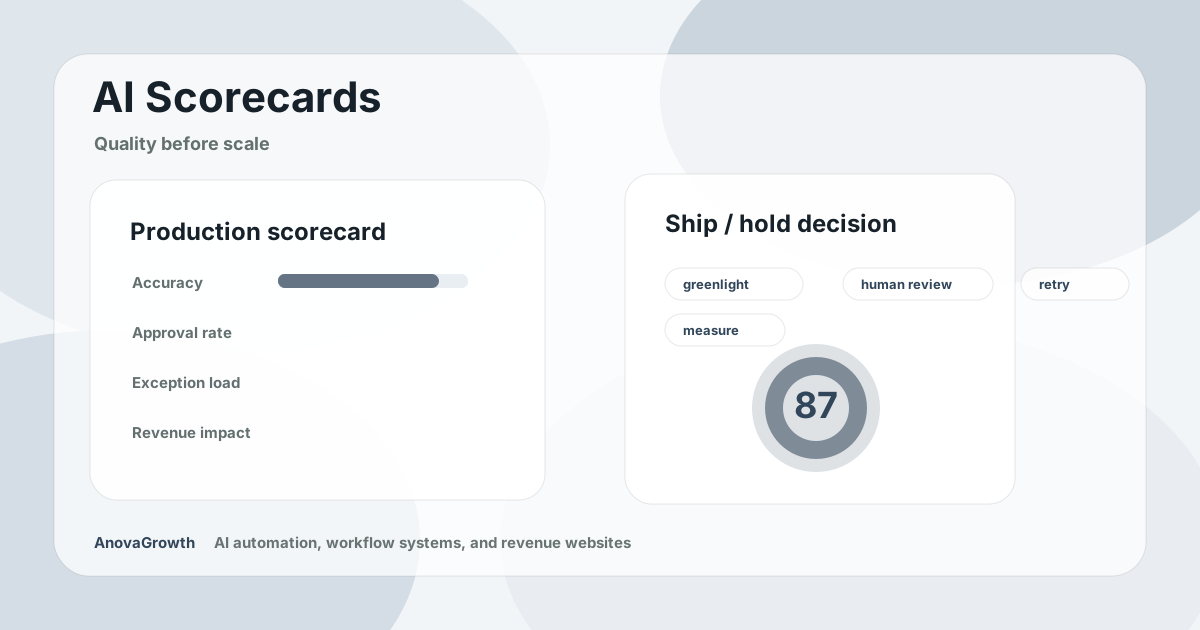
Most business owners are still asking which model to buy. This week's AI news points to a better question: how will you measure whether the workflow actually works in production?
Quick answer: AI is entering a scored, testable phase. OpenAI, Microsoft, Anthropic, Google, and AWS all spent the last 7 days pushing some version of evaluation, context quality, deployment proof, or workflow accuracy. For business owners, that means the next advantage is not another model subscription. It is a simple scorecard that tells you whether your AI workflow is trustworthy enough to scale.
Five Signals From the Last 7 Days
1) OpenAI pushed for stronger real-world evaluation standards
OpenAI argued that frontier systems can no longer be evaluated like simple chatbots. It emphasized harness choice, validity checks, and evidence reporting for systems that use tools and act across multi-step workflows.
Source: A shared playbook for trustworthy third party evaluations
2) Microsoft framed AI performance around context ownership
At Build, Microsoft focused on Work IQ, Fabric IQ, Foundry IQ, and Web IQ. The message was clear: the differentiator is not raw model access. It is whether your agents can work from real business context, structured data, and grounded retrieval.
Source: Microsoft Build 2026: Be yourself at work
3) Anthropic started grading partners on proof of production work
Anthropic's new Services Track does not just reward partner logos or theory. It measures certified practitioners, customers running Claude in production, and published customer proof.
Source: Introducing the Services Track and Partner Hub of the Claude Partner Network
4) Google made benchmark creation more local and practical
Google launched local development for Kaggle Benchmarks and highlighted dynamic evaluations built by people solving real-world tasks. That is another sign the industry is moving from abstract benchmark talk to scenario-based testing.
Source: Kaggle is making AI benchmark creation effortless
5) AWS focused on tool-calling accuracy as an operating metric
AWS highlighted a very practical failure mode: agents pick the wrong tool, format parameters badly, or break a workflow chain. The post focused on measuring and improving tool-calling accuracy before those mistakes hit production harder.
Source: Improve your agent's tool-calling accuracy with SFT and DPO on Amazon SageMaker AI
The Shared Angle
The common thread is not that AI got smarter.
The common thread is that AI vendors are acting like measurement is now part of the product:
- evaluate the workflow, not just the answer,
- ground the system in real business context,
- prove a partner has taken customers live,
- test scenarios close to the actual environment,
- measure tool-use accuracy before scale.
That is a meaningful shift for smaller businesses because it changes what a good pilot looks like. A good pilot is not a flashy demo and a few screenshots. A good pilot is a small workflow with visible pass-fail criteria.
The Scorecard Business Owners Should Use
Use a simple scorecard before you expand any AI workflow:
| Scorecard item | What to measure | Why it matters |
|---|---|---|
| Accuracy | Did the workflow complete the task correctly? | Wrong answers create cleanup work fast |
| Context quality | Did it use the right CRM fields, docs, or web content? | Messy inputs produce confident garbage |
| Tool reliability | Did it call the right system with the right parameters? | Broken handoffs kill trust |
| Approval boundaries | Which actions require a person to sign off? | Protects money, customer data, and brand risk |
| Exception handling | What happens when the AI is unsure or blocked? | Every production workflow needs a fallback |
| Outcome metric | Did response time, close rate, or rework improve? | Usage is not ROI |
Five Questions to Answer Before You Scale
- What does success look like for this workflow in one week, not one quarter?
- Which fields, files, or pages does the AI rely on, and are they clean enough to trust?
- Which action would create real damage if it fired incorrectly?
- How will you review failures without reading every single run manually?
- Which business metric should improve if this automation is actually worth keeping?
What This Looks Like in Practice
Example: a service business wants AI to qualify inbound leads, draft a first reply, and create the CRM record.
A weak rollout says, "The draft sounded pretty good."
A strong rollout says, "Out of 50 leads, the workflow created the correct record 47 times, routed the lead correctly 44 times, required human correction on 6 records, and reduced first-response time from 41 minutes to 9."
That second version is how you decide whether to expand the workflow, fix it, or kill it.
At AnovaGrowth, this is where a lot of AI projects either get real or quietly stall. The businesses that make progress are usually not the ones with the biggest AI budget. They are the ones willing to define a narrow workflow, write down the scorecard first, and let the numbers decide what scales next.
What to Do in the Next 30 Days
1) Pick one workflow tied to money or service quality
Lead qualification, quote follow-up, appointment intake, invoice processing, and ticket triage are all strong candidates.
If you are still choosing where to start, read The 7 Workflow Bottlenecks AI Automation Should Fix First.
2) Write the scorecard before the automation expands
Do not wait until after rollout to decide what matters. Pick 3-5 measures up front.
If you need help mapping the workflow first, use How to Audit a Workflow Before AI Automation.
3) Clean the context sources
If the workflow depends on CRM fields, internal docs, or service-page content, tighten those inputs before you blame the model.
This is also why Best AI Models for Business in 2026 is only part of the decision. The model matters, but input quality and workflow design matter more once production work begins.
4) Keep one visible exception queue
Every AI workflow needs a human-owned place for edge cases, blocked actions, and correction requests.
5) Review results weekly
If the workflow improves speed and quality, expand it carefully. If it only creates usage with no operational gain, cut it.
Bottom Line
This week's announcements point to a more disciplined AI market.
The winning businesses will not be the ones that keep adding tools and hoping for magic. They will be the ones that treat AI like an operating system that has to be measured, tuned, and proven on real work.
Before you buy the next model, build the scorecard.
Need help turning one messy workflow into a measured AI rollout? See our AI automation services or contact us for a practical implementation plan.
Related articles

AI Fleet Management for Service Businesses: Track Vehicles, Cut Downtime, and Reclaim Margin
AI fleet management for service businesses replaces clipboards and spreadsheets with live vehicle health, mileage, maintenance, and route data in one place.
Read the article: AI Fleet Management for Service Businesses: Track Vehicles, Cut Downtime, and Reclaim Margin
AI Quote Acceptance Prediction for Service Businesses: Score Every Estimate Before You Send It
Predict which quotes will close before you send them. Score every estimate on acceptance probability and act on the low scores.
Read the article: AI Quote Acceptance Prediction for Service Businesses: Score Every Estimate Before You Send It
AI Tech Skill Matching for Field Service: How to Raise First-Time Fix Rates and Cut Callbacks
AI tech skill matching raises first-time fix rates 8 to 15 points and cuts callbacks 30 to 50 percent in 90 days. The model and the workflow.
Read the article: AI Tech Skill Matching for Field Service: How to Raise First-Time Fix Rates and Cut Callbacks
