The Inspection That Should Have Taken 15 Minutes Took Half a Day
A roofer drives to a 2,400-square-foot house for a leak estimate. The customer wants to know what is wrong, what it costs, and when the crew can start. The roofer needs to walk the roof, count damaged shingles, photograph the flashing, measure the slopes, and write everything down. Then comes the ladder, the safety harness, the second climb because the first photo was blurry, and the third trip down to grab the right tape. Two hours later, the roofer drives back to the shop and spends another hour writing the estimate from handwritten notes that are already missing details.
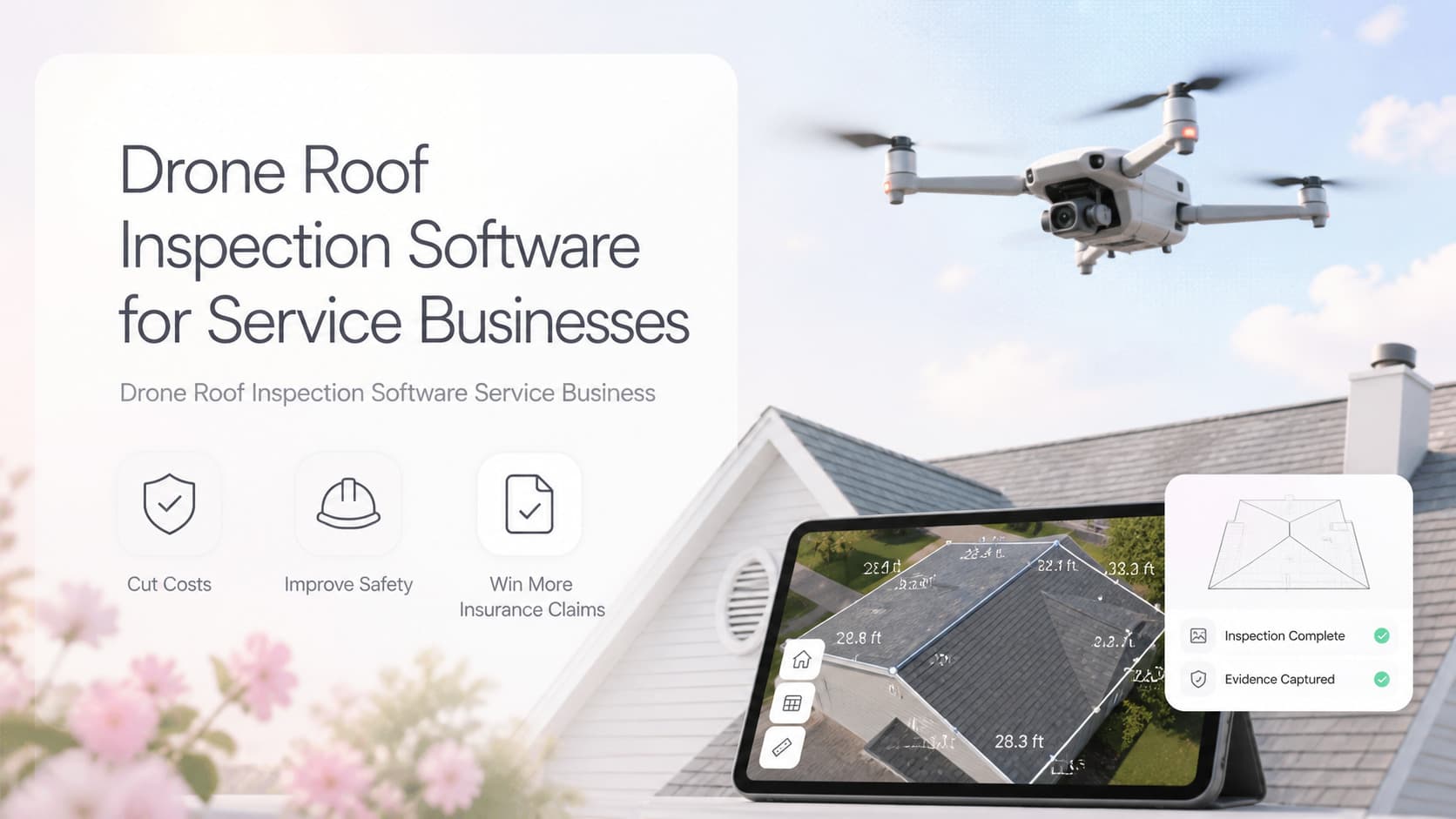
The same job with drone roof inspection software takes 15 minutes on site and 20 minutes in the office. The drone flies a pre-planned grid over the roof, captures 40 to 80 overlapping photos, and the software stitches them into a 3D model. The AI annotates damage, the software measures every slope and ridge, and the inspector walks the customer through a digital report on a tablet before pulling out of the driveway.
That is the gap. Ladder-based inspections are slow, dangerous, and inconsistent. Drone roof inspection software is fast, safe, and produces data that wins insurance claims, closes estimates, and documents every project in a way no clipboard can.
Quick answer: Drone roof inspection software combines a flight plan, automated image capture, and AI damage detection to replace ladder-based inspections. Roofing contractors, solar installers, HVAC companies, insurance adjusters, and property managers use it to cut inspection time by 60-80%, eliminate ladder time entirely, and generate insurance-ready reports with measurements and annotated photos. Setup costs less than one week of a roofer's billable hours and pays back in the first month through faster inspections, more closed deals, and fewer claim disputes.
What Drone Roof Inspection Software Actually Does
It is not a drone. It is not a camera. It is a software stack that turns a drone flight into a deliverable a customer or insurance carrier can act on.
The stack has four layers, and the value lives in how they connect.
| Layer | What It Does | What You Get |
|---|---|---|
| Flight planning | Pre-built or custom grid patterns, waypoints, altitude, overlap | Consistent capture every time, no pilot skill required |
| Image capture | Drone with RTK GPS and a 20+ megapixel camera | Centimeter-accurate orthomosaics and 3D models |
| AI analysis | Computer vision classifies damage, measures surfaces, flags anomalies | Annotated damage map, slope measurements, material quantities |
| Reporting | PDF, web share, CRM export, or insurance carrier upload | Customer-ready report with photos, measurements, and scope |
The Flight Plan Replaces the Pilot
The most common reason drone programs fail is that someone on the team has to learn to fly. Modern drone roof inspection software removes the operator from the equation. The software generates a flight plan based on the roof outline (drawn from satellite imagery or a Google Maps pin), the operator confirms the plan, the drone flies it, and the operator watches the battery level. The pilot never has to touch the sticks.
This is the practical unlock. A roofer who cannot fly a drone can still run a drone inspection program. A solar installer can put a drone in the hands of a marketing coordinator and get the same quality output as a commercial pilot.
The AI Damage Map Is the Real Product
The flight is the easy part. The hard part is what the software does with the photos. AI models trained on millions of roof images can identify:
- Missing, cracked, curled, or blistered shingles
- Exposed or rusted flashing
- Soft spots, sagging decking, or ponding water
- Hail impact bruising and wind creasing
- Vegetation, moss, and debris accumulation
- Skylight, vent, and chimney conditions
For solar installers, the same models flag shading obstructions, roof orientation, and usable square footage. For insurance adjusters, the AI flags hail strikes and matching issues that determine whether a claim is partial or full replacement.
The output is an annotated map. Every damage point has a labeled photo, a GPS coordinate, and a measurement. The inspector opens the map on a tablet, walks the customer through the findings, and sends the report before they leave the driveway.
The Report Is the Sales Tool
A drone inspection report is not paperwork. It is a sales asset. The customer sees their roof in detail, sees every damage point explained, and sees a clear scope of work. Insurance adjusters see the same evidence in a format that maps to the line items in their claim system. The closer delivers the report, the faster the deal closes.
The Real ROI of Drone Roof Inspection Software
The numbers below are conservative. We have seen service businesses beat them in the first month.
- 60-80% reduction in inspection time per site. A 90-minute ladder inspection becomes a 15-20 minute drone flight plus a 20-minute review. Across 4 inspections per day, that is 4 hours of labor recovered per tech per day.
- Zero ladder time on the roof. Workers' comp claims drop. OSHA exposure drops. Insurance premiums on the roofing line drop at renewal because the underwriter sees the program.
- 40-60% improvement in close rate on storm-damage work. Customers who see annotated drone photos of their damage close 2-3x faster than customers who see handwritten notes.
- Higher average ticket size. Drone reports surface hidden damage that handwritten inspections miss. The customer sees the full scope, not just the leak they called about.
- Faster insurance payouts. Carriers process AI-annotated reports faster than handwritten ones. Payment cycles on storm-damage jobs compress from 60-90 days to 21-30 days.
- One operator can cover 2-3 jobs per day instead of 1. The math compounds. A two-person drone team can clear the same volume of inspections as a six-person ladder team.
The payback period is almost always under 60 days. The cost of the drone kit is $1,500-$4,000 for a small commercial setup. The software subscription is $50-$300 per month depending on the platform. The only meaningful cost is the half-day of training to get the operator certified.
What Good Drone Inspection Software Looks Like
Not all platforms are equal. Here is the decision table we use when evaluating platforms for service business clients.
| Capability | Why It Matters | Where to Look |
|---|---|---|
| Automated flight planning | Operator does not need to be a pilot | Pre-built roof templates, Google Maps integration |
| RTK or survey-grade GPS | Measurements must be defensible in a claim dispute | Look for sub-inch relative accuracy |
| AI damage detection | Manual review of 80 photos is the bottleneck | Pre-trained models for shingle, metal, tile, flat roof |
| Web-based report sharing | Customer and adjuster access without a login wall | Browser link, no app download required |
| Insurance carrier integration | Direct upload to Xactimate, Symbility, or carrier portals | API or export to standard formats |
| CRM and proposal integration | Report feeds into the estimate, not a separate file | Direct export to Jobber, ServiceTitan, AccuLynx, or Salesforce |
| Per-job pricing | Volume discounts as you scale | Avoid seat-based pricing once you are past 2 pilots |
| Weather and airspace handling | Saves a flight when conditions are wrong | Built-in NOTAM checks, wind limits, rain sensor |
The platform that ticks every box at the small business level is usually a SaaS subscription like DroneDeploy, Pix4D, or Hover. The platforms that win on insurance integration are usually EagleView, Roof.ai, or ClaimConnect. For service businesses with deep custom workflows, a build on top of OpenAI Vision Models or a fine-tuned damage classifier is often the answer.
AnovaGrowth Operating Insight: The Drone Is the Easy Part, The Wiring Is the Hard Part
We have helped roofing, solar, and HVAC clients deploy drone roof inspection software more than any other automation in the last 18 months. The pattern is almost always the same.
The drone flies well on day one. The AI damage detection is impressive on the demo. The first report takes three hours to generate because the operator is learning the workflow. The customer is wowed. The team gets excited.
By week three, the team is generating reports in 30 minutes. By week six, the bottleneck is no longer the inspection. The bottleneck is what happens with the report after it is generated. The estimate is still being written in a separate system. The CRM record is still being updated by hand. The insurance claim is still being filed in a portal that does not know the report exists. The drone software produced a beautiful PDF, but the rest of the business is still running on clipboards.
The unlock is treating the drone software as one node in a workflow, not a standalone tool. The flight captures the data. The AI annotates the data. The annotations feed the CRM. The CRM builds the estimate. The estimate feeds the proposal. The proposal sends through DocuSign. The signed agreement triggers the schedule. The schedule updates the production tracker. The job photos flow back into the same system for warranty documentation.
Once that loop is wired, the drone is not a cool gadget. It is the front end of a quote-to-cash pipeline that runs six times faster than the old ladder-based process. The drone got the team interested. The wiring is what pays for the program.
How to Deploy Drone Roof Inspection Software in 30 Days
The setup is faster than most service businesses expect. The deployment is where most programs stall.
Days 1-7: Choose the Platform and Get the Pilot Certified
Pick the platform based on the table above. For most service businesses, the choice is between a SaaS subscription (faster setup, less customization) and a custom build (more upfront work, deeper integration). For under 50 inspections per month, SaaS is the right answer. For over 200, custom starts to pay.
The pilot needs a Part 107 commercial drone license. The exam is $175, the study time is 15-20 hours, and the pass rate is around 80% on the first attempt. Local community colleges and drone training shops run weekend prep courses.
Days 8-14: Build the Flight Plan Library
Pre-build flight plans for the roof types you inspect most. A 2,000-square-foot ranch. A 3,000-square-foot two-story. A 5,000-square-foot commercial flat roof. A tile roof with multiple facets. The more templates you build, the faster each flight becomes.
Most platforms let you save templates and replay them. The first flight takes 25 minutes to plan. The hundredth flight takes 30 seconds.
Days 15-21: Connect the Software to the Rest of the Stack
This is the step most teams skip. Wire the drone software into your CRM, your proposal tool, and your insurance carrier portal. The integration is usually one of three patterns:
- Direct API connection. The platform pushes the report to your CRM and your proposal tool.
- Webhook export. The report generates a link that gets attached to the CRM record automatically.
- Zapier or Make intermediary. A lightweight connector that moves the report to the right place when a flight is flagged complete.
Pick one. Do not let the team do this manually. The whole point of the program is that the data flows without a person retyping it.
Days 22-30: Train the Team and Run the First 10 Inspections
Run the first 10 inspections alongside the existing ladder process. Compare the outputs. Compare the time. Compare the close rate. You will see the gap within the first batch. Once the gap is obvious, the team will switch.
The training is short. Half a day is enough for most pilots and office staff. The bigger training is the customer-facing one. The team needs to learn how to walk a customer through a drone report on a tablet before they get out of the truck. That is a sales skill, not a software skill.
Common Mistakes When Deploying Drone Roof Inspection Software
The mistakes are predictable. Every program makes at least one of them.
Treating the Drone as the Project
The drone is the entry point. The project is the workflow that consumes the data. If the team spends the budget on the drone and not on the integration, the program stalls at month three because nobody wants to upload the report to the CRM by hand.
Skipping the Insurance Carrier Integration
The fastest payback on a drone program for roofing contractors is on insurance restoration work. If the carrier integration is not set up, the report becomes a PDF that has to be re-entered into the claim system, and the time savings evaporate. Bring the carrier portal into the workflow before the first flight.
Ignoring Privacy and Airspace Rules
The FAA requires a Part 107 license for commercial drone flights. Flying near airports, stadiums, and certain federal land requires additional authorization. Privacy laws on drone photography vary by state. Get the airspace checks into the software you choose. No exceptions.
Buying the Wrong Drone
A $300 hobby drone cannot do commercial roof inspections. You need at least 20 megapixels, RTK GPS, and the ability to fly pre-planned grids. Stick to the major commercial brands (DJI Mavic 3 Enterprise, Autel EVO II, Skydio 2+). The cheap option is the most expensive mistake in the program.
Not Tracking the Metrics
The program is not a success until it moves three numbers: inspection time per job, close rate on drone-inspected leads, and average ticket size. Track them from day one. If the numbers are not moving in 90 days, the workflow is broken and the drone is not the problem.
Putting One Pilot on the Program
Single-pilot programs stall when the pilot is sick, on vacation, or quits. Train at least two pilots from the start. Operator turnover is the most common reason drone programs quietly disappear.
How Drone Inspections Connect to the Rest of the Operation
Drone inspections get stronger when they feed the rest of the operation. The platform is the front end of a data pipeline.
- CRM and pipeline. The drone report attaches to the CRM record automatically. Sales conversations pull from real data, not phone notes. The CRM pipeline guide covers the rest of the workflow.
- Estimating and proposals. The AI measurements feed the material quantities in the estimate. Labor hours get calculated from the slope and complexity. The AI proposal generation workflow handles the rest of the proposal.
- Insurance claims. The annotated report uploads to the carrier portal. The adjuster sees the same data the inspector saw. The after-hours service workflow covers the rest of the storm response.
- Production scheduling. The drone report pre-builds the job packet. The crew arrives on day one with photos, measurements, and a clear scope. The automated dispatch workflow handles the rest of the routing.
- Maintenance and warranty. Reinspecting the same roof a year later produces a delta report. The customer sees what changed. The automated job documentation workflow handles the file history.
- Marketing and SEO. Annotated drone photos are the most compelling content a roofing company can publish. The Google Business Profile optimization guide covers the local SEO play.
The drone is one node. The wiring is the value. The service businesses that win on drone inspections are the ones that connect the data to the rest of the operation.
Frequently Asked Questions About Drone Roof Inspection Software
How much does it cost to get started?
A small commercial drone kit (DJI Mavic 3 Enterprise, controller, two batteries, rugged case) runs $3,000-$5,000. The software subscription is $50-$300 per month depending on the platform. The Part 107 commercial license is $175. Total first-year cost is usually under $5,000 for a single-pilot setup.
Do I need a licensed pilot?
Yes. The FAA requires a Part 107 commercial drone license for any commercial drone operation. The exam is 60 multiple-choice questions, takes 2.5 hours, and covers airspace, weather, regulations, and operations. The study time is 15-20 hours. There is no shortcut.
What about insurance?
Most commercial drone operators carry hull insurance on the drone and liability insurance for the operation. Aviation insurance providers offer drone-specific policies at $500-$1,500 per year for a small commercial operation. Check with your existing carrier before buying separate coverage.
What kinds of roofs can the software inspect?
Modern drone roof inspection software handles asphalt shingle, metal, tile, slate, flat, low-slope, and commercial roofs. The AI damage models are usually trained on the most common residential materials first. For less common materials (wood shake, clay tile, EPDM), the operator reviews the AI annotations manually.
Can the software handle multi-building or large commercial properties?
Yes. The flight plan scales to hundreds of thousands of square feet. The processing time grows, but the workflow is the same. For property managers with multiple buildings, the platform usually offers a portfolio view that groups inspections by site.
What is the close rate impact on storm-damage work?
We have seen 40-60% increases in close rate on storm-damage leads when the inspection is drone-based. The customer sees the damage in detail, the insurance adjuster sees the same evidence, and the lead closes faster than a competitor who showed up with a clipboard.
How does this compare to satellite roof measurements?
Satellite is cheaper ($5-$50 per report) but less accurate and not real-time. Drone data is fresh, exact, and includes the AI damage annotations that satellite cannot provide. Satellite is fine for a quick ballpark. Drone is the right tool for a quoted job.
What about HOA restricted communities?
HOA rules on drone flights vary. Most HOAs allow commercial drone operations with notice. Some require written approval. Build the HOA approval process into the workflow before the first flight in a restricted community.
Want to see what drone roof inspection software would look like for your service business? Talk to AnovaGrowth about a 90-minute operations audit. We will map your current inspection workflow, identify where the drone fits, and show you the integration points that turn the drone into the front end of a quote-to-cash pipeline that runs six times faster than the ladder-based process.