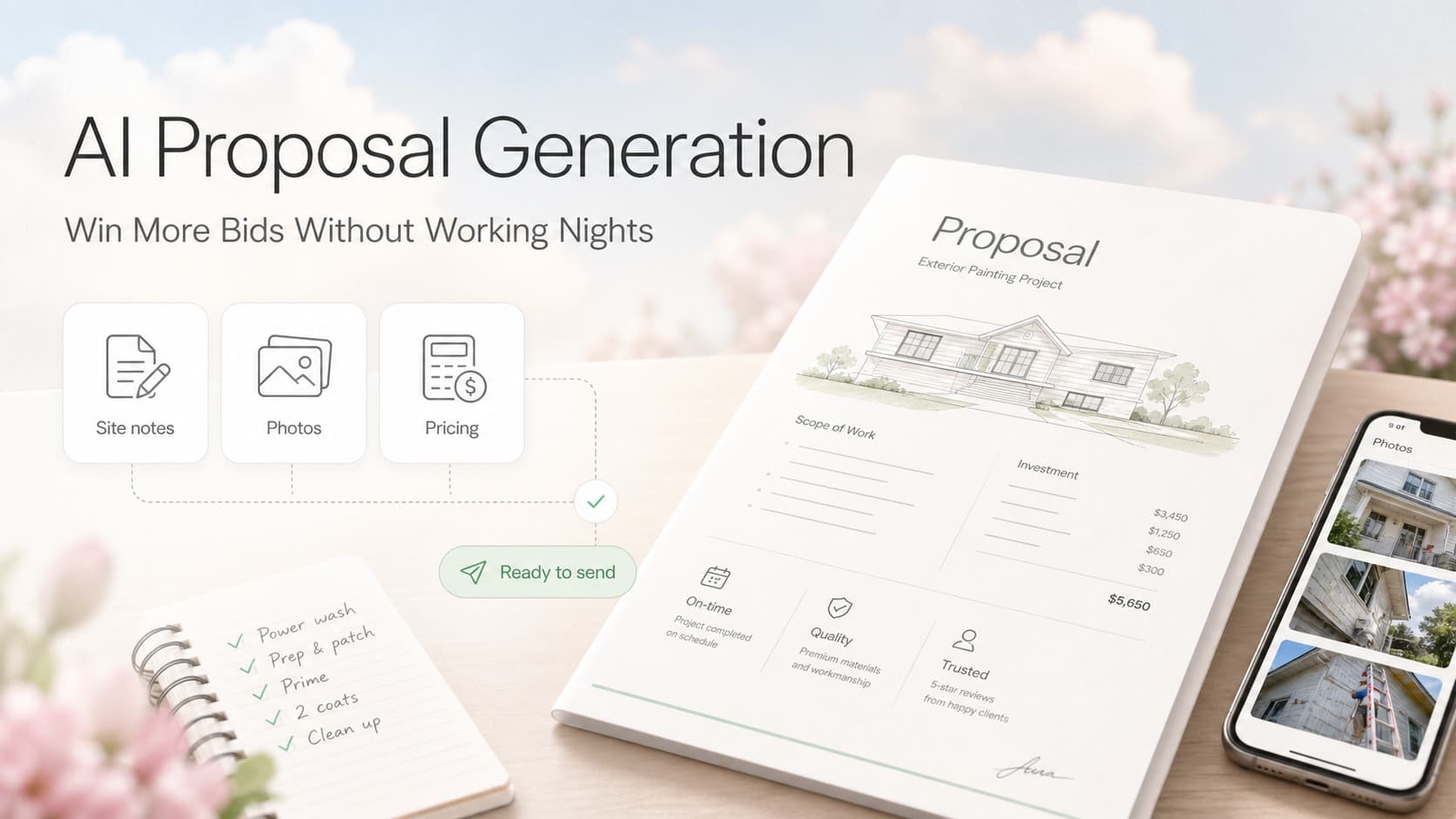
Quick Answer
AI proposal generation is a workflow that turns a discovery call transcript, site photos, job notes, and your pricing rules into a polished, on-brand proposal in under 10 minutes. Service businesses that send proposals within 4 hours of the discovery call close 30 to 50 percent more deals than competitors who take two to three days. The system usually pays for itself the first month because it frees 4 to 8 hours per estimator per week and lifts close rates without adding headcount.
The Slow Proposal Problem Costing You Jobs
Picture a homeowner in Chattanooga who calls three HVAC companies for a full system replacement. Company A sends a one-page quote the same day with a flat price. Company B sends a polished five-page proposal 36 hours later with tiered options, financing, and a clear warranty section. Company C sends a paragraph of bullet points five days later, after two reminder emails.
Most homeowners pick Company B. Not because the price is best, but because the proposal signals competence, organization, and respect for their time.
Three numbers explain why this matters for every service business:
- Speed to proposal is the single biggest controllable variable in close rate for residential and light commercial service work
- Personalized proposals that reference specific findings from the site visit close roughly 20 to 40 percent higher than templated bids
- Estimators typically spend 3 to 6 hours per proposal when they write it from scratch, which limits how many bids they can send per week
The math is brutal. If your estimator can only send 8 proposals per week at full quality, you are capped at the deals you can chase. Drop proposal time to 45 minutes and the same person can cover 20 deals without burning out.
What AI Proposal Generation Actually Does
A working AI proposal stack is not one tool. It is a four-part workflow that ties inputs, drafting, pricing, and delivery into one loop.
| Layer | What it does | Typical inputs or tools |
|---|---|---|
| Capture | Pulls the discovery call notes, site photos, measurements, and customer preferences into one record | CRM, call transcription, photo upload, intake form |
| Price | Applies your pricing rules, margin targets, and job-cost data to generate line items | Pricing sheet, job costing database, GPT prompt with rules |
| Draft | Produces a structured proposal with sections tailored to the customer and job type | Document template, style guide, structured prompt |
| Deliver | Sends the proposal with a tracking link, follow-up reminders, and e-signature | DocuSign, PandaDoc, email automation, CRM trigger |
When this is wired correctly, the estimator finishes a site visit, dictates three lines of notes into the CRM, snaps a few photos, and walks to the next job. The proposal lands in the customer's inbox 20 minutes later, ready to sign.
How the AI Drafts the Proposal
The AI is not inventing your pricing or making promises. It is given a structured prompt that includes:
- The full job description, measurements, and any constraints from the site visit
- Your approved pricing matrix, margin floors, and any rate sheets by service type
- The customer's name, address, decision timeline, and any preferences captured on the call
- A library of approved phrases, warranty terms, and exclusions
- A tone guide that matches your company voice (warm and direct, no jargon, signed by the owner)
- A rule set for what the AI must never do (never quote a final price without margin validation, never promise a timeline the operations team has not confirmed, never skip required disclosures)
The model returns a proposal with five core sections: a customer-specific intro that references the home or business, the scope of work in plain language, itemized pricing with three tiers when appropriate, a warranty and next-steps section, and a digital signature block. Total time from prompt to draft is usually under 90 seconds.
What the Output Looks Like
Customer: The Reyes family, Rome GA, 2,400 sq ft single-story home, original 1998 HVAC system
Discovery call note: "Wants variable-speed, concerned about summer humidity, two adults working from home, plan to stay 10+ years"
Drafted proposal intro (excerpt): "Thank you for inviting us into your home on Tuesday. Based on our walkthrough and your goal of consistent comfort during humid Northwest Georgia summers, the variable-speed system below is sized for your 2,400 square foot layout and the home office you mentioned. We sized the returns for the converted garage and confirmed there is adequate attic clearance for a horizontal evaporator. The proposal below includes three equipment tiers so you can match the system to your budget without sacrificing the comfort goals we discussed."
That intro took the estimator about 8 minutes to write for the previous customer. The AI version took 6 seconds and referenced the specific details that make the customer feel heard.
What to Automate vs What to Keep Human
Not every part of the proposal should be automated. The right split depends on job size, customer type, and risk level.
Fully automate the draft, estimator reviews in under 5 minutes:
- Residential service and replacement jobs under a defined dollar threshold
- Recurring maintenance plan proposals for existing customers
- Tiered options where pricing rules already exist in your system
- Add-on scopes like duct sealing, surge protection, or smart thermostat upgrades
AI drafts, estimator edits carefully:
- Custom residential work with structural or electrical complications
- Light commercial jobs where the customer has specific RFP requirements
- Jobs where the customer named a competitor and you are countering their bid
- Anything that references a specific financing promotion or rebate program
Always human-written, AI just gathers inputs:
- Jobs over a defined dollar threshold where a typo costs real money
- Proposals that include legal language, multi-phase scopes, or owner-furnished equipment
- Bids on public or institutional work where your company name and reputation are on the line
- Anything flagged by the AI as outside your approved pricing rules
This split is what separates a proposal system that scales from one that creates new liability. The AI handles the volume and the structure. The estimator handles the relationship and the judgment.
Proof It Works: A Birmingham Roofing Operator
A Birmingham roofing company with two estimators was leaving money on the table in two ways. First, the average proposal took 5 hours to write because each bid was custom. Second, the team could only send 6 proposals per week total, which meant they turned down walk-in leads they did not have bandwidth for.
We built a proposal flow that pulled the site inspection notes, drone photos, and measurements from their CRM into a structured prompt. The AI drafted a proposal with three shingle tiers, itemized labor and materials, and a clear warranty section that referenced the manufacturer's enhanced warranty option. The estimator reviewed each draft, made small edits, and sent it through PandaDoc with e-signature.
In the first 90 days:
- Average proposal time dropped from 5 hours to 38 minutes
- The team sent 22 proposals in the first month, compared to 11 in the same month the prior quarter
- Close rate on sent proposals improved from 28% to 41%
- The estimators stopped working Saturdays to finish proposals and started using that time for follow-up on slow leads
The system is not custom-built magic. It is a Make.com flow, a GPT prompt tuned to the owner's voice, and a PandaDoc template that already existed in their stack. Total monthly cost is under $140, and the labor savings paid it back in week two.
How This Connects to the Rest of Your Sales Stack
Proposal generation does not exist in a vacuum. The smartest setups wire it into the same workflow layer that handles lead capture, call recording, and follow-up.
If you have not set up the discovery call side yet, AI Call Transcription and Summarization for Service Businesses covers the half that turns the customer conversation into structured inputs your AI prompt can read. The two systems share a workflow layer, and the strongest setup feeds the call summary directly into the proposal draft so the estimator never has to retype what the customer said.
If your team is winning some bids and losing others to no feedback, Quote Win Rate Analysis for Service Businesses walks through how to track which proposals actually close and adjust your pricing and follow-up based on the data.
For owners who want to push response speed even further, AI Lead Response Speed for Service Businesses covers the first 5 minutes after the form fills, which is what determines whether the proposal is even relevant by the time you send it.
Related Questions and Subtopics
- How long should a service business take to send a proposal after the discovery call? Under 4 hours for residential, under 24 hours for commercial. Anything slower and you are losing deals to faster competitors.
- Can AI-generated proposals violate consumer protection or contract law? Only if they make false claims, omit required disclosures, or skip the human review step. Keep an estimator in the loop on every bid over a defined threshold.
- What is the best proposal tool for a 1 to 3 location service business? PandaDoc or QuoteWerks for shops that want turnkey templates. Make.com plus Google Docs for teams that want to own the document and the data.
- How do you keep proposals from sounding generic? Feed the prompt with specific job details, customer preferences, and the conversation transcript. The more context, the less it sounds like a template.
- Should residential and commercial proposals use different templates? Yes. Commercial proposals need more legal language, longer warranty terms, and clearer exclusions. Use two separate prompt libraries.
- How does AI proposal generation connect to pricing strategy? The AI follows your rules, so this works best after you have a clean pricing matrix and a margin floor. If you are guessing on price, the AI will just guess faster.
AnovaGrowth Operating Insight
We never deploy AI proposal generation as a standalone tool. We wire it into the same workflow layer that handles lead capture, call recording, and CRM updates. The reason is simple: a proposal is only as good as the inputs that feed it. The owners who get the most out of this are the ones who fix the inputs first: clean CRM records, a structured discovery call, and a pricing matrix that an estimator would actually defend. When the inputs are strong, the AI removes 80 percent of the writing time without sacrificing the parts that win the bid.
Key Takeaways
- AI proposal generation turns site notes, photos, and pricing rules into a polished bid in under 10 minutes
- Speed to proposal is the biggest controllable variable in close rate for most service work
- Send residential proposals within 4 hours of the discovery call whenever possible
- Keep a human estimator in the loop on every bid over your defined dollar threshold
- Feed the prompt with real job details, customer preferences, and your pricing matrix
- The cheapest version of this is Make.com plus a structured GPT prompt plus PandaDoc, under $150 per month
Next Steps
Start by writing down the five most common proposal types your team sends and the pricing rules that govern each one. Then build a prompt template for one type and run it against your last five real proposals. Compare the AI drafts to what your estimator would have sent. If the drafts are 80 percent there with a 5-minute edit, you have a working system. If they are missing key details, the fix is almost always in the input structure, not the model.
If you want help wiring the proposal flow, building the pricing prompts, and connecting it to your CRM, contact us for a 30-minute proposal audit. We will review your current proposal process, identify the time sinks, and outline the fastest path to a same-day proposal workflow your estimators actually trust.
Want a proposal workflow your team will use? Contact us and we will map your current proposal process, identify where the AI can save the most time, and build the first prompt against your real pricing rules.