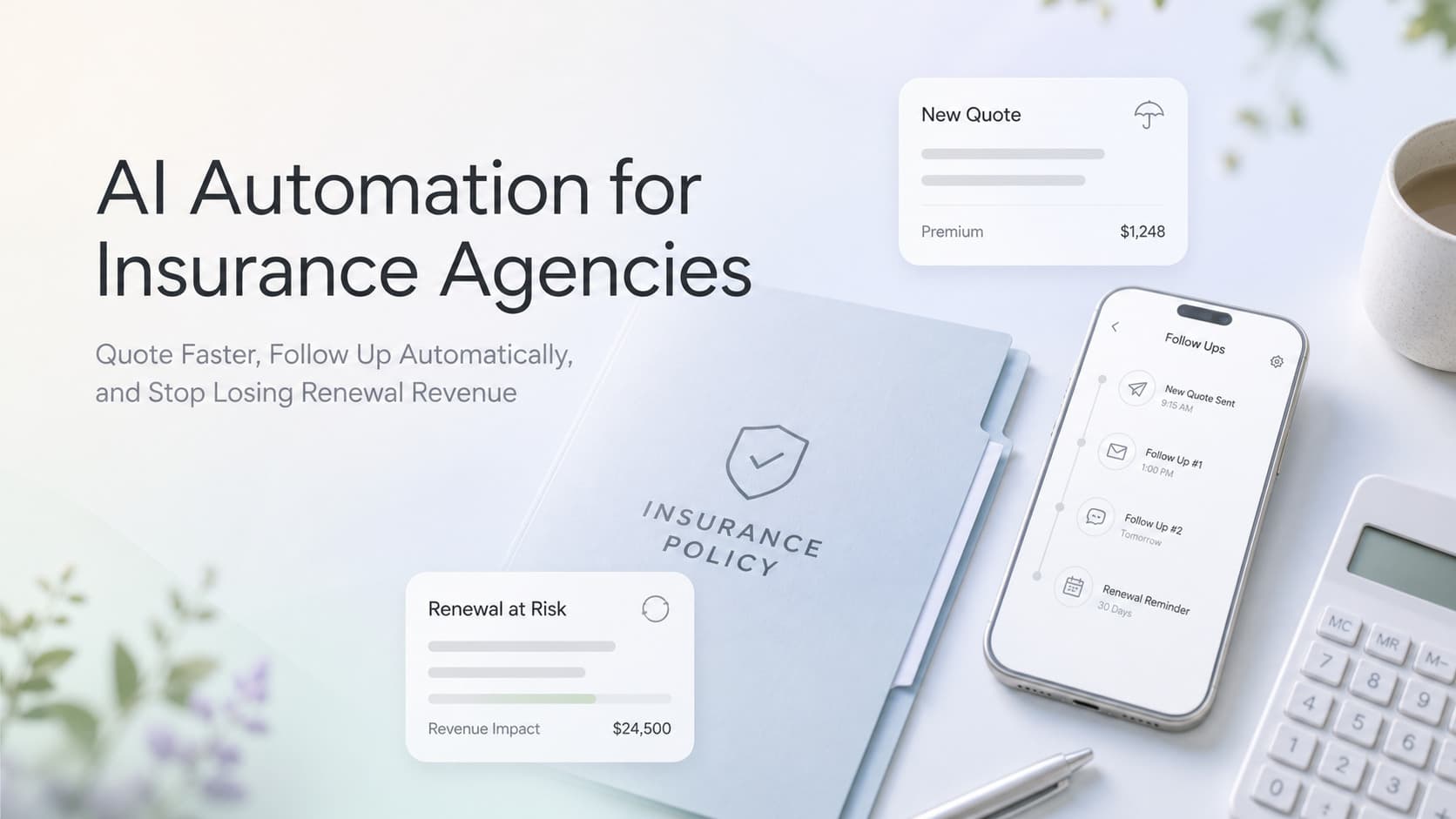
Why Insurance Agencies Bleed Revenue They Can't See
If you run an independent insurance agency, the biggest leaks are not the claims department or the carriers. They are the dozens of small touches that never happen: a quote that sits for three days before someone calls back, a renewal that goes out without a cross-sell offer, a lead that fills out a web form at 11 PM and never hears from anyone. AI automation for insurance agencies is the fix, and the agencies that adopt it now are pulling away from the ones that still rely on memory and sticky notes.
Quick answer: AI automation for insurance agencies uses machine learning and workflow tools to handle lead intake, quote follow-up, renewal reminders, cross-sell offers, and producer handoffs automatically. The result is faster response times, fewer lost quotes, higher cross-sell rates, and a producer team that spends more time on relationships and less time chasing the CRM.
Three numbers that explain why this matters for an independent agency:
- Independent agencies lose an estimated 20 to 40 percent of inbound web leads to slow or inconsistent follow-up, and the loss gets worse after hours and on weekends
- Renewal retention is the single biggest revenue lever in personal lines, yet 10 to 25 percent of renewals leave every year without a meaningful touchpoint from the agency
- Producers at the average independent agency spend 40 to 60 percent of their week on administrative tasks that could be automated, time that would otherwise go into selling and advising clients
These are not hard problems. They are repeatable processes that already exist in every agency. The fix is wiring them up so they run themselves.
What AI Automation in an Insurance Agency Actually Does
A working automation stack is not one product. It is a layered system that watches every signal your producers and clients send and responds faster than a human can.
| Layer | What it watches | What it does automatically |
|---|---|---|
| Lead intake | Web forms, chat, phone, referrals, partner leads | Routes by line of business, scores against the household, alerts the right producer in minutes |
| Quoting and binding | Quote requests, carrier responses, applications | Follows up on unconverted quotes, sends carrier-specific next steps, reminds the producer |
| Onboarding | New policy issuance, welcome sequence | Sends welcome email, schedules a 14-day check-in, adds household to the cross-sell cadence |
| Service | Email, calls, policy changes, certificates of insurance | Logs the interaction, updates the AMS, drafts a response for the CSR to review |
| Renewal | 90/60/30 day windows, life events, carrier messages | Runs a renewal sequence, surfaces cross-sell offers, escalates stuck renewals to the producer |
| Cross-sell | Household coverage gaps, life events, tenure | Triggers auto, umbrella, life, and bundling offers when a household changes |
When this is wired correctly, a lead who fills out an auto quote form at 11:14 PM gets a personalized text at 11:14 and 30 seconds, a tailored email at 11:15, and a producer call by 8:45 AM the next morning. You stop losing leads to voicemail and start winning them with speed.
The Six Workflows Insurance Agencies Should Automate First
Most agencies already know what is breaking. The question is which fix has the highest payback. Below is the order we use when we deploy into a new agency, ranked by revenue impact and time to value.
1. Lead Intake and Routing
A new lead fills out a web form, fills out a Google Business Profile lead form, calls the office after hours, or gets dropped off by a partner referral. Every minute of delay is money left on the table. Lead routing is also where most agencies are weakest because they rely on email forwarding and manual assignment.
The fix: every lead source feeds into a single inbox inside the agency management system or CRM. AI classifies the lead by line of business, scores it against the household data you already have, and routes it to the right producer based on specialty, capacity, and prior relationship. If no producer claims it within five minutes, the system escalates to a backup.
The payoff: conversion rates typically climb 25 to 50 percent once speed-to-lead drops below five minutes. For an agency doing 200 leads a month, that is often the difference between a profitable year and a flat one.
2. Quote Follow-Up
This is the silent killer. A prospect requests a quote, the producer runs it, sends the numbers, and then life happens. Three days pass without a follow-up call. The prospect calls a competitor who called back the same night. The lost quote never shows up in any report because it never made it past the proposal stage.
The fix: AI watches the agency management system for every quote that has not been bound within a set window. It sends a sequence of personalized touches, an email with a one-click review of the coverages, a text with a direct link to bind, a call reminder for the producer. The sequence adapts to behavior: if the prospect opens the email twice but does not bind, the producer gets an alert to call; if the prospect ignores everything for ten days, the lead is paused and re-engaged in 30 days.
The payoff: agencies typically lift quote-to-bind ratios by 15 to 30 percent inside the first quarter. For an agency writing 50 quotes a month, that is 7 to 15 additional policies without spending another dollar on advertising.
3. Renewal Sequences
Renewals are the highest-impact moments in an agency. The client is already bought in. The household data is in the system. The carrier has already priced the risk. All the agency has to do is reach out, confirm the coverages, and offer the next product.
Most agencies do this with a calendar reminder and a phone call. The reminder fires. The producer is busy. The call does not happen. The renewal lapses. The client goes to a captive carrier or a direct website and the agency never knows why it lost the household.
The fix: every policy in the book gets a renewal cadence at 90, 60, and 30 days out. The system pulls the current coverages, flags coverage gaps against the household profile, and sends a personalized review. If the producer marks the review as done, the sequence stops. If the producer does nothing for seven days, the system escalates to a service rep. The whole sequence is logged in the AMS so the agency can see which renewals are at risk.
The payoff: retention lifts of 5 to 10 percentage points are common once the cadence is consistent. For an agency with 2,000 households, that is 100 to 200 retained policies a year, often more revenue than the entire new-business pipeline produces.
4. Cross-Sell and Bundling
The cheapest policy you can sell is the next one to an existing client. The data already says which household has only auto, which has only home, which has a teenager about to turn 16, which is paying for two policies from different carriers. Producers know this. Producers also forget, because the daily book of business is overwhelming.
The fix: AI runs every household against a coverage matrix every night. When it finds a gap that matches a life event or a tenure milestone, it generates a cross-sell offer for the producer to review. The producer approves, edits, or kills the offer with one click. The client gets the offer through their preferred channel.
The payoff: agencies with consistent cross-sell cadences write 20 to 40 percent more policies per household over a three-year window. That compounds, and it is the single biggest lever on agency valuation when it is time to sell or partner.
5. Producer and CSR Handoffs
The handoff between producer and service team is where most agencies leak client trust. The producer sells the policy, hands it off to a CSR, and the CSR is left to figure out the client from a folder in the agency management system. The client calls with a question. The CSR puts them on hold to read the file. The client feels the friction.
The fix: every new policy issuance triggers an automated handoff packet. The producer's notes, the household profile, the coverages, the open cross-sell items, and the next renewal date all land in one place before the CSR's first call with the client. The CSR's first response time drops from hours to minutes, and the producer sees a clean handoff in their dashboard.
The payoff: handoff-related complaints drop by half within the first 60 days. Client satisfaction scores, which most agencies do not even measure, climb materially. Producers get back 2 to 4 hours per policy sold.
6. After-Hours and Weekend Coverage
Most independent agencies operate 9 to 5. Most clients do not. A client gets a new car on Saturday morning, a ticket on Sunday afternoon, a hail claim at 11 PM on a Tuesday. If the agency does not respond quickly, the client calls the carrier directly and the relationship drifts.
The fix: an AI voice and chat layer answers the phone, the chat, and the text after hours. It triages the call, handles certificates of insurance and basic service requests, and routes true emergencies to an on-call producer. The next morning, the on-call producer wakes up to a clean summary of every after-hours contact.
The payoff: after-hours lead conversion jumps from single digits to 30 to 50 percent. Existing-client satisfaction climbs because the agency is finally reachable when the client actually needs it.
The Stack Behind the Workflows
Agencies do not need ten new tools. They need the ones they already own wired together properly.
- Agency Management System as the source of truth, Applied Epic, AMS360, EZLynx, HubSpot, or whatever the agency runs
- Lead routing and intake through a CRM like HubSpot, Pipedrive, or a built-in module
- Outbound automation through a workflow tool like Zapier, Make, or n8n for the simple stuff
- AI voice and chat through a service like Smith.ai, Mongoose, or a custom build for after-hours and lead capture
- Document and email automation through a tool like DocuSign, Dropbox Sign, or the carrier's own e-sign integration
- Reporting and dashboards through a BI layer like Looker Studio, Power BI, or a custom dashboard for owner visibility
The tools matter less than the wiring. A clean, well-instrumented stack on the same five products will outperform a Frankenstein stack on twenty. The goal is one source of truth, one workflow engine, and one place to look when something breaks.
Where to Start: A 60-Day Agency Plan
The sequence below is the one we use with new agency clients and it stacks the highest-impact fixes first.
Days 1 to 14: Lock the Front Door
- Audit every lead source and confirm it feeds into a single inbox
- Turn on speed-to-lead alerts so any lead older than five minutes pings the producer and the manager
- Build a quote-follow-up sequence for your three most common lines of business
- Move all client communication templates into a shared library the system can pull from
Days 15 to 30: Add the Renewal Engine
- Pull a list of every policy renewing in the next 120 days
- Build a 90/60/30 cadence with personalized messages and cross-sell offers
- Train producers on the renewal review checklist so they can knock out a review in five minutes
- Set up an escalation path for renewals that have not been touched in seven days
Days 31 to 45: Build the Cross-Sell Loop
- Run every household through a coverage matrix and tag the gaps
- Build a cross-sell offer library by line of business and by life event
- Wire the offers into the renewal sequence so the cross-sell goes out with the renewal review
- Track every offer and bind so you can see which offers actually work
Days 46 to 60: Layer in After-Hours and Reporting
- Deploy AI voice and chat for after-hours coverage
- Connect it to the on-call rotation and the morning summary
- Build a single dashboard for the owner showing lead conversion, quote-to-bind, retention, and cross-sell
- Run a 60-day retrospective and lock in the workflows that worked
What This Looks Like in the Real World
AnovaGrowth has helped independent agencies across personal lines, commercial lines, and hybrid books deploy this kind of stack. A few patterns show up consistently:
- Speed-to-lead is the single biggest win. Agencies that drop from a 4-hour average response to a 5-minute average response typically see quote volume go up because the producers stop avoiding a backlog of stale leads
- Renewal sequences beat every other retention tactic we have seen, including carrier-side retention offers, because the agency controls the message and the timing
- Cross-sell offers only work when they are tied to a real signal, a teen driver, a new home purchase, a life event, a tenure milestone. Generic bundling pitches are ignored
- Producers who finally get their time back almost always reinvest it in higher-value accounts and referrals, which compounds the impact of the automation
The result is an agency that grows without adding headcount, retains the book it already wrote, and gives the owner time to focus on the producer team and the next stage of growth.
Common Objections From Agency Owners
These are the four we hear most often, and the honest answer to each.
"Our producers will not use it." Producers will not use anything that adds work. The whole point of this stack is to remove work. If a producer has to log into a new tool, it has already failed. Every workflow above runs inside the systems the producers already use, and the producer's job is to approve or edit, not to start from scratch.
"Our book is too small to automate." The opposite is true. A book of 500 households is exactly the size where the owner is doing everything by hand and the producers are buried. Automation at that scale gives the owner back ten hours a week and gives the producers the leads they need to hit their numbers.
"Carriers will not let us." Carriers do not care how you run your agency as long as you stay compliant and keep the book. E&O carriers actively encourage automation because it reduces human error and improves documentation. The only thing to watch is TCPA and state-level consent on outbound texting, which is a configuration problem, not a deal-breaker.
"We will lose the personal touch." You will lose the parts of your process that were already impersonal, the missed follow-ups, the forgotten renewals, the unanswered after-hours calls. You will keep every part that actually matters, the producer relationship, the policy review, the claim advocacy. Automation does the work the agency was supposed to do and was forgetting to do. It frees the producer to do the work the client actually remembers.
Key Takeaways
- AI automation for insurance agencies is not about replacing producers. It is about removing the 40 to 60 percent of producer time that is currently wasted on follow-up, routing, and reminders
- The biggest wins are lead routing speed, quote follow-up, renewal cadence, and cross-sell loops, in that order
- The stack matters less than the wiring. Most agencies can build this on the tools they already own
- A 60-day rollout is enough to lock in the highest-impact workflows and produce a measurable lift in conversion, retention, and cross-sell revenue
Related Questions Agency Owners Ask
- How fast should an agency respond to a new web lead before conversion drops off?
- What is the right cadence for personal lines renewal outreach?
- Can AI handle after-hours calls without losing the personal touch?
- How do I measure cross-sell effectiveness across the book of business?
- What is the best CRM to pair with Applied Epic or AMS360?
- How do I get producers to actually use the new automation stack?
Running an independent agency and not sure which workflow to automate first? Contact us and we will map the highest-impact fix to your book in a 30-minute working session.