The Lead That Never Called Back
You quoted a job. The prospect said "let me think about it." You followed up once, maybe twice. Then you got busy and forgot.
Three months later they hired someone else.
This is the single biggest revenue leak in most service businesses. You spend money on ads, SEO, and referrals to get leads in the door. Then you let them go cold because you don't have a system to stay in touch.
Quick answer: Automated lead nurturing uses email, SMS, and CRM triggers to follow up with prospects on a schedule you set once. Instead of chasing leads manually, your system sends the right message at the right time. Service businesses that set this up see 20-40% more booked jobs from the same lead volume, without adding staff.
Why Most Service Businesses Drop the Ball
The pattern is almost universal. A lead comes in through a phone call, website form, or Google Business Profile. You respond fast. You give a quote. Then nothing.
Here is what happens next:
| Stage | What Usually Happens | What Should Happen |
|---|---|---|
| Day 1 | Lead calls or fills a form | Instant auto-reply with confirmation and next steps |
| Day 2 | You call back, give a quote | Quote sent in writing with clear offer |
| Day 3-7 | Lead says "let me think about it" | Automated follow-up with testimonial or case study |
| Week 2 | You follow up once | Sequence continues with value-based content |
| Week 3+ | You get busy, lead goes cold | Monthly check-in until they book or unsubscribe |
The gap is not in the first response. It is in everything after the first "no" or "maybe."
What Automated Lead Nurturing Actually Looks Like
Lead nurturing automation is not a single email blast. It is a triggered sequence that responds to what the lead does.
A basic nurture sequence for a service business:
- Instant reply (0 hours): Auto-email confirming receipt, setting expectations, and linking to your booking page or a relevant case study.
- Quote delivery (24 hours): Formal quote sent with a clear scope, timeline, and price. Include a direct call to action to book.
- Social proof (3 days): Follow-up with a short testimonial from a similar customer. "Here is what a homeowner in [their area] said after we finished their HVAC replacement."
- Objection handler (7 days): Address the most common reason people delay. "Worried about disruption? Here is exactly how a typical install day goes."
- Seasonal trigger (14 days): A relevant offer or reminder tied to the season. "Summer is coming. Here is why scheduling your AC tune-up now saves you from the July rush."
- Monthly check-in (ongoing): A low-pressure "we are still here" message with useful content. No hard sell.
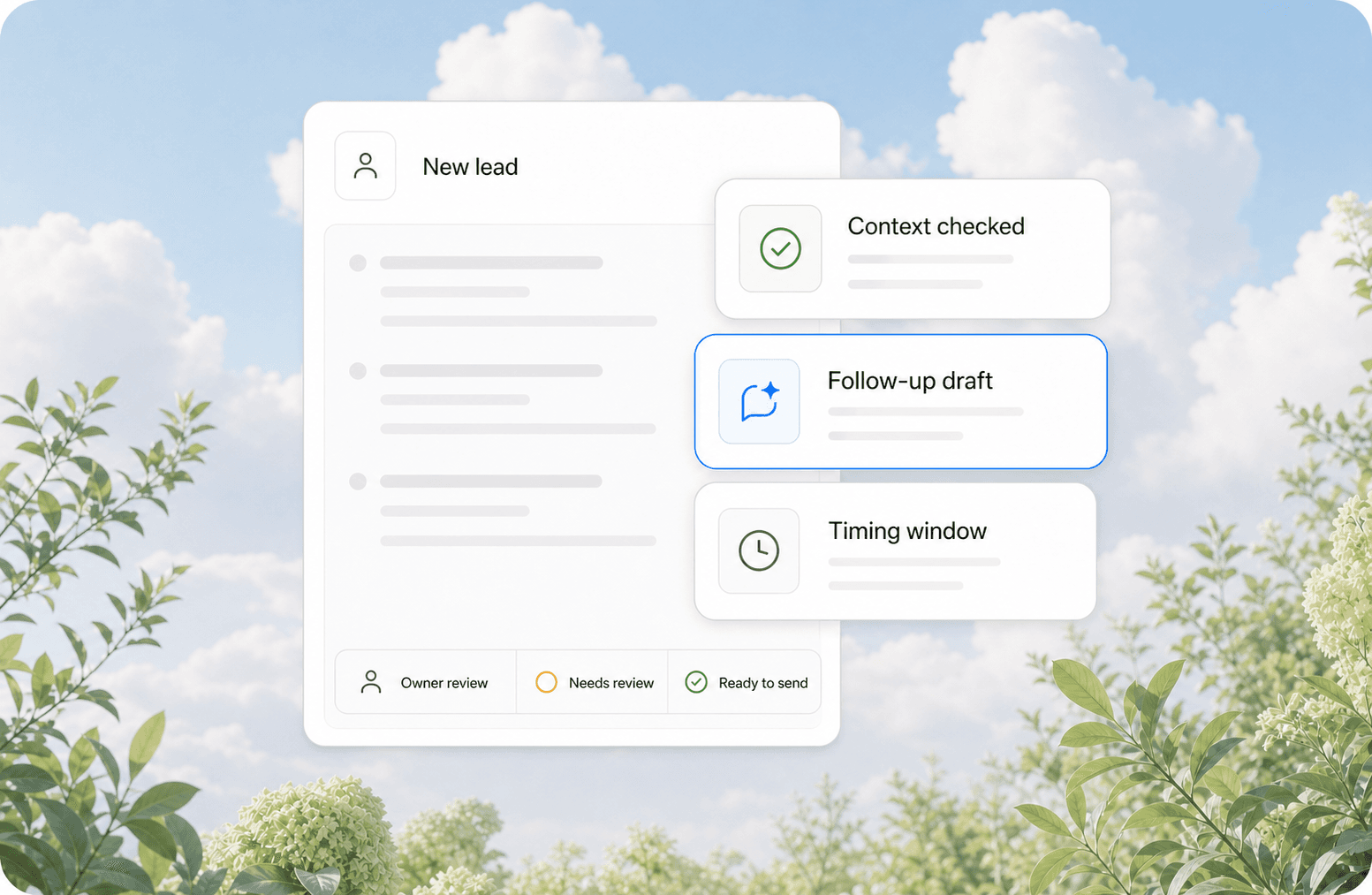
Each step only sends if the lead has not already booked. If they book, the sequence stops and moves them to a customer workflow.
The Tools That Make This Work
You do not need a complex marketing platform. Most service businesses already have the pieces.
What you need:
- A CRM that stores lead data. This is the foundation. If your leads live in a notebook or a spreadsheet, start here. A CRM like HighLevel, HubSpot, or even a well-structured GoHighLevel account gives you a place to store contact info, quote history, and communication logs.
- An email or SMS automation tool. Most CRMs include this. You write the messages once, set the timing, and the system sends them automatically.
- A trigger system. The automation needs to know when to start, pause, or stop. Triggers include: lead created, quote sent, job booked, email opened, link clicked.
How they connect:
Lead fills form → CRM creates contact → Automation starts sequence
    ↓
Lead books job → Sequence stops → Customer onboarding starts
    ↓
Lead ignores 6 messages → Sequence pauses → Manual follow-up flag
This is not theoretical. We set this up for a Rome HVAC company using GoHighLevel. Their lead-to-booking rate went from 18% to 34% over four months. The only change was a 6-step nurture sequence that ran automatically.
What to Nurture (and What Not To)
Not every lead deserves a full sequence. Segment your leads first.
High-intent leads (quote requested, called directly): Full nurture sequence. These people are actively shopping. Send faster, more direct messages. Include pricing and availability early.
Medium-intent leads (form fill, downloaded a guide): Lighter sequence. Educate first, sell second. Send 2-3 value pieces before a direct offer.
Low-intent leads (website visitor, no contact): Retargeting ads or a single "did you know?" email if you have their email from a past interaction. Do not put these in a full nurture sequence.
Past customers: Separate sequence entirely. Re-engagement for maintenance, seasonal tune-ups, or referral requests. These convert at 3-5x the rate of cold leads.
First-Hand: What We See When We Audit Service Business Lead Handling
We have audited lead handling for HVAC, plumbing, electrical, and home service companies across the Southeast. The pattern is consistent.
Most companies respond to the first inquiry within 2 hours. That is good. But 80% of them have zero follow-up after the first call. If the lead does not book on the spot, they never hear from the business again unless they call back.
The companies that do nurture see a different pattern. Their close rate on nurtured leads is 2-3x higher than on cold inbound leads. The reason is simple: most service purchases are not urgent. A homeowner needs a new water heater, but they can wait a week or a month. If you stay in their inbox, you stay top of mind. If you go silent, the next company that calls gets the job.
We also see a common mistake: businesses try to nurture every lead the same way. A commercial property manager needs different messaging than a residential homeowner. A lead who called about an emergency repair needs a different sequence than someone planning a renovation. Segment your sequences by lead type, not just by lead source.
Building Your First Nurture Sequence in 90 Minutes
You can set up a basic nurture sequence in an afternoon. Here is the fastest path.
Step 1: Pick your CRM. If you already have one, use it. If not, start with a free tier of HubSpot or a trial of GoHighLevel. The tool matters less than the sequence.
Step 2: Write 6 messages. One instant reply, one quote delivery, one social proof, one objection handler, one seasonal trigger, one monthly check-in. Keep each under 150 words. Write them in a single sitting.
Step 3: Set the timing. Space messages 2-7 days apart. Faster for high-intent leads, slower for medium-intent.
Step 4: Add a booking link. Every message should include a direct way to book or call. Do not make them search for it.
Step 5: Set stop conditions. The sequence stops when the lead books, unsubscribes, or marks themselves as not interested. Set these up before you turn the sequence on.
Step 6: Turn it on and watch. Check the sequence weekly for the first month. See which messages get opens and clicks. Adjust timing and copy based on what works.
Common Mistakes That Kill Nurture Sequences
Sending too fast. Three emails in three days feels desperate. Space them out. A weekly cadence is usually right for service businesses.
No personalization. "Hi [First Name]" is the bare minimum. Reference their specific inquiry. "I remember you were asking about ductless mini-splits. Here is a quick comparison."
No stop conditions. If a lead books a job and still gets nurture emails, they will unsubscribe. Connect your CRM to your booking system so the sequence stops automatically.
Generic content. A nurture sequence for a plumbing company should talk about plumbing, not generic "business tips." Stay relevant to the service you sell.
No mobile optimization. Most service business leads read emails on their phone. Keep messages short, use large buttons, and test on mobile before sending.
Related Questions Business Owners Ask
- How do I set up SMS follow-up without annoying my leads?
- What CRM is best for a small HVAC or plumbing company?
- How do I track whether my nurture sequence is actually working?
- Should I use email, SMS, or both for lead nurturing?
- How long should a lead stay in a nurture sequence before I give up?
- What do I say in a follow-up when the lead already said no?
The Bottom Line
Automated lead nurturing is not about selling harder. It is about staying present until the lead is ready to buy. Most service purchases happen on the customer's timeline, not yours. A nurture sequence makes sure you are there when they are ready.
The setup cost is a few hours and whatever you already pay for your CRM. The upside is 20-40% more booked jobs from the same lead volume. For most service businesses, that is the highest-ROI change they can make this quarter.
Ready to set up your nurture sequence? Contact us to discuss your current lead handling and what a custom automation would look like for your business. We work with service companies across the Southeast to build systems that turn more leads into booked jobs.
Learn more about workflow automation for service businesses. Or read about CRM integration to see how your tools connect into one flow.