Customer Journey Automation for Service Businesses: Map the Path, Automate the Steps
Service businesses lose customers at every stage of the journey. Map the path from first search to repeat booking, then automate the handoffs.

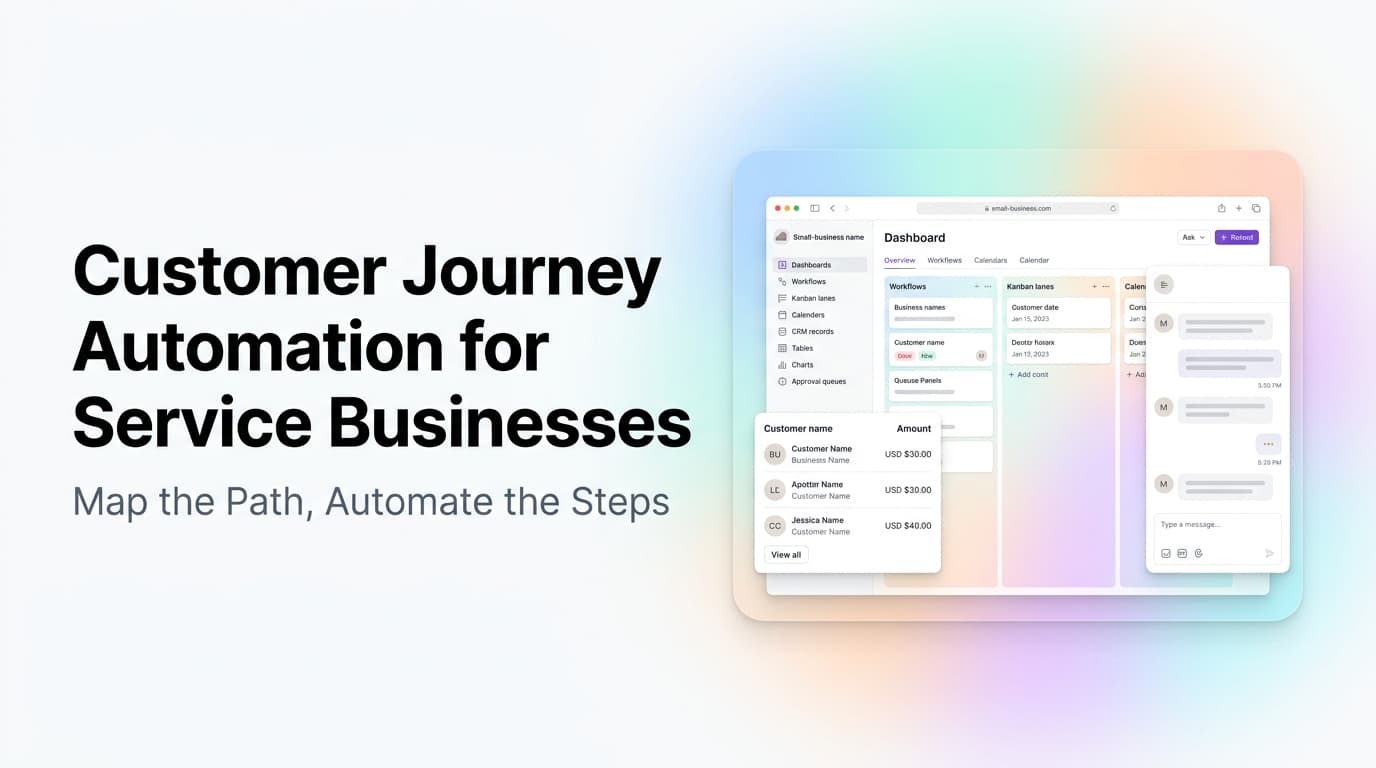
The Customer Journey Is Not a Funnel. It Is a Series of Handoffs.
Most service businesses think of their customer journey as a funnel: someone finds you, calls you, you do the work, they pay, done. But that is not how real customers behave. They search on Google, read reviews, visit your website, call, get a quote, compare, book, get the service, get billed, and maybe come back. Every one of those steps is a handoff between your marketing, your sales process, your operations, and your follow-up.
The problem is that most of those handoffs are manual. Someone has to answer the phone, send the quote, check the schedule, send the invoice, and remember to follow up next year. When those handoffs are manual, they drop. Calls go to voicemail. Quotes sit in drafts. Follow-ups never happen.
Quick answer: Customer journey automation means connecting every touchpoint from first search to repeat booking so that leads move forward without someone having to push them. For a typical service business, automating the journey cuts lead response time from hours to seconds, increases quote-to-close rates by 20-40%, and turns one-time customers into repeat revenue without manual follow-up.
The Six Stages of a Service Business Customer Journey
Every service business has the same basic customer journey. The details vary by industry, but the stages are consistent.
| Stage | What Happens | Common Leak |
|---|---|---|
| Discovery | Customer searches, finds your GBP or website | 40-60% of searchers click a competitor |
| Engagement | Customer calls, fills a form, or texts | 30-50% of leads never get a response |
| Qualification | You determine if the job fits | 20% of leads are unqualified, wasting time |
| Quote & Book | You send an estimate, they decide | 50-70% of quotes never get a follow-up |
| Service Delivery | You show up, do the work, collect payment | 15-25% of invoices are late |
| Retention | You follow up, they book again | 30-50% of customers never return |
The leaks at each stage are where automation pays for itself. Fix the handoff, capture the revenue.
Stage 1: Discovery Automation
Before a customer can engage, they have to find you. This stage is mostly about SEO and advertising, but there is one automation that matters: call tracking.
When a customer finds you through Google, you need to know which keyword, ad, or listing drove the call. Call tracking software assigns unique phone numbers to each source and logs the call data into your CRM. Without it, you are guessing which marketing works.
What to automate: Inbound call source attribution, lead source logging in CRM, and ad platform conversion tracking.
AnovaGrowth insight: We have seen service businesses spend $2,000-5,000 per month on Google Ads with zero call tracking. They could not tell which keywords produced calls versus which ones just burned budget. Adding call tracking and feeding that data back into the ad platform typically cuts cost-per-lead by 30-50% within 60 days.
Stage 2: Engagement Automation
This is where most service businesses lose the most money. A customer calls or fills a form, and nobody responds fast enough.
The data is clear: Responding to a lead within 5 minutes makes you 100x more likely to convert than responding after 30 minutes. Service businesses that use automated lead response see 20-40% higher close rates.
What to automate:
- Instant SMS or email reply when a form is submitted
- AI phone answering for after-hours and busy periods
- Lead routing to the right person based on service type and location
- Calendar availability sent automatically so the customer can self-book
Proof: A plumbing company in Atlanta set up automated SMS replies and online booking. Their lead-to-call time dropped from 4 hours to 90 seconds. Their close rate on web leads went from 18% to 41% in three months.
Stage 3: Qualification Automation
Not every lead is worth your time. Qualification automation separates serious buyers from tire-kickers before a human gets involved.
What to automate:
- A pre-qualification form or chatbot that asks job type, location, budget range, and timeline
- Lead scoring in your CRM that assigns points based on answers
- Automatic routing: high-score leads go to sales, low-score leads go to a nurture sequence
Example: An HVAC company in Birmingham set up a chatbot that asked homeowners about their AC issue, property size, and whether they owned or rented. Leads that matched their service area and showed urgency were routed to the dispatch team within 60 seconds. Low-quality leads went into an email sequence. Their sales team stopped wasting 40% of their time on bad leads.
Stage 4: Quote and Booking Automation
The gap between sending a quote and getting a booking is where deals die. Most service businesses send a quote and wait. The customer compares, forgets, or picks someone who responded faster.
What to automate:
- Quote generation from a standardized price list or job template
- Automated quote delivery via email and SMS
- Follow-up sequence: day 1, day 3, day 7 if no response
- Online booking with calendar sync so the customer can schedule immediately
- Deposit collection or payment link in the quote itself
Decision table: When to automate quoting vs. keep it manual
| Scenario | Automate | Keep Manual |
|---|---|---|
| Standard jobs with fixed pricing | Yes | - |
| Jobs that vary by site visit | Quote template + manual adjustment | Full manual |
| Emergency or same-day service | Auto-send base rate + booking link | - |
| Large commercial projects | - | Yes, needs custom pricing |
| Recurring maintenance contracts | Auto-generate from previous job data | - |
AnovaGrowth insight: We worked with a landscaping company that was losing 60% of quotes because they took 2-3 days to send them. We set up a system where the estimator entered job details on-site, the system generated a quote from their price list, and the customer received it via text before the estimator left the driveway. Their close rate went from 35% to 62% in one season.
Stage 5: Service Delivery Automation
Once the job is booked, the operational handoffs begin. Dispatch, scheduling, job status updates, invoicing, and payment collection all need to happen in sequence.
What to automate:
- Dispatch and route optimization for field teams
- Automated job status notifications to the customer (en route, on site, completed)
- Digital invoice generation and delivery
- Payment follow-up for outstanding balances
- Review request after job completion
The result: A cleaning company in Nashville automated their dispatch and customer notifications. Their techs stopped spending 20 minutes per job on the phone giving status updates. Customers stopped calling to ask "when will they arrive?" The company saved 8 hours per week per dispatcher and saw a 15% increase in positive reviews because customers felt informed.
Stage 6: Retention Automation
The most expensive customer to acquire is the one you already had. Service businesses that automate retention see 30-50% higher repeat rates.
What to automate:
- Post-service follow-up at 30, 60, and 90 days
- Seasonal maintenance reminders (HVAC tune-up before summer, gutter cleaning before fall)
- Automated review requests after each completed job
- Reactivation campaigns for customers who have not booked in 6+ months
- Referral request sequences timed to peak satisfaction
Example: A pest control company set up automated reminders for quarterly treatments. Customers got a text 2 weeks before their scheduled service, a reminder 3 days before, and a confirmation the day of. Their retention rate went from 55% to 78% in one year. The automation cost less than one monthly marketing retainer.
How to Start Mapping Your Customer Journey
You do not need to automate all six stages at once. Start with the stage that leaks the most revenue.
- Pick one stage where you are losing customers. For most service businesses, that is engagement (slow lead response) or quote follow-up.
- Map the current process. Write down every step from customer action to your team's response. Include timing.
- Identify the manual handoff. Where does a human have to do something for the next step to happen?
- Automate that handoff. Use your CRM's built-in automation, a tool like Zapier or Make, or a custom integration.
- Measure the change. Track response time, close rate, or repeat rate before and after.
Related questions to explore:
- How do I set up automated lead routing for my service business?
- What CRM features matter most for service business customer management?
- How do I build an automated quote follow-up sequence?
- What is the best way to automate review requests after service?
- How do I create a customer reactivation campaign that works?
- When should I use AI chatbots vs. automated email for lead engagement?
Key Takeaways
- The customer journey has six stages: discovery, engagement, qualification, quote and book, service delivery, and retention
- Every stage has a handoff that can be automated
- Most service businesses lose 30-50% of potential revenue to manual handoff failures
- Start with the stage that leaks the most, not the one that is easiest to automate
- Measure before and after to prove ROI and justify the next automation
Conclusion
Your customer journey is already happening. The question is whether your team is pushing each lead forward manually or whether the system does it for them. Every manual handoff is a leak. Every automated handoff is a fix.
Start with one stage. Map the current process. Automate the handoff. Measure the result. Then move to the next stage.
Ready to map your customer journey? Contact us to discuss where your service business is leaking revenue and how automation can fix it.
Learn more: Automated Lead Routing for Service Businesses | Quote-to-Cash Automation for Service Businesses | Automated Customer Retention for Service Businesses
Related articles

AI Automation for Landscaping and Lawn Care Businesses: Win More Bids, Route Crews Faster, and Stop Losing Maintenance Contracts
Landscaping companies lose 30-50% of bids to slow follow-up and 20-40% of maintenance contracts to silent churn. AI automation fixes both.
Read the article: AI Automation for Landscaping and Lawn Care Businesses: Win More Bids, Route Crews Faster, and Stop Losing Maintenance Contracts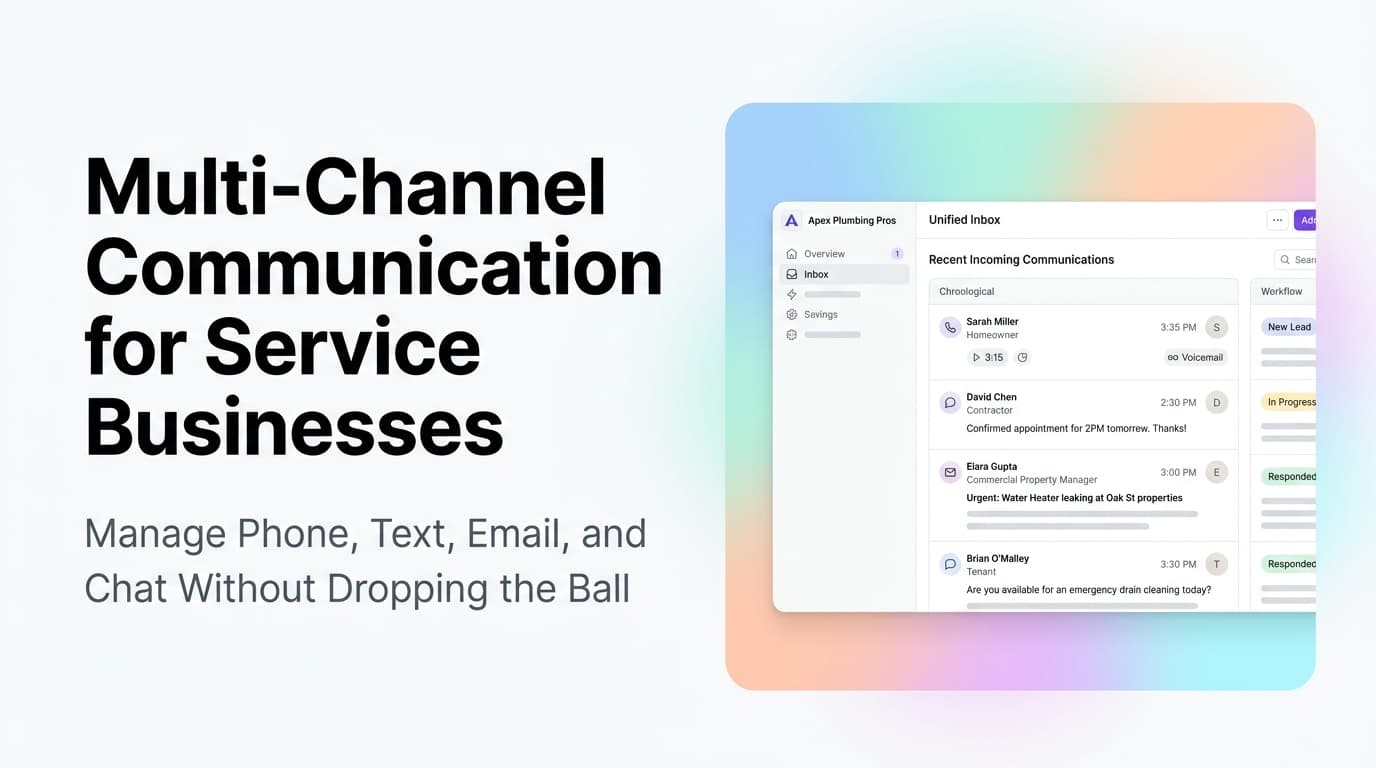
Multi-Channel Communication for Service Businesses: Manage Phone, Text, Email, and Chat Without Dropping the Ball
Service businesses juggle phone calls, texts, emails, and web chat every day. Here is how to unify them into one system that never drops a lead.
Read the article: Multi-Channel Communication for Service Businesses: Manage Phone, Text, Email, and Chat Without Dropping the Ball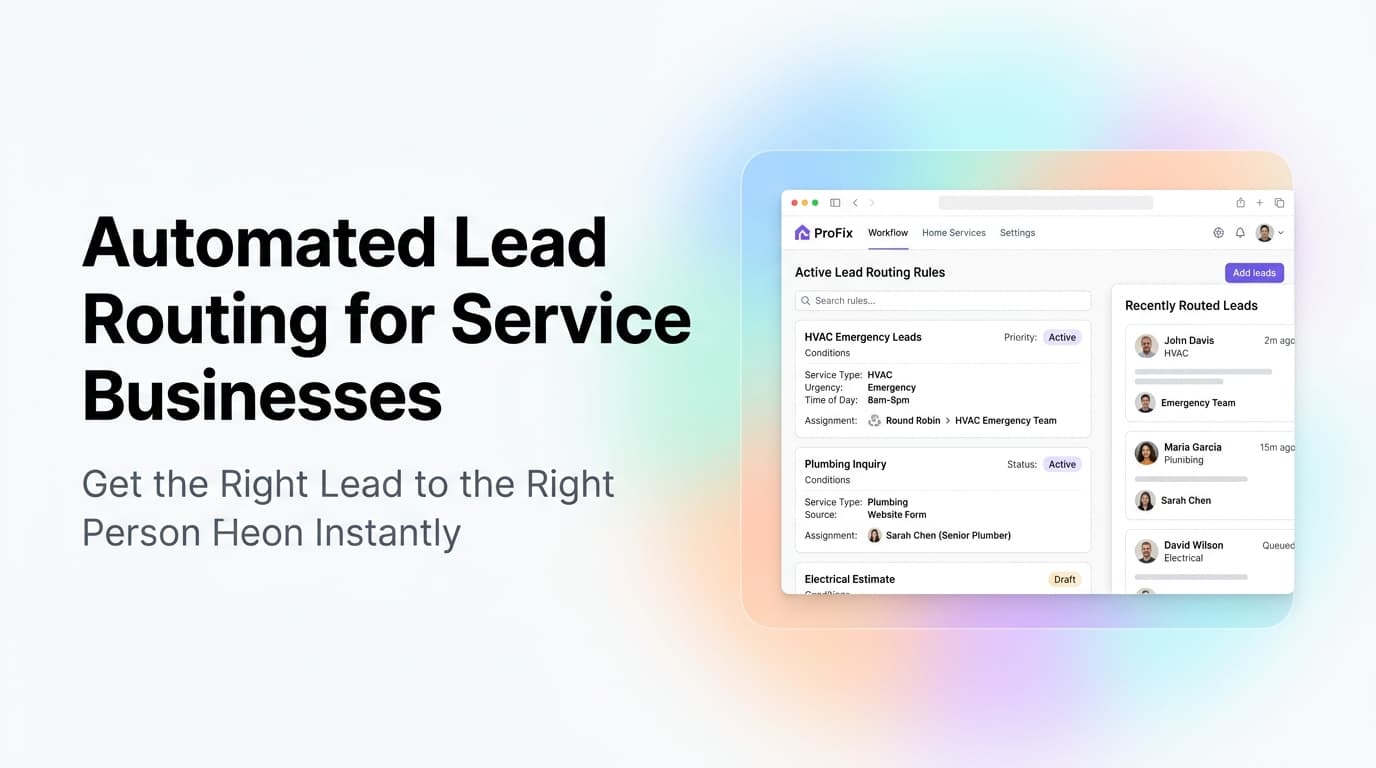
Automated Lead Routing and Assignment for Service Businesses: Get the Right Lead to the Right Person Instantly
Service businesses lose 30-50% of leads to poor routing. Automated lead assignment gets the right lead to the right person instantly.
Read the article: Automated Lead Routing and Assignment for Service Businesses: Get the Right Lead to the Right Person Instantly
