Quick Answer
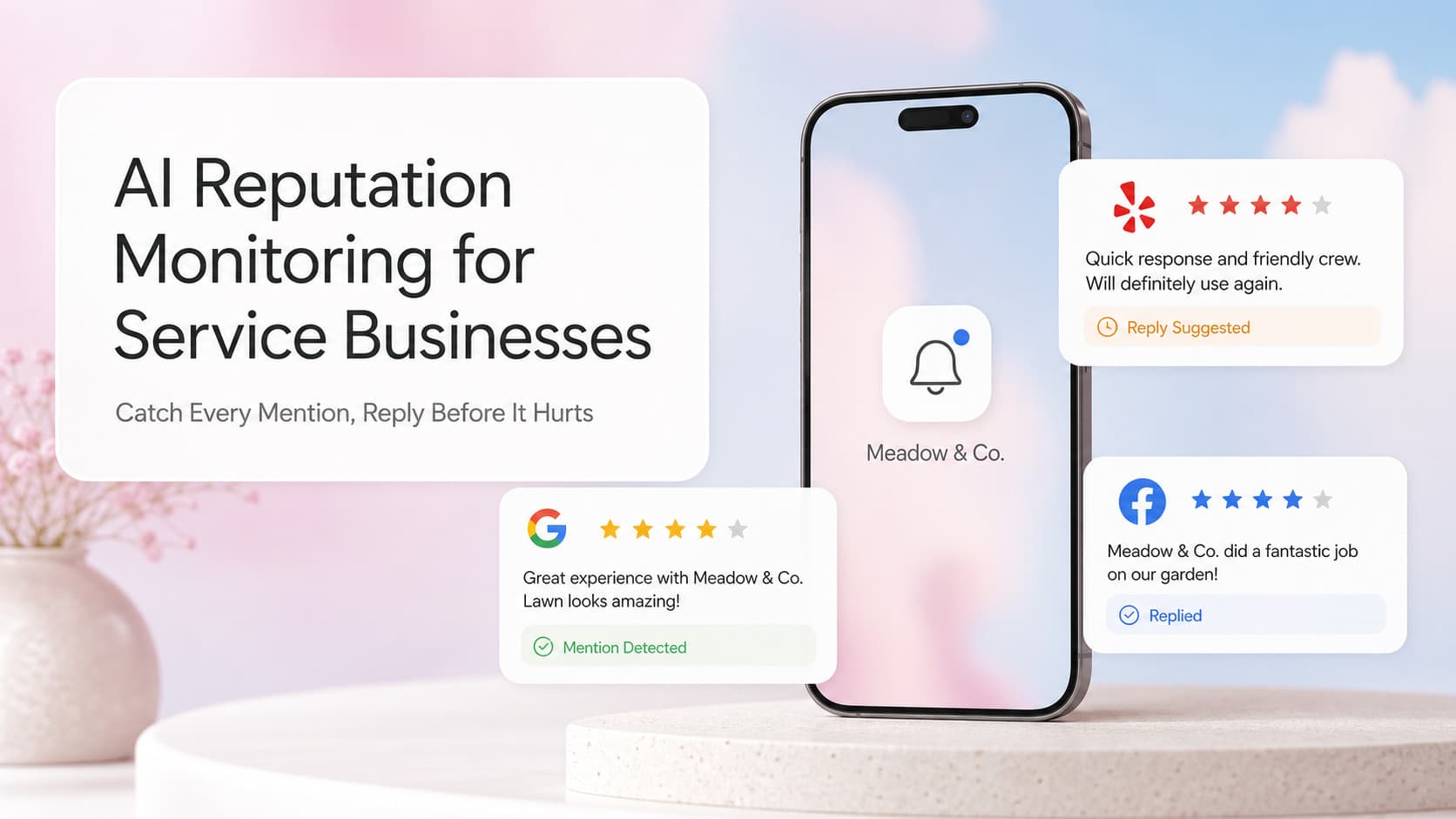
AI reputation monitoring is a system that watches Google, Yelp, Facebook, Nextdoor, and industry directories for every new review, social mention, and star rating tied to your business, then routes each one into a single inbox where AI drafts an on-brand response for your approval. Service businesses that respond to every review within 24 hours earn roughly 0.3 to 0.7 extra stars on average and convert 35% more leads from local search. The setup usually takes two to three weeks and pays for itself the first time a negative review gets a thoughtful reply before going viral in a local Facebook group.
The Slow Reply Problem Most Service Businesses Do Not Realize They Have
A homeowner in Atlanta searches "plumber near me" on a Tuesday morning. Three companies show up in the map pack. One has 4.8 stars with 312 reviews. Another has 4.2 stars with 84 reviews. The third has 4.6 stars with 41 reviews, but the most recent review is from 11 days ago and the owner replied with one line: "Thanks."
That third company is leaving leads on the table every single day. Not because the work is bad, but because the response pattern signals neglect.
Three numbers explain why:
- Roughly 88% of consumers read local business responses to reviews before making a purchase decision, according to public consumer survey data from review platforms.
- Review responses are weighted as a freshness signal by local search algorithms, which means unanswered reviews slowly drag down your map pack ranking even if your star count stays the same.
- A 1-star unreplied review can cost a service business 30 or more future customers, because the public silence reads as a confirmed complaint.
The problem is not that owners do not care. The problem is that reviews land on five different platforms, the team is on a job site, and by the time someone checks, the 24-hour window is gone.
What AI Reputation Monitoring Actually Does
A reputation monitoring stack is not one tool. It is a four-part workflow that ties reviews, mentions, response drafts, and reporting into one loop.
| Layer | What it does | Typical tools |
|---|---|---|
| Monitor | Pulls every new review and brand mention from Google, Yelp, Facebook, Nextdoor, BBB, and industry sites | ReviewTrackers, Podium, Birdeye, BrightLocal, custom Make.com flow |
| Route | Sends each mention to a shared inbox, tagged by star rating, location, and source | Gmail, Front, Help Scout, Slack channel |
| Draft | Generates a response using AI trained on your tone, services, and approved replies | GPT-class model with a structured prompt and style guide |
| Approve | Sends the draft to the owner or office manager for one-click approval | Slack reaction, Gmail reply, Front workflow |
When this works, a plumber running a 4-truck shop gets a single Slack ping every morning with three drafts waiting for approval. Total time to clear the inbox is five minutes. Before this, the same reviews sat for two weeks.
How the AI Response Draft Is Built
The AI does not invent the response. It is given a structured prompt that includes:
- The full review text, star rating, and any photos attached
- Your business name, service area, and the technician who completed the job
- A library of approved phrases and policies (refund rules, warranty terms, contact channels)
- A tone guide (warm, direct, no jargon, signed by the owner or office manager)
- A rule set for what the AI must never do (never admit legal liability, never offer discounts above a threshold, never promise a timeline without internal data)
The model returns a response with three sections: a thank-you, a specific acknowledgment of the work mentioned, and a next step. The reviewer reads it, edits if needed, and posts. Most replies need fewer than 10 seconds of editing.
What the Output Looks Like
Review (Google, 5 stars): "Mike and his team replaced our water heater the same morning we called. Clean work, fair price, walked us through the warranty paperwork. Already recommended them to two neighbors."
Drafted reply: "Thanks for trusting us with the water heater replacement, Sarah. Mike takes a lot of pride in clean installs and walking customers through the warranty terms, so I will pass this along. If anything comes up in the next 30 days, our office number is below, and you can always reach me directly."
The drafted reply references the technician by name, mentions the specific service, and offers a real next step. It does not sound like a template because the prompt is shaped by your voice and your policies.
What to Automate vs What to Keep Human
Not every review should get the same treatment. The right split looks like this:
Fully automate the draft, approve in one click:
- 4 and 5 star reviews with no specific complaint
- Routine thank-you responses
- Reviews that reference common services by name
- "Glad we could help" replies on recurring maintenance jobs
AI drafts, human reviews carefully:
- 3 star reviews with constructive criticism
- Reviews that mention a specific technician by name (loop that tech in before posting)
- Mentions of pricing, timeline, or warranty terms
- Anything that could be quoted out of context
Always human, AI just routes:
- 1 and 2 star reviews with accusations of damage, negligence, or fraud
- Reviews that threaten legal action or mention an attorney
- Posts that reference a specific employee dispute
- Anything flagged by the AI as outside policy
This split is the difference between a reputation system that protects you and one that creates new liability. The AI handles the volume. The human handles the risk.
Proof It Works: A Southeast HVAC Operator
A Rome, GA HVAC company with three trucks was getting reviews on Google, Facebook, and Nextdoor, but the owner was checking each platform once a week and missing most of them. Two negative reviews sat unreplied for 18 days, and a third customer posted a complaint in a local Facebook group that got 47 comments.
We built a monitoring flow that pulled every new review and Facebook mention into a single Slack channel. AI drafted replies for everything except the negative posts. The owner reviewed drafts in the morning, edited two, and posted the rest in under six minutes.
In the first 90 days:
- Average response time across all platforms dropped from 14 days to 9 hours
- The business replied to every 1 and 2 star review, and two of the four turned into 5-star updates after the office called the customer
- Google star count moved from 4.3 to 4.6 because three unresolved complaints were answered in a way that invited the customer back
- Map pack ranking for "HVAC Rome GA" improved from position 5 to position 2 within 60 days
The system is not fancy. It is a Make.com flow, a Slack channel, and a GPT prompt tuned to the owner's tone. Total monthly cost is under $90.
How This Stacks Against the Other Reviews Content
This post covers the second half of reputation: catching every mention and replying well. If you have not built the request side yet, Review Request Automation for Service Businesses covers the half that fills the funnel with new reviews in the first place. The two systems share a workflow layer, and the smartest setup wires them together so a customer complaint that lands in private feedback loops back into the response queue.
If your reviews are landing but your map pack ranking is flat, the problem is usually the GBP itself, not the review count. Google Business Profile Optimization for Service Businesses covers the foundational setup that has to be right before monitoring moves the needle.
For teams that want to push response quality further, AI Phone Answering for Service Businesses shows how to capture the call that often precedes a bad review, so the negative never reaches a public platform in the first place.
Related Questions and Subtopics
- How fast should a service business reply to a negative review? Within 24 hours, ideally within 4. Public silence is read as a confirmed complaint.
- Can AI-generated review responses violate FTC or platform rules? Only if they are posted without disclosure that they are AI-written, or if they contain false claims. Keep a human in the loop on every reply.
- What is the best monitoring tool for a 1-3 location service business? Podium or Birdeye for shops that want turnkey; Make.com plus the Google Business Profile API for teams that want to own the data.
- How do you respond to a fake or malicious review? Flag it in the platform first, then post a calm factual reply. Do not argue, do not call out the customer, do not threaten legal action in public.
- Should responses be different on Google vs Yelp vs Facebook? Yes. Google responses weigh more for local SEO. Yelp discourages owners from soliciting reviews, so the response tone there should be more reserved.
- How does AI reputation monitoring connect to the rest of the CRM? Most setups route the review into the same CRM record as the customer, so the office manager sees the service history and the latest sentiment in one place.
AnovaGrowth Operating Insight
We do not push reputation monitoring as a standalone project. We wire it into the same workflow layer that handles lead capture, job completion, and review requests. The reason is simple: every review is also a customer record, and treating it as part of the CRM is what separates a reputation system from a reputation dashboard. The owners who get the most out of this are the ones who stop thinking of reviews as a marketing function and start treating them as a service recovery loop.
Key Takeaways
- AI reputation monitoring catches every mention across Google, Yelp, Facebook, and Nextdoor in one inbox
- AI drafts responses tuned to your tone, but a human approves every post before it goes live
- 1 and 2 star reviews always need a human review, not just an AI draft
- Average response time under 24 hours is the line that separates a working reputation system from a slow one
- Wire reputation monitoring into the same CRM as your leads and jobs, not a separate marketing tool
- The cheapest version of this is Make.com plus Slack plus a structured GPT prompt, under $100 per month
Next Steps
Start by listing every platform where a customer can leave a public review tied to your business. Most service businesses miss at least two. Then set up a single inbox or Slack channel where new reviews land. Once you can see them all in one place, the response workflow becomes obvious.
If you want help wiring the monitoring flow, training the AI on your tone, and connecting it to your CRM, contact us for a 30-minute reputation audit. We will map your current review footprint, identify the platforms you are missing, and outline the fastest path to a one-click response workflow.
Want a full reputation audit? Contact us and we will review your current review footprint across every platform, identify what you are missing, and outline the fastest path to consistent replies.