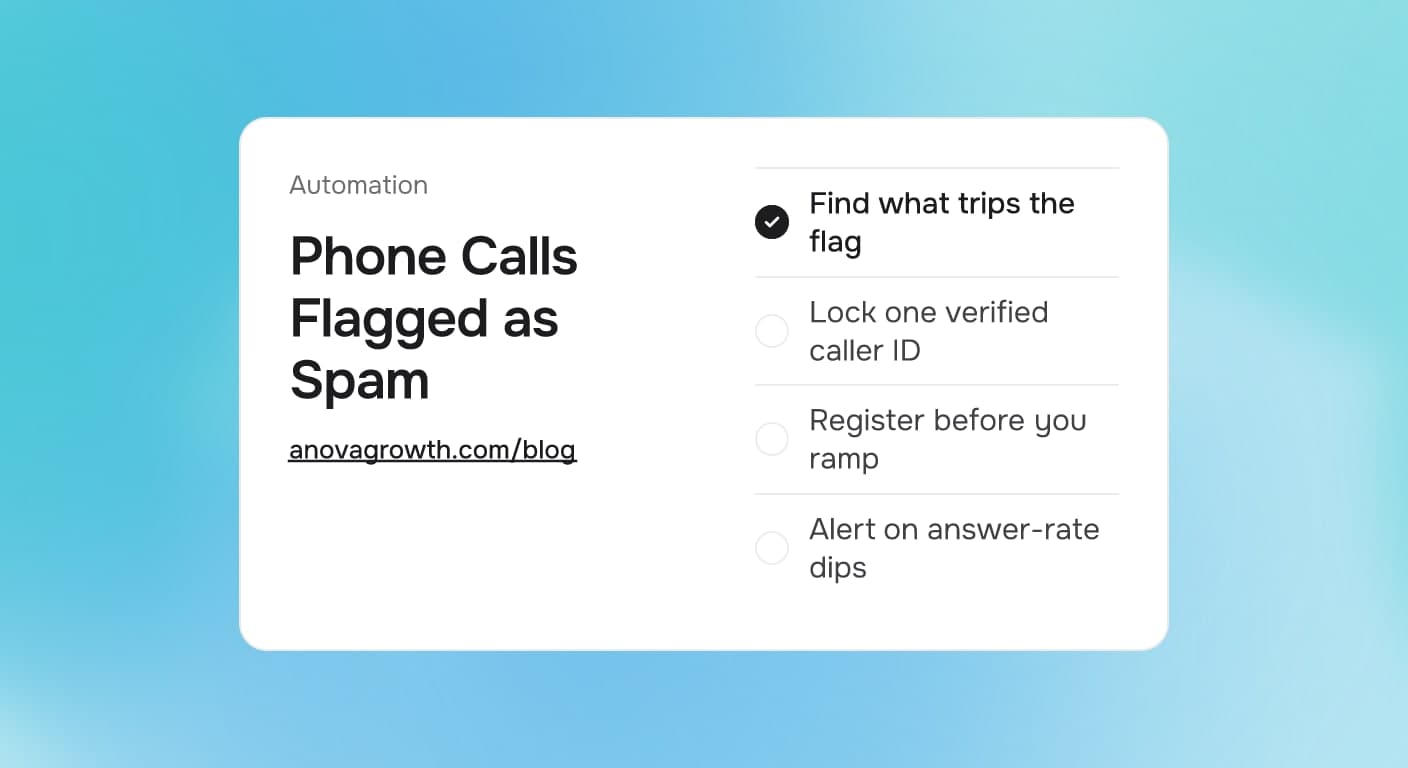
Phone Calls Flagged as Spam: How Service Businesses Fix Caller ID Reputation
Carriers can show your number as Spam Likely before anyone answers. Learn what triggers flags, how to fix caller ID reputation, and what to watch weekly.

The Quick Answer
When your team's calls show up as Spam Likely, the problem is reputation, and your phone system rarely caused it. Carriers score every call you place, and weak signals turn a working number into a rejected one. Find the signal that tripped the flag, verify one caller ID, register the number, ramp volume gently, and watch connect rates every week. Most of the fix costs nothing.
Why Good Numbers Get Flagged as Spam
Every outbound call passes through scoring systems your customers never see. Wireless carriers run or subscribe to analytics engines that judge a number's calling history: how many calls it places, how long people stay on, and whether the caller ID matches what your provider registered. When those signals resemble the patterns scammers produce, the receiving phone shows a label instead of your business name.
Two systems sit behind a label, and they fix differently:
- Call signing. US carriers follow STIR/SHAKEN, the framework that signs each call to confirm the number belongs to the caller. This layer answers one question: does your provider vouch for your identity?
- Reputation scoring. Separate analytics engines watch calling patterns and user reports to judge a number's behavior. This layer answers a different question: does this behavior look trustworthy?
A correctly signed call can still carry a bad reputation score. The engines track signals such as:
- Call blasts, meaning hundreds of outbound calls from one line inside a short window
- Short conversations, quick hang-ups, and unanswered dials
- Customer reports, since people can flag a call as spam with one button press
- Recycled numbers, where you inherit the calling history of whoever owned the number before you
- Mismatched identity, where the caller ID name or city disagrees with your registered data
- Patterns that resemble spoofing, like digits that rotate across area codes
None of these signals care what you say during the call. That is why a legitimate shop can carry a label for weeks without knowing, and why the fix starts with how calls are placed rather than with the script.
What Phone Calls Flagged as Spam Do to a Service Business
Service businesses live on answered calls: dispatch confirmations, quote follow-ups, appointment reminders, and reactivation calls. When a label appears, fewer people pick up, and every refused call costs a slot on the schedule. The call still counts inside your phone system, so the dashboard can look normal while customers quietly screen you out.
What this looks like in practice: say your estimator calls 40 quotes a week and your office places its own batch of morning confirmations. A promotion week pushes both batches through a single line during the same afternoons. That volume from one number resembles the pattern scoring engines punish, and a label lands on your main line within days. Nothing about your work changed. The number's reputation did, along with how many customers answer and confirm.
The damage compounds quietly. A customer who screens the quote follow-up call keeps shopping your competitors. A reminder nobody hears turns into a no-show. A reactivation call that never connects is work that stays out of your pipeline. Meanwhile the team blames weak leads or an unlucky month, because nobody tracks answer rates per line.
The Decision: Monitor, Repair, or Rebuild
| What you see | What it means | The move |
|---|---|---|
| One label on one line, the rest clean | A single number caught a reputation problem | Test calls, verify identity, request a re-evaluation, keep volume steady while it clears |
| Labels right after a call-heavy week | The calling pattern tripped the scoring | Stagger the volume, cap calls per line per day, spread campaigns across the week |
| A new number labeled within days | It carried bad history before you owned it | Slow ramp with one consistent caller ID, and replace it if the label holds |
| Caller ID shows the wrong name or city | Identity data disagrees with your registration | Publish and verify the caller ID with your provider, matching your public listings |
| Connect rates slide while volume holds | The label is spreading between carriers | Fresh test calls, provider escalation, and a text-back fallback for anything missed |
Repair beats replacement in most cases, because a mature number with clean history is an asset that takes months to rebuild. Replacement makes sense once a label has survived verification, registration, and a careful ramp, or when you bought the flag along with the number.
How to Fix Caller ID Reputation Step by Step
- Document the damage. Place test calls to phones you control on several carriers, and note each label exactly as it appears. Log the labels and your current connect rate per line, so you can prove later that anything you did actually moved the number.
- Lock one identity. Call out from one published caller ID name and number that match your website footer, email signature, and Google Business Profile. Rotating digits or mismatched names teach the scoring engines to distrust everything you send.
- Register your numbers. Phone platforms differ in how they hand caller ID data to the carrier registries. Ask yours which registration steps it supports, then finish them for every line your team calls from, including the estimator's mobile if it routes through your system.
- Ramp before you blast. Give a new or repaired line a few weeks of steady, modest volume before any campaign day. A clean number that suddenly calls hundreds of strangers looks exactly like the thing these engines exist to catch.
- Watch two numbers every week. Track connect rate per line and the share of conversations that end in seconds. When either moves without a cause you chose, place fresh test calls before the schedule fills with screened calls.
- Set a text-back fallback. An automated text after an unanswered call gives the customer a way back, and it keeps bookings moving while you work a label. Our guide to missed-call text-back covers how to run it.
What We Do in Our Own Shop
Our outbound volume is modest compared to a shop running full campaigns, but we treat call deliverability the way we treat email deliverability: as a reputation that carries a monitoring habit. Quote follow-ups and confirmations spread across the week instead of stacking on one line. Test calls to our own devices go out at the start of any push, so someone on our side sees a label before a customer does. Connect rates sit next to our other weekly numbers, and a dip gets an owner instead of an excuse. None of this requires a paid tool, and none of it works by accident.
Common Fan-Out Questions
Is this the same problem as email landing in spam?
Related, but a different system. Email deliverability is built from domain records such as SPF and DMARC plus sending habits, while call deliverability is built from number identity and calling patterns. If you cleaned up one, the other runs on the same logic: verified identity, steady volume, close monitoring. Our email deliverability guide walks through the email side in detail.
Does a new phone system or answering service fix it?
A better platform gives you per-line settings, caller ID control, and the analytics to see trouble early, and those tools matter. Labels follow the number and the pattern, though, so moving a flagged number to a new provider usually carries the label along. Upgrade the system for features, then do the identity and registration work on top. Our cloud phone system guide covers how to choose one.
How long does a cleanup take?
Setup steps finish in days: verifying the caller ID, completing registration, and setting up monitoring. The reputation rebuild is the slower half, because scoring engines need weeks of clean, steady activity to revise a judgment. Set expectations with your team in weeks rather than days, and measure progress with test calls rather than guesses.
Should we keep buying fresh numbers instead?
No. Rapid rotation looks like spoofing behavior, burns through each new number faster, and throws away whatever trust earlier lines earned. One or two stable, verified lines beat a drawer of disposable ones. Add a number only when call volume genuinely requires it, then ramp it the same careful way.
How do we catch the next label early?
Monitor connect rates per line every week, place test calls before any campaign, and alert on answer-rate dips so a flag surfaces as a trend instead of a slow month. A text fallback keeps bookings moving during the gap. Multi-channel outreach also protects you, because no single channel should carry the whole pipeline.
Key Takeaways
- Spam labels come from carrier scoring, and they attach to numbers and calling patterns, not to intentions.
- Call blasts, short conversations, customer reports, recycled numbers, and mismatched caller ID are the triggers you control most.
- Verify one caller ID, register every line your team calls from, and match that identity across your public listings.
- Ramp gently and review connect rates per line weekly, so a label appears as a trend instead of a crisis.
- Keep an automated text fallback per line, so missed calls still turn into booked work while any label clears.
Next Steps
If connect rates on any line slid this quarter, start with the test calls and identity check this week. The whole pass runs from one phone platform session and a spreadsheet. We build call flows, text-back automations, and weekly monitoring as part of our AI automation work. Talk to us about your call process, and bring your current connect rates to the first conversation.
Related articles

Hurricane Isaias Gulf Coast Business Recovery: Build Resilient Workflows
Hurricane Isaias exposed fragile Gulf Coast operations. Build recovery workflows that keep customers informed, requests routed, and bookings moving.
Read the article: Hurricane Isaias Gulf Coast Business Recovery: Build Resilient Workflows
Automated Service Business Tax Prep Workflow: Close Your Books Faster Every Quarter
Most service businesses spend two weeks doing tax prep manually. Here is how to automate the monthly close so quarter-end takes hours instead of days.
Read the article: Automated Service Business Tax Prep Workflow: Close Your Books Faster Every Quarter
Quote-to-Close Automation for Service Businesses: Close More Jobs Without the Follow-Up Marathon
Service businesses lose jobs in the gap between sending a quote and getting a yes. Automate your quote-to-close pipeline and stop leaving revenue on the table.
Read the article: Quote-to-Close Automation for Service Businesses: Close More Jobs Without the Follow-Up Marathon
