Trip Charges and Minimum Service Call Fees for Service Businesses
Set a trip charge or minimum service call fee without losing jobs. Compare waiver rules, credit-back policies, and how to tell customers about the fee.

The Quick Answer
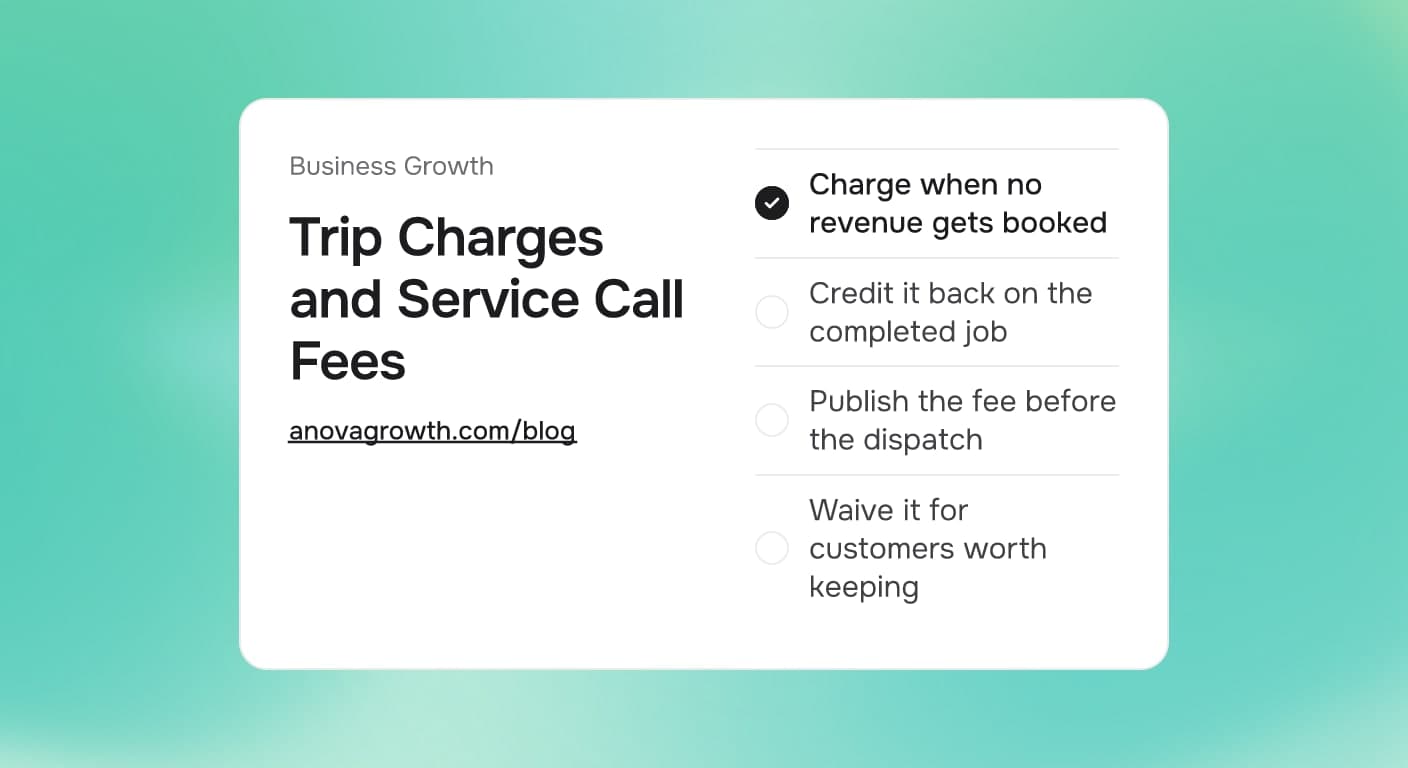
Charge a trip charge or a minimum service call fee whenever a truck rolls and no revenue is certain. Publish the amount before the visit, credit it back on the completed job, and waive it only as a deliberate choice for customers you want to keep. A stated fee turns wasted drives into paid dispatches and keeps tire-kickers from spending your best technician's morning.
Why a Free Drive Costs More Than It Looks
A trip is the cheapest-looking expense in a service business, which is exactly why it goes unmanaged. The call comes in, the caller will not commit to anything on the phone, and the dispatcher sends a tech anyway. Forty minutes later the tech is standing in a driveway with a customer who wanted a number, not a visit. Nothing gets signed, and the two paying jobs behind it slide to tomorrow.
Count what that visit actually cost: fuel, vehicle wear, and an hour or more of your most expensive field labor. If that happens a few times a week, you are funding a small part-time payroll for people who were never going to buy. The hidden cost is worse. Every wasted drive pushes a real job back, and pushed jobs create the rushed work that turns into callbacks.
The trip fee's real job is not revenue. It is commitment. A caller who pays to reserve the visit shows up, answers the door, and treats the estimate like an appointment. A caller who will not commit twenty minutes of their own schedule for one was telling you something already.
The Decision: Charge, Credit Back, or Waive
| Your situation | Policy | Why it works |
|---|---|---|
| Estimate visit, caller will not commit to a budget or scope | Charge a trip fee, credit it back if the job books | The fee filters shoppers and the credit keeps it fair |
| Repair or service call already booked with agreed scope | No separate fee, state a minimum job price instead | A second fee on committed work reads as a gotcha |
| After-hours or weekend dispatch | Charge, and publish the after-hours rate | Covers overtime and self-filters emergencies from inconveniences |
| Warranty or callback on your own work | Never charge | A callback is your defect, not the customer's errand |
| Service agreement holders and steady commercial accounts | Waive | The contract already pays for the drive many times over |
The throughline: charge when the visit might not become revenue, and build the fee into the job when it already is.
What the Fee Should Be
Anchor the amount to the cost of the visit, not to what the market will bear. The honest calculation is round-trip drive time at your loaded technician rate, plus fuel, rounded to a figure a dispatcher can say without flinching. Two common shapes work: a flat trip fee for estimate visits, or a diagnostic fee on repair calls that becomes a credit toward the fix.
Example: the math on a wasted visit, in illustration form
If your fully loaded tech rate is $70 an hour and a failed estimate round trip eats 90 minutes, the drive costs about $105 before fuel. A trip fee near that number, credited back on the booked job, means each visit either converts or pays for itself. These numbers are illustrative, so anchor yours to your own rate card instead of copying them.
One warning from watching owners set this: a fee sized to be intimidating backfires. The goal is to recover a wasted drive, not to make estimate bookings rare. If your booked-estimate rate drops after you announce the fee, the number is wrong, and it is wrong in the direction that starves next month's pipeline.
Who Gets the Waiver
A waiver policy written down is a loyalty tool. A waiver decided moment to moment is a discount your office staff hands out under pressure. Same dollars, opposite outcomes.
The waiver list is short and specific: customers on service agreements, commercial accounts that produce repeat work, and warranty callbacks you would never charge anyway. Everyone else gets the standard rule. If a manager wants to waive for a strategic reason, that is fine, but it should be recorded with a reason so the pattern can be reviewed each quarter.
Avoid the reverse mistake too. Owners who waive for everyone to be nice end up training their best customers to expect free visits while funding the worst ones. Pick the list, publish it internally, hold the line.
How to Say It So the Job Still Books
The sentence that works states the fee and the credit in the same breath: "There is a service call fee for the visit, and if you go ahead with the repair, that fee comes off the final invoice." The customer hears a fair rule, not a toll booth. The dispatcher never has to apologize because the frame is built in: the fee is real if they walk, and free if they proceed.
Put the same language where leads find you before the call. Your website should publish the policy next to your prices, since a fee that surprises people at booking reads as a bait and switch even when the credit is generous. For the mechanics of that, see our guide on publishing prices on your website.
Trip Charge vs Deposit vs Diagnostic Fee
Three tools, three moments, and owners who conflate them create confusion at exactly the wrong second.
- A trip charge pays for the drive and applies before any work is discussed, typically on estimate visits.
- A deposit pays for the work itself and applies after scope is agreed, before the truck rolls. We break down the mechanics in collecting deposits before the truck rolls.
- A diagnostic fee pays for expertise on repair calls and converts to a credit when the customer approves the fix.
If your process needs all three, sequence them by process stage: fee to book the visit, deposit to book the work, diagnostic at the truck. If stacking all three sounds heavy for your trade, the simple version that most small shops use is a diagnostic fee on repairs and a trip fee on estimates, with deposits only on jobs over your comfort line.
The Failure Modes to Watch
- The fee exists but nobody states it. Put it in the booking script and the confirmation text, then automate the confirmation so it never depends on a busy dispatcher remembering. Our appointment reminder and no-show recovery workflows handle this step.
- The fee is collected and the credit never applied. Map the credit step into your booking-to-invoice flow the day you launch the fee. If that mapping lives in someone's head, customers will get double-charged and the policy dies. The wiring belongs in your CRM, the way we describe in our lead-to-cash CRM integration guide.
- The amount never gets reviewed. Gas, wages, and traffic patterns move, so put a quarterly check on the calendar next to your pricing review.
How We Run This Rule at AnovaGrowth
We hold our own pipeline to the same standard. Instead of free "come tell us about your project" meetings that turn into unpaid scoping, our first commitment from a prospect is a paid, scoped discovery session, and the fee is credited against the project cost when work proceeds. Before that rule, our calendar filled with conversations that were really free consulting with a friendly opening. After it, the calls that survived had real intent, and the discovery session became the first deliverable a client ever receives from us instead of the last favor. Same principle as the trip charge: commitment is information, and the credit-back keeps it fair.
Key Takeaways
- Charge a trip fee when the visit might not become revenue; build the cost into the job when it already is.
- Size the fee to recover the real cost of the visit, not to intimidate.
- Credit every fee back on the booked job, and wire that credit into your CRM the day you launch.
- Waivers are written policy for agreements and commercial accounts, and never apply to your own callbacks.
- Say the fee and the credit in one sentence, and publish both on your website.
Conclusion
You can set this policy in an afternoon: pick the amount from your rate card, write the waiver list, add one line to your booking scripts, and publish the rule next to your prices. The wasted drives stop quietly, and the fee starts doing the qualification work your dispatcher has been doing for free. If you want the fee, confirmation, and credit-back wired into your booking and CRM workflows so it runs without supervision, contact us and we will map it with you.
Ready to get started? Contact us to discuss how we can help your business.
Related articles
Flat Rate vs Hourly Pricing for Service Businesses: How to Choose and Switch
Flat rate prices the job and hourly prices the time. Learn how to choose, build a price book from real job data, and switch models without losing customers.
Read the article: Flat Rate vs Hourly Pricing for Service Businesses: How to Choose and Switch
Collecting Deposits for Service Jobs: Get Paid Before the Truck Rolls
Big jobs stall when money is uncollected. Learn when to require a deposit, how much to ask, and the booking automation that enforces it without losing jobs.
Read the article: Collecting Deposits for Service Jobs: Get Paid Before the Truck Rolls
How to Announce a Price Increase Without Losing Customers
Raising prices does not have to cost you customers. Learn the notice windows, segmentation, and automated follow-up that keep renewals steady.
Read the article: How to Announce a Price Increase Without Losing Customers
