Collecting Deposits for Service Jobs: Get Paid Before the Truck Rolls
Big jobs stall when money is uncollected. Learn when to require a deposit, how much to ask, and the booking automation that enforces it without losing jobs.

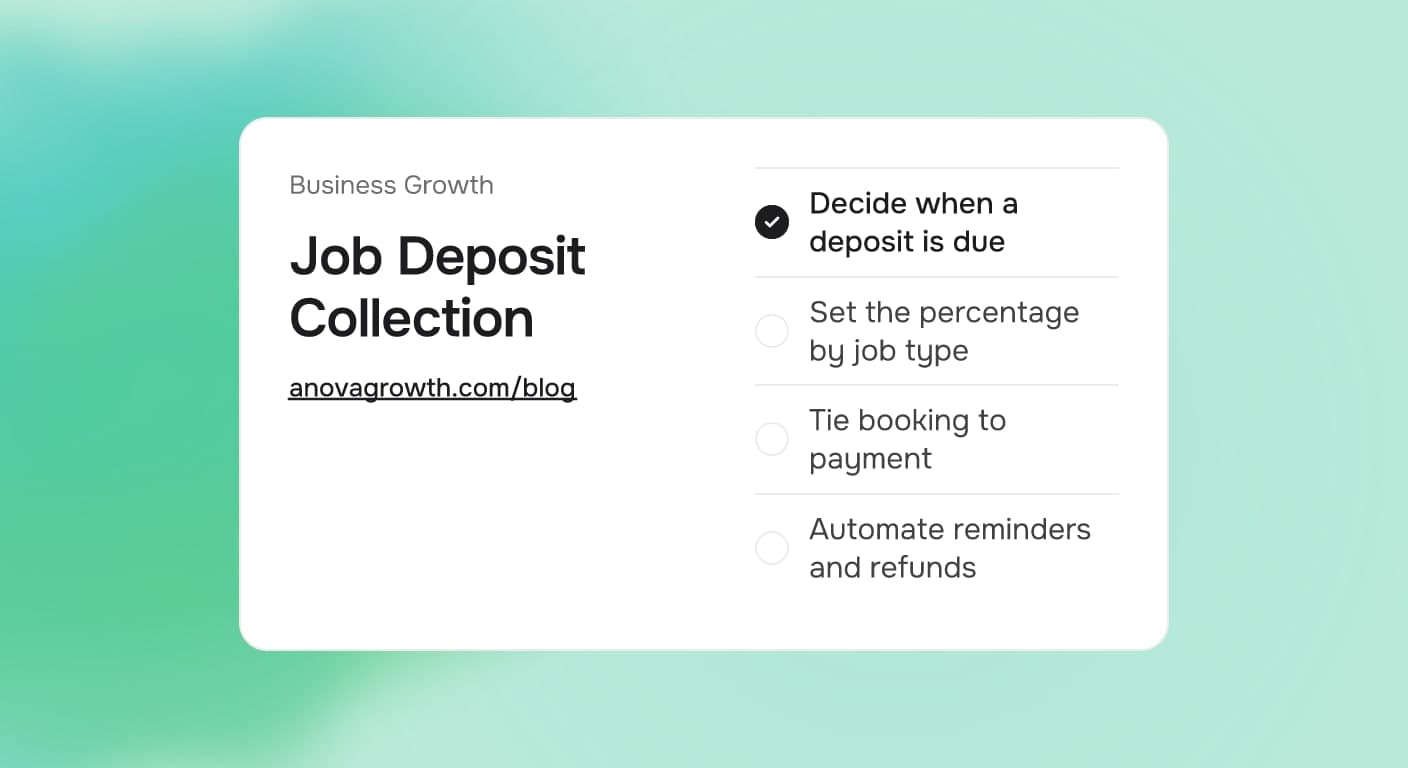
The Quick Answer
A free booking is a request, not a commitment. Requiring a deposit on the right jobs (materials-heavy work, tight scheduling windows, repeat no-show customers) converts reservations into paid commitments. Decide the rule once, attach it to your booking flow, and let automation invoice, remind, and enforce the refund policy. Your calendar holds and your crews stop driving to empty houses.
Why Unsecured Bookings Cost You Money
A booking that costs nothing to make competes with everything else in the customer's week. Free slots get forgotten, traded, or abandoned when a cheaper quote shows up, and your crew is the one that pays for it in windshield time. The office then spends the afternoon calling people who already decided not to answer.
Deposits solve this at the source. A paid slot is a decision, not a plan, and customers treat it that way: they answer follow-ups, they show up, and they reschedule properly instead of vanishing. The phone-tag work your office does today to protect the schedule is the work a payment step does once.
When a Deposit Earns Its Place
Not every job needs one. Deposits create friction, and friction on a routine two-hundred-dollar visit loses more than it protects. The table below is how we frame the decision with owners:
| Situation | What to require | Why it works |
|---|---|---|
| Special-order materials | Full materials cost upfront | You never front inventory for a maybe |
| Large installs with stock parts | 10 to 25 percent booking deposit | Covers sunk cost if the booking dies |
| Peak-season premium slots | Full slot fee, credited to the invoice | A scarce slot is real value, and the waitlist proves it |
| Repeat no-show customers | Card on file, deposit after a second miss | The track record carries the risk now |
| Long-term contract customers | No deposit, contract terms instead | Paperwork and tenure already protect you |
| Small routine jobs | Nothing | Friction costs more than exposure |
Decide the Rule Once, Not Customer by Customer
A deposit policy only functions as a rule, so write it down and apply it like one:
- Write the threshold down. Job size, material exposure, or booking channel all work as the line that triggers a deposit.
- Apply it by job type, not by mood. Customers compare notes, and inconsistent asks read as improvisation rather than policy.
- Show the policy early. Put it on the quote and the booking confirmation so nobody meets it for the first time on an invoice.
- Keep exceptions rare and owned. Only the owner grants them, only before the booking is made, never mid-argument on the phone.
How Much to Ask For
Start from the worst case. The deposit should cover what you actually lose if the customer never shows: committed materials, drive time, and the slot you could have sold twice. Cover those and you are protected. Go past that and you are simply pricing bookings out of reach.
When owners want a starting point, we default to 10 to 25 percent on standard installs, full materials cost on special orders, and flat slot fees on tight-season calendars. Your numbers should come from your own job costs, not from someone else's template, for the same reason you would not copy a competitor's price list wholesale.
Make the Deposit the Booking Gate
The mechanics matter more than the percentage. A deposit policy that lives in the owner's head fails on the first busy Monday. The flow we build looks like this:
Example flow we deploy for owners:
- The customer books online, or the office books on their behalf.
- The booking triggers an invoice or payment link within minutes, not days.
- The slot sits in a pending state, and nothing on the reminder calendar fires until the deposit lands.
- Payment confirms the booking and starts the confirmation and reminder sequence automatically.
- An unpaid slot releases on a timer, and a short recovery message gives the customer one easy way back in.
The two failure points are the gap and the release. Keep the booking-to-payment gap under a few minutes whenever the customer books themselves, because every hour in limbo is an hour to keep shopping. Make the release timer honest too: same-day handling for office bookings, about 24 hours for online ones. A slot that quietly sits half-committed forever is the worst of both worlds.
Write the Refund and Reschedule Policy Before You Automate Anything
This is the step owners skip, and it is the one that turns a good policy into a dispute. Decide three things up front:
- Refunds. Full refund inside a short window, credit toward the job after it, and state both in writing.
- Reschedules. One free reschedule with real notice is reasonable in most trades. After that, the deposit holds.
- Weather and access failures. Name them. Crews cannot pour concrete in a storm, and customers cannot leave for work in one.
Then put the policy on the payment link itself. A customer who reads it while paying has accepted it. A customer who first reads it after a dispute has not.
Handle the Pushback Without Losing the Job
Some customers ask why. The honest answer is short: we buy your materials and hold the crew's day as soon as you book, so the deposit protects both of us. That script converts better than a defensive one because it is true, and it frames the payment as service rather than suspicion.
For cash-tight customers, a refundable window or a card on file is a softer ask that still proves commitment. And when the hesitation on a big-ticket job is really about cash flow rather than trust, offering financing at the quote is the cleaner fix than shrinking the deposit. We covered that decision separately: customer financing for big jobs.
What We See Deploying This at AnovaGrowth
We build these booking and payment flows for service businesses, so a few operating notes from real deployments:
- Policy before plumbing. Every smooth rollout started with a written refund and reschedule policy. Automating an undecided policy just industrializes the ambiguity.
- Short gaps win. Flows where payment lands within minutes of booking show the least slot churn. The longer the limbo, the more re-shopping happens inside it.
- Audit after a quarter. Look at what actually cancelled or no-showed. Most owners find their rule catches the wrong half of the calendar and adjust the thresholds once.
Fan-Out Questions
Owners usually arrive at this topic with the same six questions:
When exactly should the deposit be collected? At the moment of commitment. For booked jobs, that is booking time. For estimate-driven work, that is quote approval, and the invoice fires while the yes is still warm.
Does a deposit replace reminders and confirmations? No. It raises the stakes, it does not remove the hygiene. Paid customers still get confirmations and reminders, they just generate far fewer of the expensive outcomes like same-day cancellations.
What about commercial accounts we trust? Contract terms beat deposits for those relationships. Renewal language, net terms, and service agreements already carry the protection, which is why the table above leaves those accounts alone.
Will this cost us bookings? A few, at the edge, and usually ones that were already half-gone. The calendar you keep afterward is filled with customers who paid to be on it, which is the calendar you can schedule crews against.
How do we phrase the ask without sounding like distrust? Tie it to their protection: the slot hold and the materials order. A payment framed as we are buying your parts today lands completely differently from a bare we require a deposit before we come out.
Where does the deposit fit with the final invoice? It is the first payment, not a separate sale. Issue the final invoice with the deposit already applied, so the customer sees one clear balance instead of a mystery subtraction.
Deposits Sit First in Your Money Timeline
A deposit is the opening move in a payment chain that runs from quote to final balance, and the other links matter just as much. Quote follow-up automation keeps approvals moving in the first place, appointment confirmations protect the slot after it is paid, and closeout collections capture the balance the deposit could not. A deposit policy bolted onto a leaky follow-up flow only half-works.
Conclusion
Deposits are not about distrust, they are about proof. Decide the rule, make payment part of booking, write the refund policy first, and let software carry the reminders and the releases. You end up with a calendar that reflects real demand and crews whose drive time is spent on jobs with money behind them.
Ready to put deposits, booking, and payment on autopilot? Contact us to discuss how we can help your business.
Related articles
How to Announce a Price Increase Without Losing Customers
Raising prices does not have to cost you customers. Learn the notice windows, segmentation, and automated follow-up that keep renewals steady.
Read the article: How to Announce a Price Increase Without Losing Customers
Tampa Bay Digital Infrastructure: Build Workflows Before Growth
Tampa Bay is planning for digital infrastructure and maritime growth. Local businesses can prepare by connecting the workflows behind every customer.
Read the article: Tampa Bay Digital Infrastructure: Build Workflows Before Growth
Service Business Weekly Operations Meeting: The 30-Minute Cadence That Keeps a Small Service Company on Track
A 30-minute weekly ops meeting turns scattered owner reactions into one predictable cadence. Most service companies under 50 people can run it themselves.
Read the article: Service Business Weekly Operations Meeting: The 30-Minute Cadence That Keeps a Small Service Company on Track
