Quick answer: SMS marketing compliance for service businesses comes down to three things: collect express written consent before any marketing text, store the consent record so it can be produced on demand, and honor opt-out requests the moment a customer replies STOP. Most service businesses violate these rules without knowing it because their intake forms, CRM records, and SMS platforms are not wired together. Fix intake, fix the storage, fix the opt-out handling, and the exposure drops to near zero.
Why SMS Compliance Is the Quiet Risk in Your Service Business
Most service business owners know they need a website, a CRM, and a way to text customers. Few know that the same text messages they send every day, the appointment reminders, the quote follow-ups, the seasonal promotions, are regulated by the Telephone Consumer Protection Act in the US and similar rules in Canada and the EU.
The risk is not theoretical. Class action plaintiffs actively scan for businesses that text without documented consent. The damages per text are set by statute, multiplied by every recipient, multiplied by every text in the campaign. A single bad campaign can produce a six-figure demand letter. Many of the settlements we see in the trade press settle for amounts that would change a small service business overnight.
The risk grows with every new lead source. A lead comes in from a Google Local Services Ad. The form asks for a phone number but not for text consent. The CRM imports the lead. The SMS platform sends a welcome text. Three weeks later, the customer files a complaint that they never agreed to receive marketing texts. The service business has no record proving otherwise, because the intake form did not capture one and the CRM did not store one.
The fix is a system, not a one-time project. Three pieces have to work together: the intake form that collects consent, the CRM or consent database that stores it, and the SMS platform that respects opt-outs in real time. If any one of the three is broken, the business is exposed.
What "Consent" Actually Means Under the Rules
In the US, the Telephone Consumer Protection Act and the FCC's implementing rules require what is called prior express written consent for marketing texts to wireless numbers. Express written consent means more than a phone number on a form. It requires:
- Clear and conspicuous disclosure. The customer has to see, in plain language, that by submitting their information they agree to receive marketing text messages from your business. Burying the disclosure in a privacy policy does not count.
- Unambiguous affirmative action. A checkbox the customer has to tick, not a pre-checked box. A signature on a paper form. A clear "I agree" tap on a phone. The action has to be the customer's, and it has to be specifically about text messages.
- Identification of the seller. The consent has to be tied to a specific business or brand. A blanket "I agree to receive texts from partners" does not cover your business unless your business is named.
- Disclosure of message frequency and opt-out. The customer has to know, at the time of consent, that message frequency varies and that they can opt out at any time by replying STOP.
Transactional texts, like appointment reminders and service notifications, are generally treated differently from marketing texts. The FCC and the courts have carved out "informational" categories that do not require prior express written consent. The line between transactional and marketing is not always clear, and the safer rule for service businesses is to collect consent for both.
If you operate in Canada, the rules are run by the Canadian Radio-television and Telecommunications Commission under the Unsolicited Telecommunications Rules. Express consent is required, and the same form and storage logic applies. If you operate in the EU, GDPR rules apply on top, with stricter consent withdrawal and data subject access obligations.
The shape of the answer is the same everywhere: collect consent in a specific, affirmative, documented way. Store the record. Respect the opt-out.
The Intake Form Changes That Fix 80% of the Risk
The biggest source of non-compliance for service businesses is the intake form on the website, the booking page, or the lead source. Most forms collect a phone number and assume consent. They do not.
The fix is a four-part change to every form that captures a phone number.
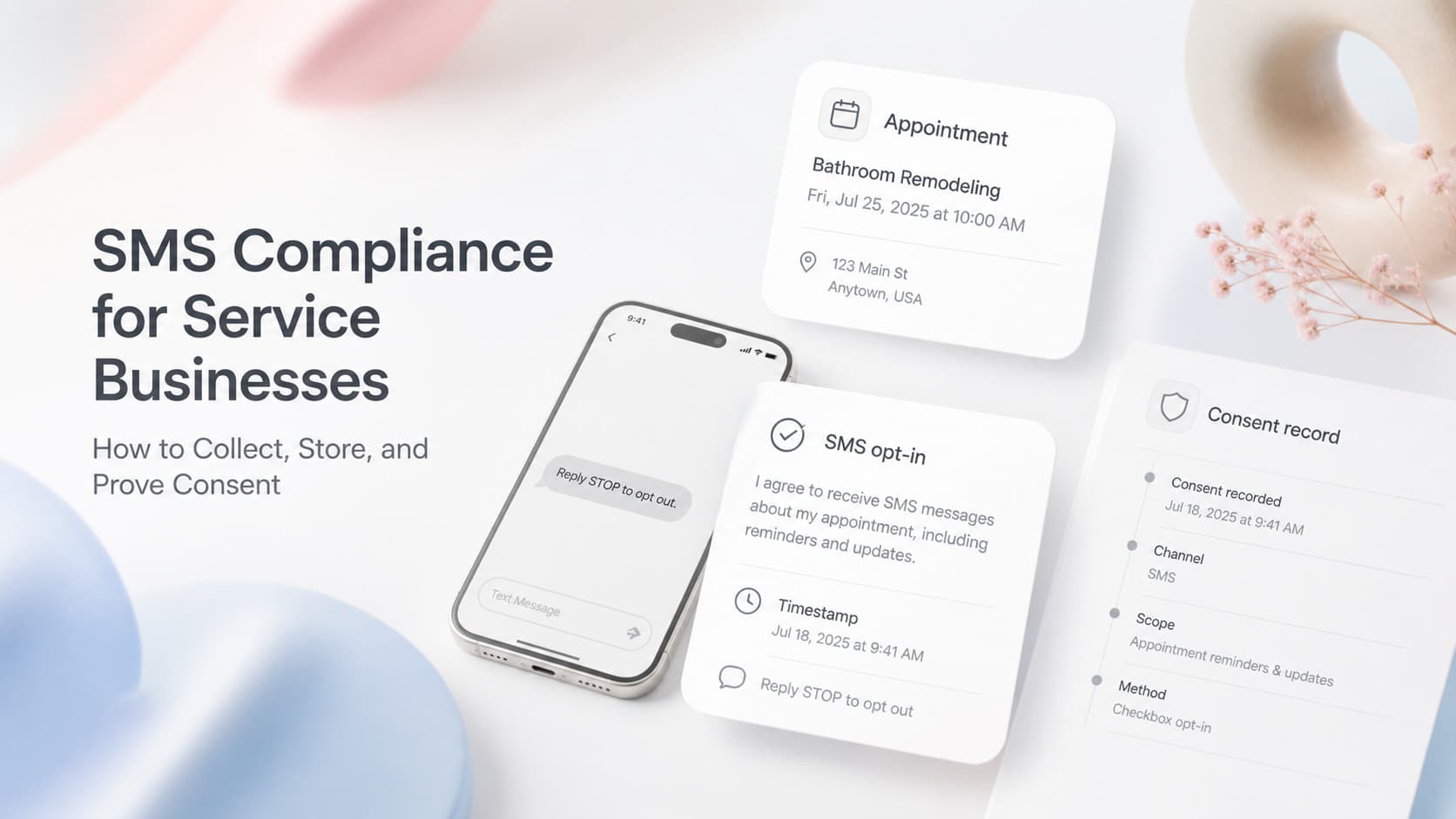
1. Add a text consent line with a checkbox. Below the phone number field, add a single line that reads something like: "I agree to receive text messages from [Your Business Name] about my appointment, quotes, and service updates. Message frequency varies. Reply STOP to opt out. Message and data rates may apply." Then a checkbox the customer must tick. The checkbox must be unchecked by default.
2. Capture the consent metadata. When the form submits, store four additional fields alongside the phone number: the exact consent language shown to the customer, the timestamp of the submission, the IP address of the submission, and the user agent. These are the four pieces you need to defend the consent record in a dispute.
3. Link the consent to a specific campaign or source. Tag every consent record with where it came from: the Google ad, the referral partner, the website form, the phone call. If a class action targets a specific campaign, you can pull every consent record from that campaign and prove each one independently.
4. Sync the consent record into your SMS platform and CRM in real time. The moment a form submits with consent, the SMS platform should mark the contact as opted in. The CRM should log the consent timestamp, the source, and the language shown. Manual data entry is where most consent records get lost.
For lead sources you do not control, like Google Local Services Ads or third-party aggregators, add a text consent step before you send any SMS. A short confirmation text that says "Reply YES to confirm you want text updates from [Business]" filters out leads who never agreed and creates a fresh consent record for those who do.
How to Store Consent So You Can Prove It
Consent records do not live in the SMS platform alone. The SMS platform can delete contacts, can change, or can go out of business. The consent record needs to live in a system the business controls.
The minimum viable setup looks like this:
| Data Point | Where It Lives | Why It Matters |
|---|---|---|
| Phone number | CRM as primary contact field | Unique identifier for the contact |
| Consent language shown | CRM as a custom field, exact text captured | Proves what the customer saw at consent time |
| Consent timestamp | CRM as a date field | Proves when consent was given |
| Consent source | CRM as a tag or custom field | Proves where the consent came from |
| IP address | CRM or consent database | Proves the customer was the one who submitted |
| User agent | CRM or consent database | Proves the customer was on a real device |
| Last opt-out status | SMS platform in real time, CRM as backup | Proves the customer's current opt-in state |
| Message history | SMS platform with consent flag attached | Proves what was sent and that consent existed |
For most small service businesses, this lives in two places: the CRM (for the consent record) and the SMS platform (for the opt-out state and message history). The CRM is the source of truth for the consent. The SMS platform is the source of truth for the current state and the message log.
For larger service businesses with legal exposure, a dedicated consent database or a customer data platform with consent management is worth the investment. Tools like OneTrust, TrustArc, or a custom consent table in your data warehouse give you audit-ready records and the workflows to handle data subject access requests.
The right time to set this up is before you send the first text. The second-best time is today. Every text sent without a stored consent record is exposure that grows over time.
How to Handle Opt-Out the Right Way
The third leg of compliance is honoring opt-out requests. The rules are simple: when a customer replies STOP, you stop. Not in a few hours. Not after the next campaign. Immediately. Most SMS platforms handle this automatically. The risk is the gap between the SMS platform and the rest of your systems.
The pattern that causes trouble looks like this: the customer replies STOP to your SMS platform. The SMS platform marks them as opted out in the platform. The CRM does not know. Your email platform does not know. Your call center does not know. Next week, the customer gets a marketing email. The week after, a sales call. The customer files a complaint that you kept contacting them after they opted out.
The fix is a real-time sync of opt-out state from the SMS platform to every other system that contacts the customer. Most modern CRMs and marketing platforms support this through a webhook or a Zapier-style integration. When a contact opts out in the SMS platform, the CRM contact is flagged, the email platform suppresses the contact, and any outbound calling list removes the number.
A second piece is the opt-in re-engagement flow. Some customers opt out by accident, or opt out and then want to come back. The rules allow re-engagement only with a fresh, affirmative opt-in. The right pattern is a "reply YES to opt back in" flow that creates a new consent record on the date of re-engagement. Anything older than the opt-out window, typically 30 to 90 days, should not be reused.
A third piece is the help reply. Customers reply HELP, INFO, or questions to your texts. The reply should be an automated message that includes the opt-out instructions, the business contact info, and a way to reach a human. Most SMS platforms handle HELP responses with a templated reply. Confirm the template includes your business name, your contact info, and the STOP instruction.
Operating Insight: The Three-Question Audit
Before we set up an SMS workflow for a service business, we run the same three-question audit. It takes 30 minutes and finds the compliance gaps before the first text goes out.
Question 1: Can you produce the consent record for any contact in under 60 seconds? Pick 10 random contacts in the CRM. For each, can you find the consent timestamp, the source, and the exact language the customer agreed to? If the answer is no for any of them, that contact is exposure.
Question 2: Does your opt-out flag sync everywhere? Reply STOP from a test number. Watch the SMS platform. Watch the CRM. Watch the email platform. Watch the call list. If any one of them still shows the contact as marketable, you have a leak.
Question 3: What happens when a customer replies with a question, a complaint, or a request? Most SMS platforms route STOP and HELP automatically. Anything else falls into a queue that nobody watches. That queue is where complaints sit until they become demand letters. The fix is a daily review of the inbound SMS queue and a documented path for complaints to a human within an hour.
In one plumbing client, the three-question audit found 38% of active contacts in the SMS platform had no consent record in the CRM. Every one of those contacts was marketing exposure. The fix took a week. The peace of mind has lasted three years.
The Compliance Stack for a Small Service Business
For a service business that is not ready to hire a privacy lawyer, the practical stack looks like this:
| Layer | Tool Options | Cost |
|---|---|---|
| Intake form with consent checkbox | Website form builder, CRM built-in form, dedicated consent form | $0-50/month |
| Consent storage | CRM custom fields, consent database, customer data platform | $0-200/month |
| SMS platform with opt-out automation | Twilio, SimpleTexting, TextMagic, ServiceTitan SMS | $30-200/month |
| Opt-out sync across systems | Zapier, Make, native CRM integrations | $0-100/month |
| Audit and reporting | CRM reports, manual quarterly audit | $0 in time |
Total cost: under $500 per month for most small service businesses. Total time to set up: two to four weeks for the full stack, one afternoon for the basics.
The cost of getting it wrong is dramatically higher. A single class action settlement can be more than the entire annual revenue of a small contractor. The math favors the compliant stack even if you never see a complaint.
What This Connects to Your Other Systems
SMS compliance is a layer, not a standalone project. It touches every system that talks to a customer.
If you are wiring consent into your intake forms, CRM Integration for Service Businesses covers the rest of the data flow between your tools.
If the SMS workflow is part of a broader automation program, CRM Automation Triggers for Service Businesses covers the triggers that move contacts through the customer journey on consent-respecting rails.
If the SMS platform is replacing manual reminder calls, Automated Appointment Reminders and No-Show Recovery for Service Businesses covers the operational playbook for cutting no-shows without creating compliance exposure.
If you are building the consent capture into your lead source mix, Building a Lead Generation Engine That Runs on Autopilot covers the upstream side of the lead flow.
If the audit found gaps that need a deeper clean, CRM Data Cleanup Before AI Automation covers the cleanup pass that gets the existing contact database audit-ready.
Related Questions and Subtopics
- What is prior express written consent for SMS marketing? It is a specific, affirmative agreement to receive marketing text messages, captured with clear disclosure of what the customer is signing up for, who is sending the messages, and how to opt out. Pre-checked boxes do not count.
- Do appointment reminders require SMS opt-in? Transactional texts like appointment reminders are generally treated as informational, but the rules vary by jurisdiction and the safest practice is to collect consent for both transactional and marketing texts on the same form.
- How long should I keep SMS consent records? As long as the customer remains opted in, plus a reasonable retention window after opt-out for dispute resolution. Most service businesses keep consent records for the life of the customer relationship plus three to five years.
- What happens if a customer replies STOP? Stop sending marketing texts immediately. Sync the opt-out flag to every system that contacts the customer. Keep the suppression record. Do not contact the customer again for marketing unless they complete a fresh opt-in.
- Can I text a lead who filled out a contact form without a text consent checkbox? No. A phone number on a contact form is not consent for marketing texts. The lead must specifically agree to receive text messages from your business.
- What is the penalty for texting without consent in the US? Statutory damages per text are set by federal law and multiplied by every recipient and every text in the campaign. Class actions have produced settlements in the tens of millions. The exact penalty range depends on the court and the facts.
- Does the same rule apply in Canada and the EU? Similar consent rules apply in Canada under CRTC rules and in the EU under GDPR. The mechanics differ but the principle is the same: collect specific consent, store it, respect opt-outs.
- How do I handle a customer who opted out of SMS but is still on my email list? The opt-out channel is independent. A STOP to text does not opt the customer out of email. Send a separate confirmation email offering an email unsubscribe link, and respect it on receipt.
- Can I buy a list of opted-in contacts? No. Purchased lists rarely include valid consent records, and the burden of proving consent falls on the sender, not the list vendor. Build your own consent-based list from your own lead sources.
- What is the difference between express consent and express written consent? Express consent covers most non-marketing texts. Express written consent is the higher standard required for marketing texts. The difference matters because marketing texts are the ones most often challenged in disputes.
Key Takeaways
- SMS marketing compliance comes down to three things: collect express written consent, store the consent record so it can be produced on demand, and honor opt-out requests the moment a customer replies STOP.
- Most service businesses violate the rules without knowing it because their intake forms, CRM records, and SMS platforms are not wired to capture and store consent.
- The fix is a system: the intake form collects consent with a checkbox and metadata, the CRM stores the consent record with timestamp, source, and exact language, and the SMS platform honors opt-outs in real time.
- Transactional texts like appointment reminders are treated differently from marketing texts in most jurisdictions, but the safest practice is to collect consent for both on the same form.
- Consent records should live in a system the business controls, not just inside the SMS platform. The SMS platform can change. The CRM is the source of truth.
- Opt-out state must sync in real time from the SMS platform to every other system that contacts the customer. A STOP that only updates the SMS platform is exposure.
- The three-question audit (can you produce the consent record in 60 seconds, does opt-out sync everywhere, what happens to inbound questions) catches most compliance gaps in 30 minutes.
- The minimum viable compliance stack costs under $500 per month and takes two to four weeks to set up for a small service business.
- Re-engagement of an opted-out contact requires a fresh, affirmative opt-in. Anything older than the opt-out window, typically 30 to 90 days, should not be reused.
- The cost of compliance is small. The cost of non-compliance can change a small service business overnight.
Next Steps
The fastest way to start is to pull the last 10 SMS messages you sent and try to find the consent record for each recipient in under 60 seconds. If you cannot find a record for a recipient, that contact is exposure you can reduce today by adding them to your suppression list and never texting them again until they complete a fresh opt-in.
The second step is to update your intake forms with a text consent checkbox and metadata capture. The third step is to wire the consent record into your CRM and your SMS platform so the two systems stay in sync. The fourth step is to run the three-question audit on your full contact database every quarter.
If you want help designing the intake form changes for your lead sources, wiring the consent storage into your CRM, building the opt-out sync across your SMS, email, and call systems, and standing up the quarterly audit rhythm that keeps the stack compliant as your contact list grows, contact us for a 30-minute SMS compliance review. We will audit your current intake forms, your CRM consent records, and your SMS platform opt-out handling, and outline the changes that close the gaps in your specific stack.
Ready to take the exposure off the table? Contact us and we will run the three-question audit on your SMS workflow, identify the contacts without consent records, and design the intake, storage, and opt-out sync that keeps you off the class action list.