Quick answer: Missed call text back is an automation that detects when your business line rings out or goes to voicemail, then instantly sends the caller a personalized SMS saying you saw their call and asking how you can help. For service businesses, it typically recovers 20-40% of otherwise-lost calls within the first minute, before the caller has time to dial a competitor. Setup takes a few hours and pays for itself after one recovered job.
The Phone Call You Did Not Hear
Your tech is under a sink. Your dispatcher is on the line with a supplier. The office phone rings four times, then rolls to voicemail. The caller hangs up, scrolls to the next Google result, and dials the next company on the list.
This happens 20-40 times a day at a typical 5-truck service business. Industry data consistently puts missed call rates between 20% and 40% for HVAC, plumbing, electrical, and roofing companies. Most owners assume those callers will leave a voicemail. They will not. Roughly 80% of callers who reach voicemail hang up without leaving a message.
The fix is older than smartphones and cheaper than you think: send the caller a text the moment your phone stops ringing. Done well, it turns a missed call into a booked job. Done badly, it turns into spam. The difference is timing, wording, and the follow-up sequence after the first reply.
What Missed Call Text Back Actually Does
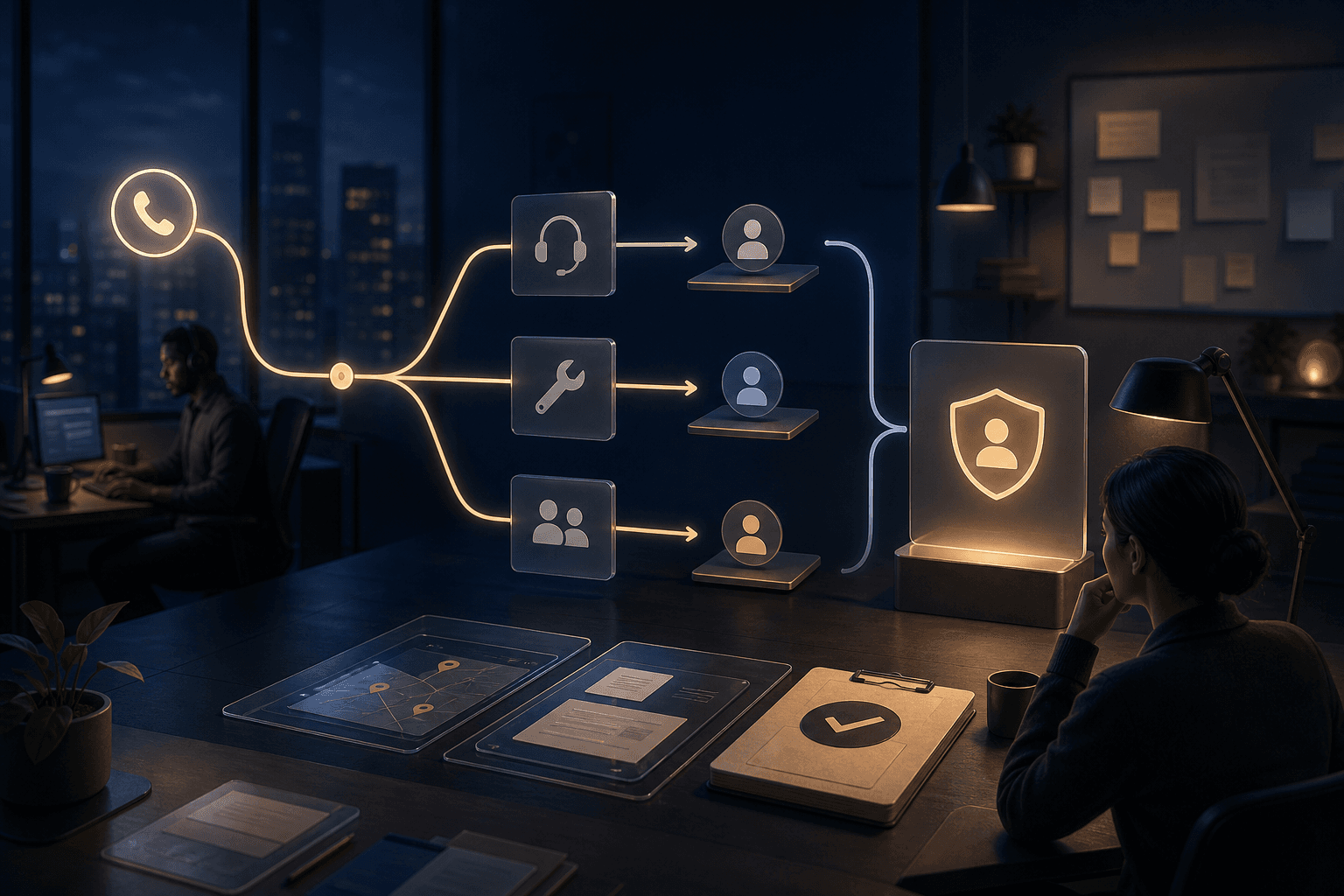
The system is simple. When your business number rings out or hits voicemail, an automation fires within seconds. The caller receives a text that looks like it came from a person on your team, not a marketing blast.
The most common message format:
Hi, this is [Name] at [Business]. Sorry I missed your call. How can I help? You can text me here or book a time at [link].
That is it. No menus, no "press 1 for sales." A real human sentence and an open door.
If the caller replies, the conversation flows into your normal text inbox or your CRM. If they do not reply within 5 minutes, an automated follow-up fires:
- A second text with your service hours and a booking link
- An email with the same booking link and a quick FAQ about your most common service
- A Google review request if the contact is already an existing customer
The whole sequence runs without anyone on your team touching it. You only get involved if the lead actually replies.
The Numbers Behind Missed Call Text Back
| Outcome Without Text Back | Outcome With Text Back |
|---|---|
| 80% of callers who hit voicemail do not leave a message | 30-50% of missed-call recipients reply to the first text |
| 5-10% of voicemails result in a booked job | 20-40% of missed-call recipients book a job within 24 hours |
| Caller dials a competitor within 2-3 minutes | Caller stays in your conversation thread and does not redial |
| No record of the missed call in your CRM | Every missed call is logged with timestamp, caller ID, and reply history |
The math is straightforward. A business that misses 25 calls a day and recovers 30% of them via text back adds roughly 7-8 booked conversations per day. At a 50% close rate on those conversations and a $350 average ticket, that is $1,200-1,400 per day in recovered revenue, or roughly $25,000 per month.
What You Need to Set Up
The technology stack is shorter than most owners expect.
1. A business line that can trigger on missed calls
This works with most modern phone systems: RingCentral, Dialpad, OpenPhone, Twilio, or any carrier that supports missed-call webhooks. If your office still uses an old copper line from the local telco, you will need to port the number to a VoIP provider before this works.
2. An SMS sending service
Twilio, Telnyx, or the SMS feature inside your CRM (HighLevel, Jobber, ServiceTitan) all work. The key is that the text appears to come from your actual business number, not a random short code.
3. A simple automation flow
The flow has three jobs: detect the missed call, send the first text, and send the follow-up sequence if there is no reply. Most automation platforms handle this with a single workflow.
- Make, Zapier, or n8n if you want flexibility and do not mind a small monthly bill
- HighLevel or Jobber automations if your CRM already has the feature built in
- A custom webhook if you want full control and your developer can wire it up in an afternoon
4. A booking link or scheduler
The text back should give the caller one obvious next step: book a time. Without a link, the conversation stalls. With a link, the caller can self-serve and your dispatcher does not have to play phone tag.
Most businesses set this up in a single afternoon. The hard part is writing the first text message well.
How to Write the First Text That Actually Gets a Reply
The first message is the entire game. Most failed setups send something generic like "Sorry we missed your call, please call back at 555-0100." That gets deleted.
Texts that work share three traits:
1. They come from a named person, not a brand. "Hi, this is Sarah at Cool Air HVAC" gets a reply. "Hi, this is Cool Air HVAC" gets ignored. People text people.
2. They open a conversation, not a transaction. "How can I help?" works better than "Would you like to book a service call?" The first invites a reply. The second sounds like a sales push and triggers a "not now."
3. They include exactly one next step. A booking link. A phone number. A question. Not all three. One decision reduces friction and increases replies.
A tested message that works for most service businesses:
Hi, this is [Name] at [Business]. Just saw I missed your call. What can I help you with? If you'd rather pick a time, here's my booking link: [link]
Short, personal, and clear. The booking link is there for the caller who is ready. The open question is there for the caller who wants to explain what is going on first.
Where Missed Call Text Back Fits in Your Stack
Missed call text back is not a replacement for your phone system, your CRM, or your AI answering service. It is the safety net under all of them. The right setup stacks them in layers:
| Layer | Handles | Example Tools |
|---|---|---|
| 1. Live answer | Caller reaches a real person on the team during business hours | Office staff, receptionist, dispatcher |
| 2. AI phone agent | After-hours or peak overflow calls get a full AI conversation that qualifies and books | AI voice agent connected to your calendar |
| 3. Missed call text back | Calls that slip through both layers still get a fast SMS reply | Twilio + Make or your CRM's built-in feature |
| 4. Follow-up sequence | Leads that did not book get a 48-hour automated nudge | Email + SMS sequence tied to the original call |
Each layer covers what the previous layer missed. Most service businesses start at Layer 3 because it is cheap, fast to deploy, and recovers the lowest-hanging fruit first. They add Layer 2 when they need after-hours coverage. They keep Layer 1 because real human conversations still close the highest-value jobs.
Common Mistakes That Make Text Back Backfire
Sending the same canned message to everyone
If every missed call gets "Hi, this is Joe's Plumbing, sorry we missed your call," savvy callers recognize the automation and ignore it. Personalize the message with the caller's first name and your team member's first name. Use the data your phone system already has.
Sending the text from a different number than your business line
If the text comes from a random 5-digit short code or a number the caller does not recognize, it looks like spam and gets ignored. The text must come from the same business number the caller just dialed.
Following up too aggressively
A missed call plus five texts in ten minutes is harassment. One text immediately, one follow-up after 30 minutes if there is no reply, and one final nudge the next morning is the right cadence. More than that and you risk opt-outs and a complaint to your carrier.
Not logging the missed call in your CRM
If the text back fires but the missed call never lands in your CRM, you have no idea how many leads you are recovering. Every missed call should create a contact record with timestamp, caller ID, and the reply history. That data is how you measure ROI and tune the message.
Forgetting about existing customers
The same flow that recovers new leads also captures existing customers who called about a follow-up or warranty issue. Tag the contact as "existing customer" if the number matches a record in your CRM. The text back can be adjusted to reference their last service visit or open ticket.
How We Wire This Up for Service Businesses
At AnovaGrowth, missed call text back is usually the first automation we set up for a new client, because it pays for itself inside a week and proves the model before we tackle bigger builds. The standard setup takes about three hours and connects three pieces:
- The phone system. A missed-call webhook from the business line triggers the flow. This works with most VoIP providers and any modern PBX.
- The automation layer. A Make or n8n workflow receives the webhook, looks up the caller in the CRM, and sends the appropriate text. Existing customers get a "Hi [Name], saw your call about your last service" message. New callers get the standard first-touch message.
- The booking link. Calendly, Housecall Pro, or the booking widget inside your CRM. The text includes a direct link so the caller can self-serve.
For one plumbing company we worked with, the setup recovered 8-12 missed calls per day in the first week. About 35% of those led to booked jobs within 24 hours. Their monthly recovered revenue was in the $20,000-25,000 range, all from a system that costs roughly $50 per month to run.
That kind of ROI is why missed call text back is usually the first thing we build, not the last.
Related Questions Business Owners Ask
- How fast does the text back need to send after a missed call?
- Can missed call text back work with a landline or do I need VoIP?
- What is the best SMS provider for a service business with 5-20 trucks?
- How do I stop the text back from firing when my team is on a call?
- Should the booking link go to Calendly, my CRM, or my website?
- How do I measure how many missed calls my text back actually recovers?
Key Takeaways
- Missed call text back recovers 20-40% of inbound calls that would otherwise go to voicemail
- The first text must come from a named person, not a brand, and include one clear next step
- Setup takes an afternoon: phone webhook, SMS provider, automation flow, booking link
- Stack it with live answering and an AI phone agent so every call has a safety net
- Track every missed call in your CRM so you can measure ROI and tune the message
Ready to recover the calls you are losing? Contact AnovaGrowth to set up missed call text back for your service business. Most setups ship within a week and pay for themselves with the first recovered job.
Related reading: AI Phone Answering for Service Businesses | AI Lead Response Speed for Service Businesses | After-Hours Service Call Handling