Schema Markup for Service Businesses: What Structured Data Is Worth Adding
Which structured data types a service business actually needs, which plugin promises to ignore, and how to test that search engines read your facts right.

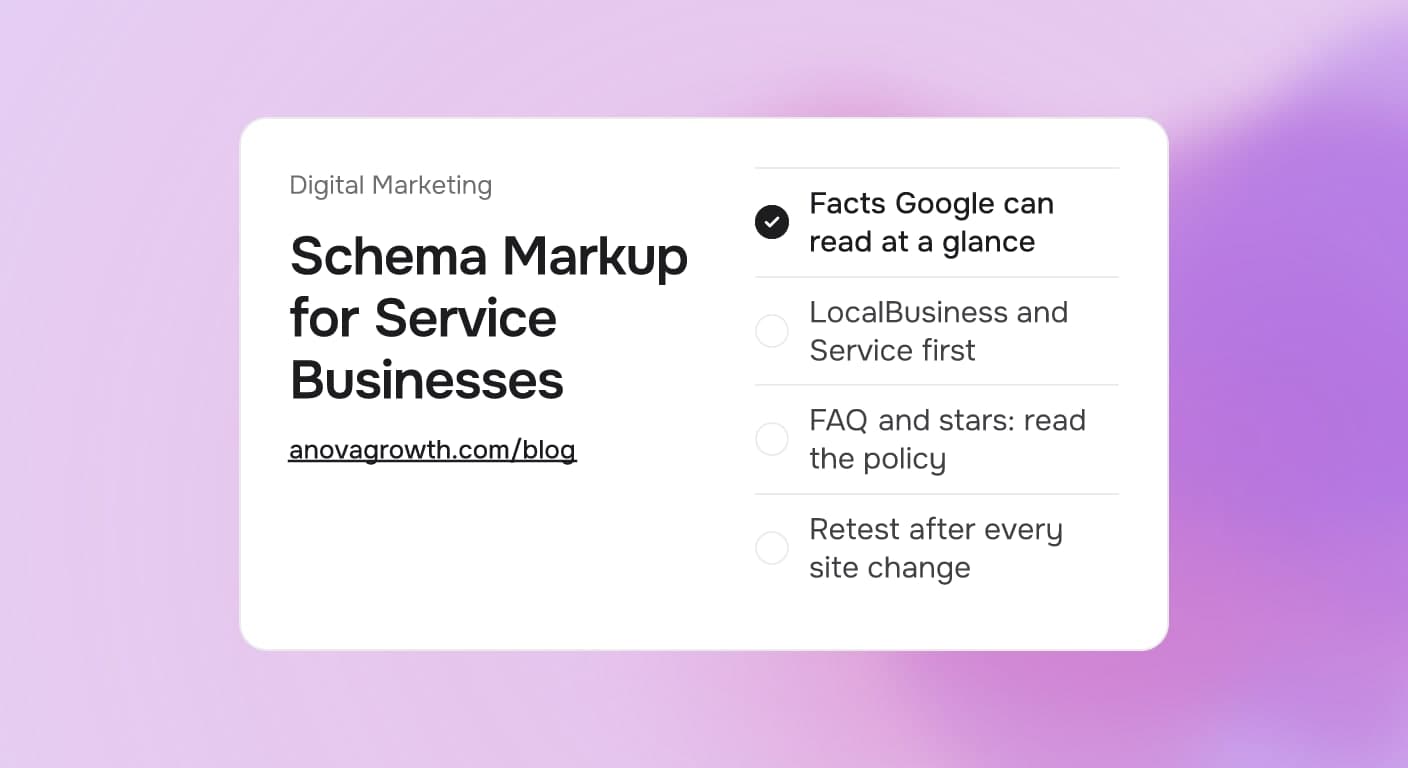
Quick answer
Schema markup is machine-readable information about your business that search engines can lift straight off the page: your name, services, service area, hours. It does not buy rankings, but it removes guesswork about who you are and what you do, and it is a prerequisite for any rich result your site can still earn. For service businesses, a small set of types does almost all the work.
What structured data actually is
Your website says things in human sentences, and visitors read them fine. Search engines have to parse those same sentences for meaning, and parsing is where small facts get lost: which number is the phone number, whether that city is your service area or your location, whether you are open on Saturday.
Structured data is a standard vocabulary, published at schema.org, that labels those facts so a machine reads them the way you meant them. It lives on the page alongside your visible content and describes the same reality: this is a local business, here is its name, here are the services it sells, here are its hours. Most sites implement it with the script-based format Google recommends, added either by hand or by whatever web platform you run. The markup is invisible to your visitors. It only changes how machines interpret the page.
Two clarifications that prevent most arguments about this topic:
- It is not a ranking factor you can buy. Adding markup does not move you up results the way an ad does. It makes your pages eligible for certain displays and easier to interpret, which is a real but quieter benefit.
- It is not magic either. Missing structured data is a fixable gap, not the reason nobody finds you. If there is a technical hole, it is worth closing in the right order, after the basics like service area pages that give search engines something to mark up in the first place.
The decision table: what to mark up, in order
| Structured data type | Priority | Why |
|---|---|---|
| LocalBusiness (with your vertical subtype) | Do first | Names your organization, location or service area, hours, and contact. The foundation for a service business site |
| Service | Do first | Labels what you actually sell, tied to your business entity, so each service page is self-describing |
| Breadcrumb | Easy win | Shows the page trail in some search displays and helps machines map your site structure |
| FAQPage | Depends | Only where real questions live and answers are yours to state. Google narrowed FAQ rich results in 2023, so most ordinary business sites no longer get the dropdown treatment. The data still aids understanding |
| Review or aggregateRating on your own site | Mostly skip | Stars from ratings of your own business on your own site stopped being eligible years ago under Google's self-serving rule. The markup does no harm, the stars rarely come |
| JobPosting, Event, Product, the rest | Skip unless true | Add types that match something you genuinely publish. Markup for things you do not do is noise, and wrong markup is worse than none |
The top two rows describe your business and your offer. The middle rows describe your content. The bottom rows are mostly where money gets wasted on things that quietly do nothing.
The plugin promise, and why to temper it
Many platforms and SEO plugins now emit basic structured data for you, which is progress: the foundation row of the table above often exists the moment you fill in your business name in a settings panel. That is worth checking before you pay anyone for anything, and it is the first thing we check on a client build.
The tempered part is what gets promised on top of that. Two claims repeat in marketing everywhere, and both outrun reality:
- "We'll get you those review stars." Stars for a local business generally come from the places where third parties rate you, most visibly your business profile, not from rating widgets on your own homepage. Google's own guidance treats self-collected ratings of your own entity as ineligible. A plugin that promises stars for your testimonials is describing markup that usually displays nothing.
- "Add FAQ schema to every page." After the 2023 narrowing, FAQ markup on an ordinary contractor or clinic page is unlikely to earn the expandable FAQ display that the pitch implies. Add it when a page genuinely answers customer questions, not as a growth hack.
Neither means structured data is pointless. It means the honest case for it is machine understanding and eligibility, not guaranteed decorations, and a vendor who sells guaranteed decorations is a vendor to question.
Common fan-out questions
Does schema markup improve rankings?
Not directly, and anyone selling it as a ranking factor is overstating it. It helps engines interpret your pages and makes you eligible for displays that can lift click-through. Those are the honest benefits, and they compound with real content, not instead of it.
Should a single-location business and a service-area business mark up differently?
Yes, and the difference matters for consistency. A storefront can publish its address; a business that hides its home address should publish its service area instead, the same choice made on the business profile. Whatever you publish, the name, address, phone, and hours need to agree everywhere they appear. Search engines cross-check, and contradictions read as sloppiness.
Which fields need to be true rather than just filled in?
All of them, honestly, but hours and service area are the ones that rot. Every markup field is a little promise about the real world. Stale hours or a moved address are the classic failures, and they confuse machines and humans alike, which is why structured data belongs to the same discipline as any other operational record: maintain it or it drifts.
How do I test what my site already emits?
Use Google's Rich Results Test on your homepage and main service pages; it parses the page and shows what markup exists and what it validates. The Search Console enhancement reports then show the same story across the whole site. Both are free, and between them you learn in an hour whether your site already speaks the vocabulary.
My web platform handles it. Anything left?
The platform emits what its template knows: usually your name, a logo, sometimes hours. What it cannot know is your actual service list, your service-area choices, or whether your FAQ page should carry FAQ markup. Someone still has to decide what is true and add what is missing, and re-check it whenever the site changes.
How we handle structured data at AnovaGrowth
We build and maintain service business websites, and our own site is in the same category, so here is the operating version rather than the brochure version.
On every build we add LocalBusiness and Service markup deliberately, by hand, matched against the business profile exactly: same name, same phone format, same hours, same service-area call. Platform defaults are a starting point we verify, never the deliverable. We skip review-star markup on client sites and say why, which occasionally disappoints someone who was promised stars, and saves them from paying for nothing. After every website redesign or content migration we re-run the tests, because markup has a way of surviving a redesign as markup for a business that no longer exists.
The habit that keeps it useful is the same one we apply to CRM data: facts with an owner. Hours change, services expand, a second location opens. Whoever owns the operational change owns the markup update, because structured data nobody maintains is a slow-motion lie and search engines eventually believe it less.
Where this fits in the local SEO stack
Structured data is one layer of several that work together, and it pays best when the layers agree:
- Pages worth marking up first: service area pages for local SEO create the city-level content that your Service and LocalBusiness markup should point to. Markup on thin pages adds precision to nothing.
- The measurement loop: the Google Search Console monthly checklist tells you what queries already reach you and whether enhancement reports show markup errors. Testing and schema live in the same monthly hour.
- The profile side: automating your Google Business Profile keeps the half of your facts that live outside your site consistent with the half that lives in your markup.
Next steps
Run the Rich Results Test on your homepage and your two main service pages. Thirty minutes tells you whether you already have LocalBusiness markup, whether it matches your business profile, and what is missing. Most service business sites need one hour of work on the foundation rows of the table above and a decision to stop paying attention to star promises. If your hours, services, or service area change later, change the markup the same week.
If you want a site that already ships with the right structure and someone to keep it true, contact us. We build service business websites with this work done deliberately, not left to platform defaults.
Ready to get started? Contact us to discuss how we can help your business.
Related articles

Local SEO for Charleston Hospitality and Real Estate
Charleston businesses win local search by matching strong websites with neighborhood intent, review signals, and fast follow-up.
Read the article: Local SEO for Charleston Hospitality and Real Estate
AI Search Visibility for Small Businesses: What to Fix Now
ChatGPT shopping, Google retail media, and new AI safety signals all point to one shift: your business data has to be structured, measurable, and trustworthy.
Read the article: AI Search Visibility for Small Businesses: What to Fix Now
Rome, GA Local SEO in 2026: How to Get Found When Customers Are Looking
Rome, GA is growing fast. More businesses means more competition for local customers. Here's how Rome service businesses win on Google in 2026.
Read the article: Rome, GA Local SEO in 2026: How to Get Found When Customers Are Looking
