Automated Referral Systems for Service Businesses: Turn Happy Customers Into a Self-Sustaining Lead Source
Service businesses leave 30-60% of referral revenue on the table. Automated referral systems turn happy customers into a steady lead pipeline.

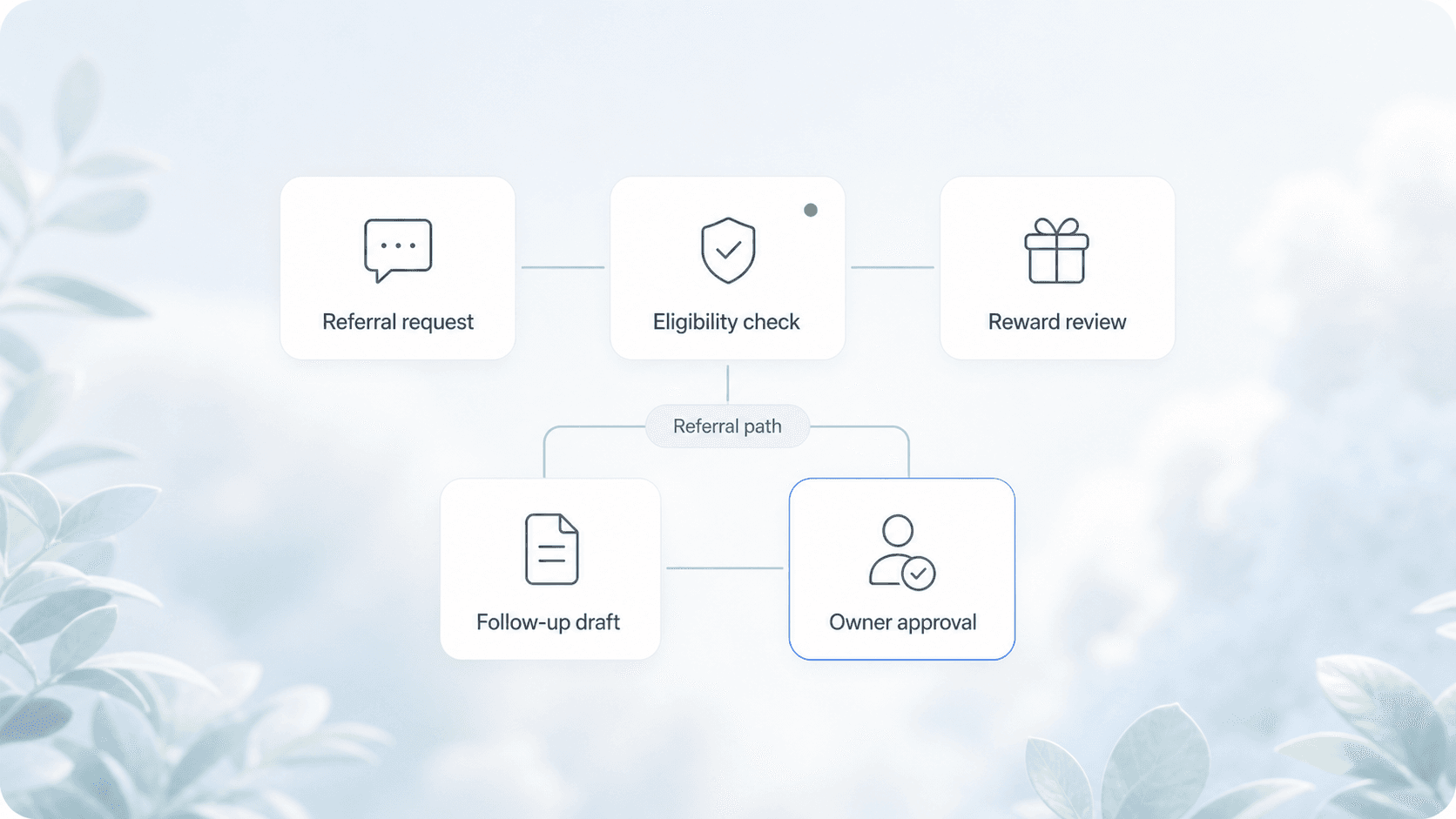
Quick answer: An automated referral system sends a referral request at the right moment (right after a positive service experience), tracks who sent whom, and rewards both parties automatically. Service businesses that set this up see 20-40% of new leads come from referrals within 6 months, with a customer acquisition cost 60-80% lower than paid ads.
Why Most Service Businesses Leave Referral Revenue on the Table
Every service business owner knows referrals are the best leads. They convert at 3-5x the rate of cold traffic, close faster, and tend to be higher-value customers. But most businesses treat referrals like a hope, not a system.
The typical pattern: a customer says "you did great work" and the owner says "tell your friends." Maybe they throw in a discount if someone mentions their name. That's not a system. That's a wish.
Here is what actually happens:
| Approach | Referral Rate | Tracking Accuracy | Scalability |
|---|---|---|---|
| Word of mouth (no system) | 5-10% of customers refer | Near zero | None |
| Manual ask + discount card | 10-15% of customers refer | Low (honor system) | Low |
| Automated referral system | 25-40% of customers refer | Full attribution | High |
The gap is not that customers don't want to refer. It's that most businesses never ask at the right time, never make it easy, and never track what's working.
What an Automated Referral System Actually Looks Like
An automated referral system is a sequence of triggers, communications, and rewards that runs without manual effort. Here is the core structure:
Trigger: A positive service event. Job completed, invoice paid, 5-star review left, or a customer satisfaction survey scores high.
Action: An automated message (email, SMS, or both) goes out asking for referrals. It includes a unique referral link or code the customer can share.
Tracking: Every referral link is tagged to the original customer. When someone clicks and books, the system records the source.
Reward: Both the referrer and the new customer get a reward automatically. Discount on next service, gift card, or service upgrade.
Follow-up: If the referral converts, the referrer gets a thank-you message. If the referral doesn't book within 30 days, a gentle reminder goes out.
The Timing Is Everything
The single biggest mistake service businesses make is asking for referrals too late or too early. Ask before the job is done and it feels pushy. Ask three months later and the positive emotion has faded.
The sweet spot is within 24-48 hours of a confirmed positive outcome. That means:
- After a repair is completed and the customer says they're happy
- After a clean install with no callbacks
- After a positive post-service survey response
- After a 5-star Google review is posted
An automated system fires at exactly this moment. No human has to remember. No one has to feel awkward about asking.
How to Set Up a Referral System That Runs Itself
Step 1: Pick Your Trigger Event
Choose one event that reliably signals a happy customer. For most service businesses, this is either "job marked complete in the CRM" or "positive survey response." Pick the one that happens most consistently.
Step 2: Create Your Referral Offer
The offer needs to be valuable enough to motivate action but not so expensive it eats your margin. Common structures:
- Dual-sided: $50 off for the referrer, $50 off for the new customer
- Service upgrade: Free add-on service for both parties
- Tiered: $25 credit for one referral, $75 for three, $200 for five
The best offers are services you already deliver at low marginal cost. An HVAC company offering a free tune-up costs them $15 in labor but feels like $150 to the customer.
Step 3: Build the Automation
This is where the system comes together. The flow looks like:
- Job completion triggers an automated satisfaction check
- If positive, a referral request sends via email or SMS with a unique link
- The link goes to a simple landing page where the referral books or fills out a form
- The CRM tags the lead source and notifies the referrer
- When the referral converts, rewards trigger automatically
Tools like Make, Zapier, or HighLevel can connect your CRM, email, and SMS to run this flow. A one-time setup takes 2-4 hours. After that, it runs on its own.
Step 4: Track and Optimize
Once the system is running, watch these metrics:
- Referral request open rate: Are people seeing your ask?
- Referral link click rate: Are they clicking through?
- Referral conversion rate: Are referred leads booking?
- Reward redemption rate: Are people using their rewards?
If open rates are low, change the subject line or timing. If click rates are low, simplify the ask. If conversion is low, the offer might not be compelling enough.
What This Looks Like in Practice
A plumbing company we worked with had a solid reputation but almost no repeat referral business. Customers would say "great work" on the phone and that was the end of it. They had no way to turn that goodwill into leads.
We set up a simple automation: when a job was marked complete in their CRM and the invoice was paid, an automated text went out 24 hours later. It said "Thanks for your business. If you know someone who needs help, here is a $50 credit for you and $50 for them." The text included a link to a one-page referral form.
Within 90 days, 18% of their new jobs came from referrals. Within 6 months, it was 34%. Their cost per acquired customer dropped from $87 (Google Ads) to $14 (referral). The system required zero ongoing effort from their team.
The key detail: they had been getting positive feedback for years. The only thing missing was the ask at the right moment.
Common Objections and Why They Don't Hold Up
"My customers don't want to be bothered." Customers who just had a great experience are the most likely to help. A well-timed ask with a real reward feels like appreciation, not a bother.
"I don't want to pay for referrals." Compare $50 in referral rewards to $87 in ad spend. The math is clear. Plus, referred customers stay 25-30% longer on average.
"I already get referrals without a system." You might get some. But without tracking, you have no idea how many you're missing. Most businesses underestimate their referral potential by 3-5x.
"This sounds complicated to set up." The automation setup is a one-time project. After that, it runs on its own. Compare that to running ads, which requires ongoing management and budget.
Related Questions Business Owners Ask
- How do I ask for referrals without sounding desperate?
- What reward structure works best for service businesses?
- How do I track referral sources without a dedicated tool?
- Should I use email or SMS for referral requests?
- How do I handle referral rewards in my accounting?
- What if a referred customer is a bad fit for my business?
What AnovaGrowth Does Differently
We have built referral automation for HVAC, plumbing, electrical, and home service companies across the Southeast. The common thread: every business already had happy customers. They just needed a system to turn that goodwill into a repeatable lead source.
The setup is not about fancy technology. It is about connecting the tools you already use (CRM, email, SMS) into a flow that asks at the right time, tracks the result, and rewards the behavior. Most businesses have the pieces. They just need them wired together.
We also see businesses overthink the reward. A simple, predictable offer beats a complex tiered program every time. Customers do not need gamification. They need a clear reason to take 30 seconds to share a link.
Key Takeaways
- Most service businesses get 5-10% of customers to refer. A good automated system pushes that to 25-40%.
- Timing is the single most important factor. Ask within 24-48 hours of a confirmed positive outcome.
- A dual-sided reward (both parties get something) outperforms single-sided offers by 2-3x.
- The setup is a one-time project. After that, the system runs without ongoing effort.
- Referred customers cost 60-80% less to acquire and stay longer than any other channel.
Next Steps
If you have happy customers but no consistent referral flow, you already have the raw material. The missing piece is a system that asks at the right time and tracks the result.
Start by identifying your trigger event. What moment in your process reliably signals a happy customer? That is your starting point.
Ready to build a referral system that runs itself? Contact us to discuss how we can set this up for your business. Or read about workflow automation to see how we connect your existing tools. For more on lead generation, check out automated lead nurturing and appointment scheduling automation.
Related articles
Tampa Bay Digital Infrastructure: Build Workflows Before Growth
Tampa Bay is planning for digital infrastructure and maritime growth. Local businesses can prepare by connecting the workflows behind every customer.
Read the article: Tampa Bay Digital Infrastructure: Build Workflows Before Growth
Scalable Service Business Operations: How to Build a Company That Grows Without Growing Pains
Most service businesses scale revenue and multiply problems at the same rate. Here is how to build operations that handle growth without adding chaos.
Read the article: Scalable Service Business Operations: How to Build a Company That Grows Without Growing Pains
How to Make Your Southeast Service Business Sellable for Maximum Value
Most Southeast service business owners leave 30-50% of sale value on the table because the business cannot run without them. Here is the prep checklist that changes that.
Read the article: How to Make Your Southeast Service Business Sellable for Maximum Value
