Something big is happening in the world of AI, and almost nobody outside of tech circles is talking about it yet.
It's not a new chatbot. It's not a flashier version of ChatGPT. It's something more foundational, and honestly, more interesting.
AI agents are learning to talk to each other.
And when that fully lands in the business world, which is happening right now, it's going to change how work gets done at every level. From Fortune 500 companies to the independent HVAC shop down the street.
Let's break this down from the beginning.
What Is an AI Agent? (Start Here)
Before we get into agents talking to each other, we need to make sure we're on the same page about what an AI agent actually is.
Most people's experience with AI is a chatbot. You type a question, it types back an answer. Simple, one-way, done.
An AI agent is different. Think of an agent as an AI that can actually do things, not just answer questions.
You give it a goal, and it figures out the steps to get there. It can browse the web, pull data from your software, send emails, update spreadsheets, make bookings, whatever tools you've given it access to. It can string together multiple actions in a row to complete a task from start to finish.
Here's a simple example: instead of asking an AI "what's the best time to schedule this meeting?" and then going and doing it yourself, an AI agent would check everyone's calendar, find the slot, send the invites, and add the agenda, all on its own.
That's the shift from AI as a tool to AI as a worker.
Now Imagine Those Agents Working Together
Here's where things get interesting.
Right now, even the most advanced AI setups typically have one agent handling a task, start to finish. It does everything in a single chain.
But real businesses don't work that way. You've got a CRM (a customer relationship management system, the software that tracks your leads and customers). You've got an accounting system. A project management tool. An email platform. A scheduling app.
Each of those systems is its own island. Today, connecting them requires either a human doing manual work, or a developer writing custom code to bridge them.
What A2A (Agent-to-Agent) protocols are building is the equivalent of a universal language for AI agents, so that the AI agent in your CRM can talk directly to the AI agent in your accounting software, which can then talk to the agent managing your team's project board, without a human being involved in any of those handoffs.
It's like giving your business systems the ability to coordinate with each other in real time, automatically, and intelligently.
The Two Protocols You Need to Know
Two standards have emerged that are shaping how this all works. You don't need to memorize the technical details, but you should know they exist and who's behind them.
MCP, Model Context Protocol
MCP was launched by Anthropic (the company behind the Claude AI) in November 2024. Think of MCP as the connector layer, it's what lets an AI agent plug into a tool or data source and actually use it.
Imagine MCP like a universal power adapter. Before it existed, every AI model had to be specifically wired to each tool separately. MCP created a standard plug so that any AI can connect to any tool that supports the standard.
Within one year of launch, it had been adopted by OpenAI, Google, Microsoft, and Amazon Web Services. By December 2025, Anthropic donated MCP to the Linux Foundation, meaning it's now an open, community-governed standard, not owned by any one company.
That's significant. When competing tech giants agree on a standard and hand it to a neutral foundation, it means the standard is here to stay.
A2A, Agent2Agent Protocol
A2A was launched by Google at Google Cloud Next in April 2025. Where MCP handles the connection between an agent and a tool, A2A handles the communication between two agents.
Think of it this way: MCP is how an agent talks to software. A2A is how one agent talks to another agent.
On day one of launch, Google had more than 50 major technology partners committed to the protocol, including Salesforce, SAP, ServiceNow, Workday, PayPal, Atlassian, and Intuit. By June 2025, the Linux Foundation had taken over stewardship of A2A as well, alongside MCP.
Microsoft also announced support in May 2025, building A2A compatibility directly into their Azure AI platform with enterprise security baked in.
UiPath, one of the biggest names in business automation, put it plainly: "A2A is a significant step towards a future in which AI agents, robots and humans collaborate seamlessly to drive transformative business outcomes."
Why This Is a Bigger Deal Than It Sounds
When major competitors, Google, Microsoft, Amazon, Anthropic, OpenAI, all agree on the same underlying plumbing, that's a signal. That's the industry saying: this is the direction everything is going.
The last time this kind of consensus happened in tech was with mobile internet. When every phone maker, carrier, and software company agreed on the same web standards, it unlocked an explosion of apps and services that nobody could fully predict ahead of time.
A2A and MCP are building that same kind of shared foundation, but for AI automation.
Here's what that means in practice: once AI agents can reliably communicate across platforms and companies, the scope of what you can automate goes from "tasks within one tool" to "entire workflows that span your whole business, and your vendors' businesses too."
What This Actually Looks Like for Real Businesses
Let's get out of the abstract and into the concrete.
For a Restaurant
Today: A customer calls to book a table. Your staff checks availability, logs it in the system, confirms via text.
With A2A: A customer asks your AI agent to book a table for Saturday at 7pm. That agent talks to your reservation system agent, checks inventory with your kitchen management agent, confirms staff coverage with your scheduling agent, and sends a confirmation, all without a single human involved.
When something changes, say the kitchen closes early that Saturday, the agents coordinate the update and reach back out to the customer automatically.
For a Law Firm or Service Business
Today: A new client inquiry comes in, someone manually enters their information into the CRM, creates a file, schedules an intake call, and follows up.
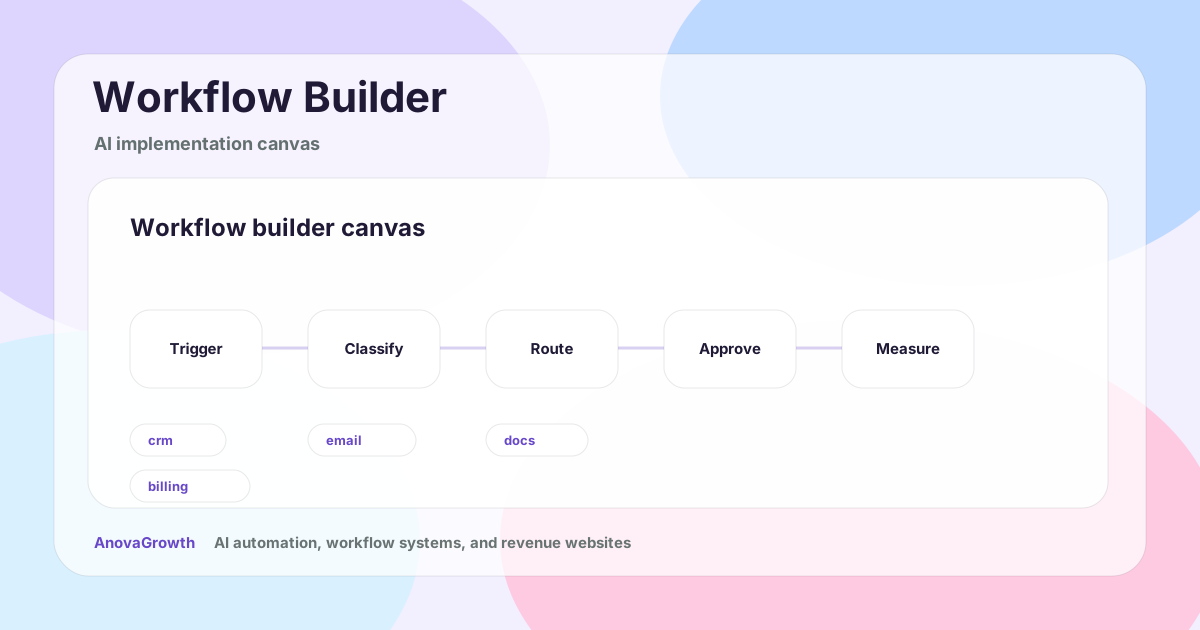
With A2A: The inquiry agent qualifies the lead, the CRM agent creates the contact and matter file, the calendar agent books the intake, the document agent generates the intake packet, and the email agent sends it all, triggered by one form submission.
No manual data entry. No dropped balls. No delay while someone gets around to it.
For a Retailer
IBM gave a good example of this in November 2025: imagine a retail store's inventory agent detects a product running low. Using A2A, it contacts the ordering agent, which reaches out to the supplier's agent, which confirms stock and pricing, which kicks off a purchase order, all before a human even knows there was a problem.
That's not sci-fi. That's early-stage production.
The MCP + A2A Combination
Here's how the two standards work together, since they're often talked about side by side.
MCP is what lets an agent connect to your tools and data, your CRM, your calendar, your email, your database.
A2A is what lets agents coordinate with other agents, whether those other agents live in a different part of your business, a different software platform, or even a different company entirely.
Together, they're building the infrastructure for what's sometimes called a "multi-agent economy", where businesses can have specialized AI agents that each handle a domain (customer service, scheduling, billing, inventory) and those agents coordinate automatically to run entire business processes end-to-end.
"But My Business Is Small. Does This Affect Me?"
Yes. Possibly more than anyone.
Large corporations have armies of software engineers and operations teams to coordinate their systems manually. They've managed fine without this. Small businesses haven't had that luxury, and the gaps in their operations (the manual hand-offs, the dropped emails, the things that fall through the cracks) are where revenue and time disappear.
A2A and MCP are being built into the tools that small businesses already use. Salesforce, Workday, Intuit (QuickBooks), PayPal, ServiceNow, these are the platforms that run small businesses. When A2A is fully embedded in those platforms, and those platforms' AI agents can coordinate with each other, a business running on QuickBooks + a scheduling tool + a CRM suddenly has AI agents that can orchestrate end-to-end client management automatically.
You don't have to build anything from scratch. The infrastructure is being wired into the software you already pay for.
What Should You Do Right Now?
You don't need to hire a developer today. But you should be thinking about a few things.
Get your data in order. AI agents work best when your business data is clean, centralized, and consistent. If your customer information is scattered across a spreadsheet, three inboxes, and a notes app, you'll want to fix that before agents can do anything useful with it.
Think in workflows, not tasks. Start identifying the repetitive, multi-step processes in your business that eat time every week. Those are exactly the workflows that A2A-powered automation will handle first.
Don't wait to start experimenting. Simpler AI automation is available today, agents that handle individual tasks in your existing tools. Getting comfortable with those now puts you ahead of the learning curve when the more connected, multi-agent systems arrive.
Talk to people who are paying attention to this. Most business owners won't hear about A2A until their competitors are already using it. The businesses that move early will have meaningful advantages in speed and cost.
The Bigger Picture
We're moving from an era where AI is a feature inside software to an era where AI is the coordination layer between software.
The protocols that make this possible, MCP and A2A, are already built, already adopted by the major players, and already running in early production systems. The Linux Foundation is stewarding both of them as open standards.
This isn't a prediction about something that might happen. It's a description of infrastructure that's already been laid.
The question for your business isn't whether this shift will arrive. It's whether you'll be positioned to use it when it does.
AnovaGrowth helps businesses in Rome, GA, Birmingham, Charleston, and across the Southeast build the kind of AI-ready operations infrastructure that makes this transition smooth instead of chaotic. If you want to understand what this actually looks like for your specific business, reach out and let's talk.