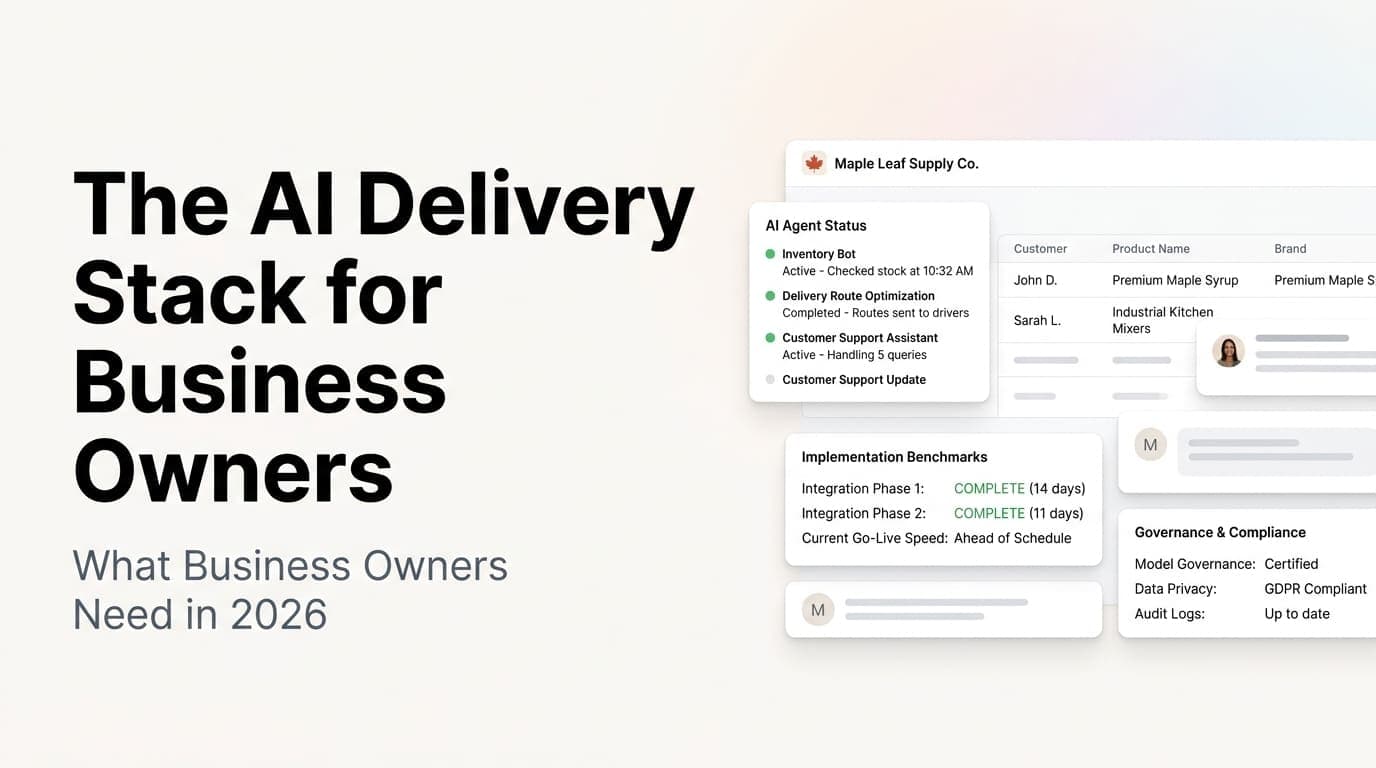
If your AI plan is still "pick the best model and start prompting," you are already behind.
This week’s announcements from OpenAI, AWS, Anthropic, and Google point to a different reality: results are now driven by delivery infrastructure, implementation capacity, and governance discipline. Model quality still matters, but it is no longer the main bottleneck for most businesses.
For business owners, that is good news. You can stop chasing benchmark headlines and start building a system that consistently ships outcomes.
The Market Shift Happening Right Now
In the last seven days, five updates made the pattern obvious.
- AWS announced OpenAI models, Codex, and Managed Agents in Amazon Bedrock preview, with enterprise controls like IAM and audit logging.
- OpenAI detailed major compute expansion through Stargate and new capacity commitments.
- OpenAI also published a cybersecurity action plan focused on AI-era defensive readiness.
- Anthropic announced a new enterprise AI services company with major financial partners, aimed at mid-sized business implementation.
- Google’s latest April recap emphasized enterprise agent platforms and practical AI tooling for organizations.
That is not a "new model" story. It is an execution story.
Why This Matters More Than Model Rankings
Most companies do not fail at AI because the model is weak. They fail because delivery is fragmented.
Typical failure pattern:
- One team runs experiments in isolation.
- Another team owns security and blocks production use late.
- Operations gets no workflow redesign.
- Leadership sees demos, not measurable business gains.
The announcements this week are all trying to solve that. Vendors are packaging deployment controls, platform governance, and implementation support because the market has learned where projects actually break.
For small and mid-sized companies, this means your edge comes from operational clarity, not just tool access.
Build Your AI Delivery Stack in Four Layers
Think in layers, not one-off tools.
1) Execution Layer
This is where workflows run: lead response, proposal drafting, customer support triage, scheduling, reporting, and follow-up.
Your goal here is simple: convert repetitive steps into reliable automations with clear ownership.
If you are still deciding where to start, use this workflow-first approach: Small Business Automation: Where to Start.
2) Integration Layer
Your AI should connect to real systems: CRM, inbox, ticketing, knowledge base, and calendar. If it cannot act inside those systems, it stays a demo.
This is why cloud-native agent deployments matter. They reduce custom glue work and make controls easier to enforce.
3) Governance Layer
Set policy before scale:
- What data can be used?
- Which actions require human approval?
- What logs are retained?
- Who is accountable for failures?
This week’s cybersecurity and guardrail-focused announcements show governance is no longer optional. It is now part of product design.
4) Adoption Layer
No adoption, no ROI.
Create role-based playbooks so your team knows exactly when to use AI and when to escalate to a human. This is the difference between occasional usage and process-level performance improvement.
What Business Owners Should Do in the Next 30 Days
Skip the broad "AI transformation" plan. Run a focused execution sprint.
- Pick one workflow with clear revenue or cost impact.
- Define baseline metrics before automation.
- Deploy with governance rules from day one.
- Track weekly operational outcomes, not prompt quality.
- Expand only after one workflow proves measurable gain.
Strong first candidates:
- Missed lead follow-up recovery
- Service quote turnaround
- Customer support triage and routing
- Invoice/chasing automation
If your team needs a framework for action-heavy systems, this guide helps: What Are AI Agents? A Business Guide.
The New Decision Rule for 2026
When comparing AI vendors or partners, ask this first:
"How fast can this setup ship governed production workflows in my business?"
Not:
- "Who has the flashiest benchmark chart?"
- "Which demo looked smartest in a sandbox?"
Speed to controlled deployment is now the real competitive metric.
Final Takeaway
This week’s AI news confirms a major transition: the winners will not be the companies with the most AI experiments, but the companies with the strongest AI delivery stack.
That stack combines execution workflows, system integrations, governance rules, and adoption playbooks. Build those four layers, and model upgrades become fuel instead of chaos.
Ready to turn AI into measurable operating results? Start with AI Automation Services or contact our team to map your first delivery sprint.