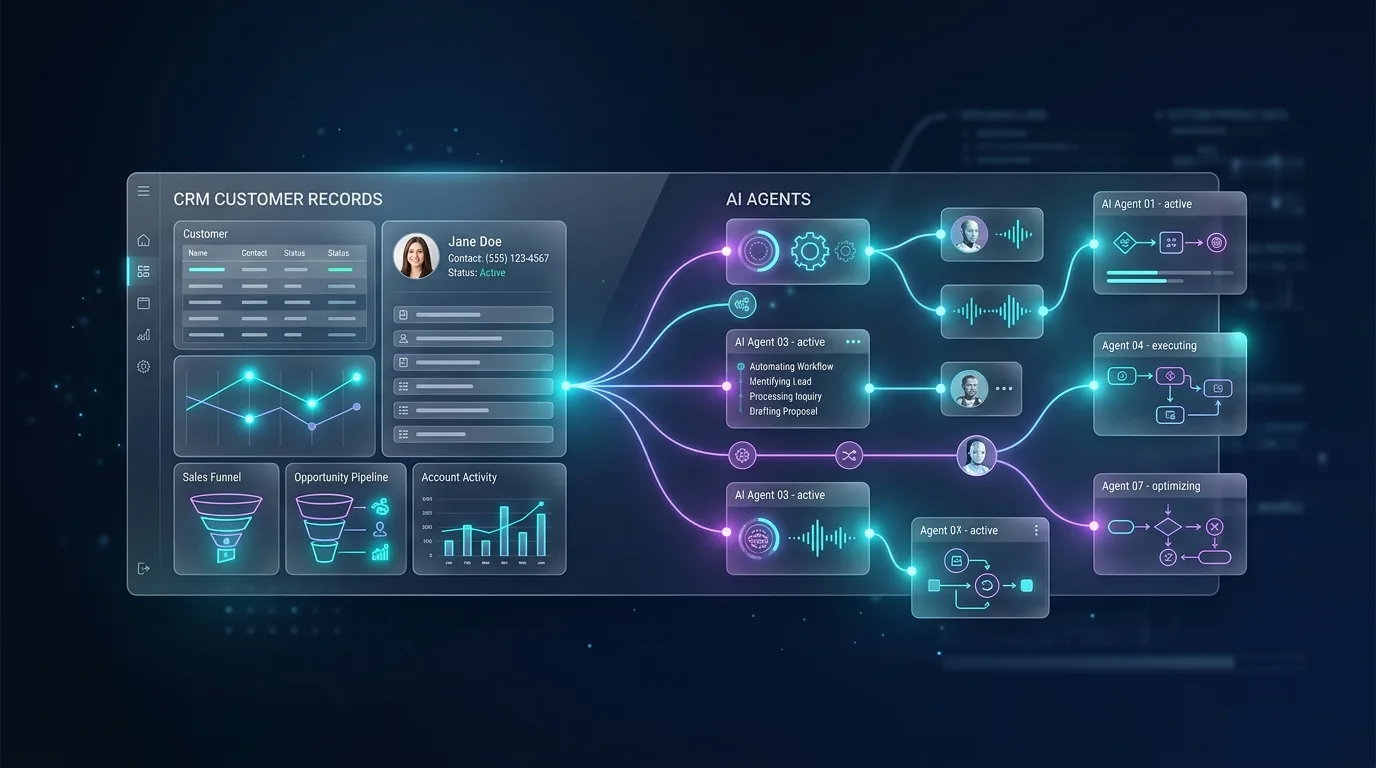
For most of the last decade, business software had one job: store and display information. Your CRM logged customer interactions. Your accounting system tracked transactions. Your helpdesk organized support tickets.
These tools improved visibility. They didn't reduce work.
Sales reps still manually updated pipelines. Operations managers still copy-pasted data between systems. Someone still had to read every report and decide what to do next.
That model is ending.
What's Actually Changing in 2026
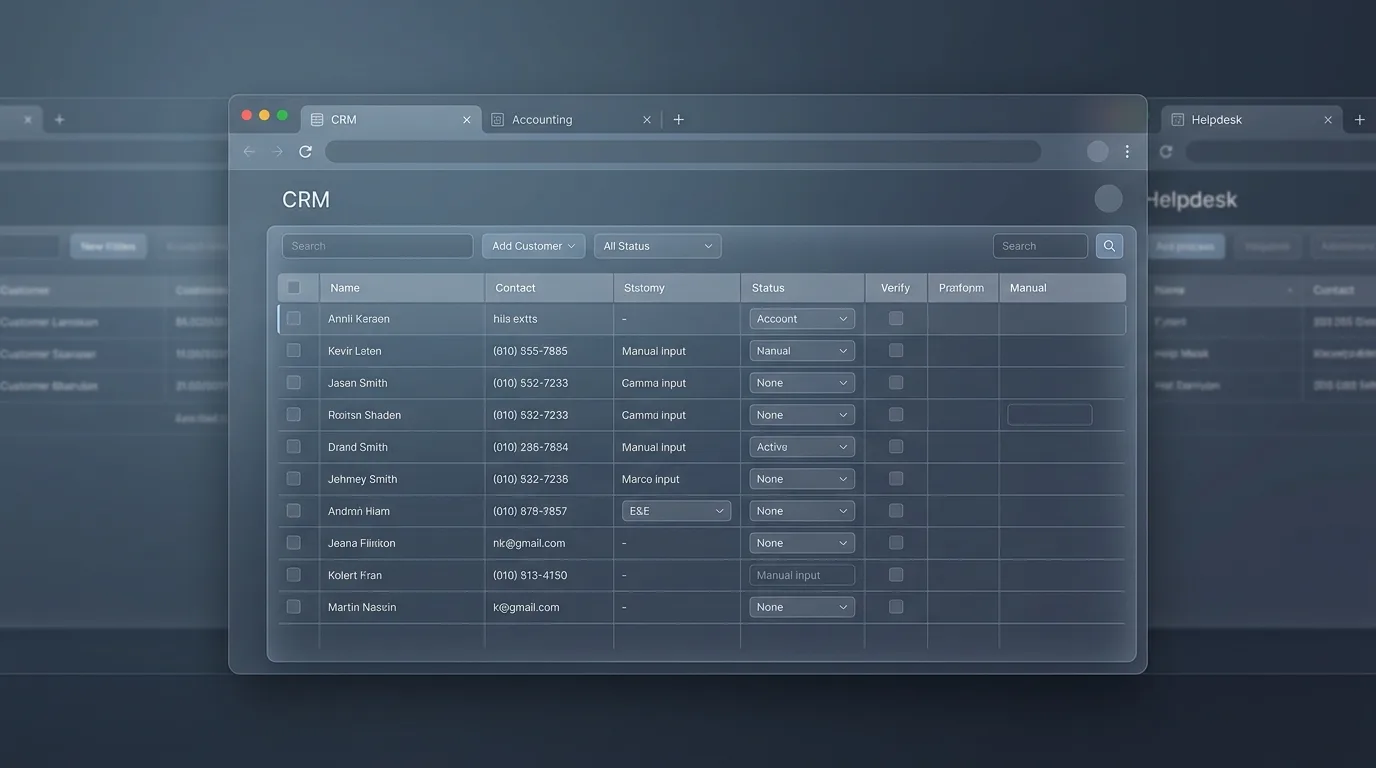 Legacy business software showing disconnected CRM, accounting, and helpdesk tools with manual data entry workflows
The shift isn't about better dashboards or smarter reports. It's about software that takes action on its own.
Alibaba made headlines this week with the launch of Accio Work, a pre-configured "AI taskforce" designed specifically for small and mid-size businesses. It autonomously handles tasks across the business lifecycle: market research, supplier sourcing, inventory monitoring, order management. You give it goals; it executes.
That's one product, but it signals a broader pattern. Across the software landscape, platforms are embedding AI agents that don't wait for user input. They monitor what's happening, interpret what it means, and do something about it.
This is a genuine inflection point for business owners. The question is no longer whether AI can automate something, it's whether your current setup is ready for software that operates autonomously.
Most SMBs run on 10 to 20 different SaaS tools. Those tools hold enormous amounts of operational data. The new generation of AI agents sits on top of that stack and connects the dots. Lead comes in from your website, the agent enriches it with company data, scores it, assigns it to the right rep, and drafts a personalized outreach. Invoice arrives in email, the agent extracts the details, matches it to a purchase order, and routes it for approval. No one touched those workflows.
What AI Agents Actually Do Differently
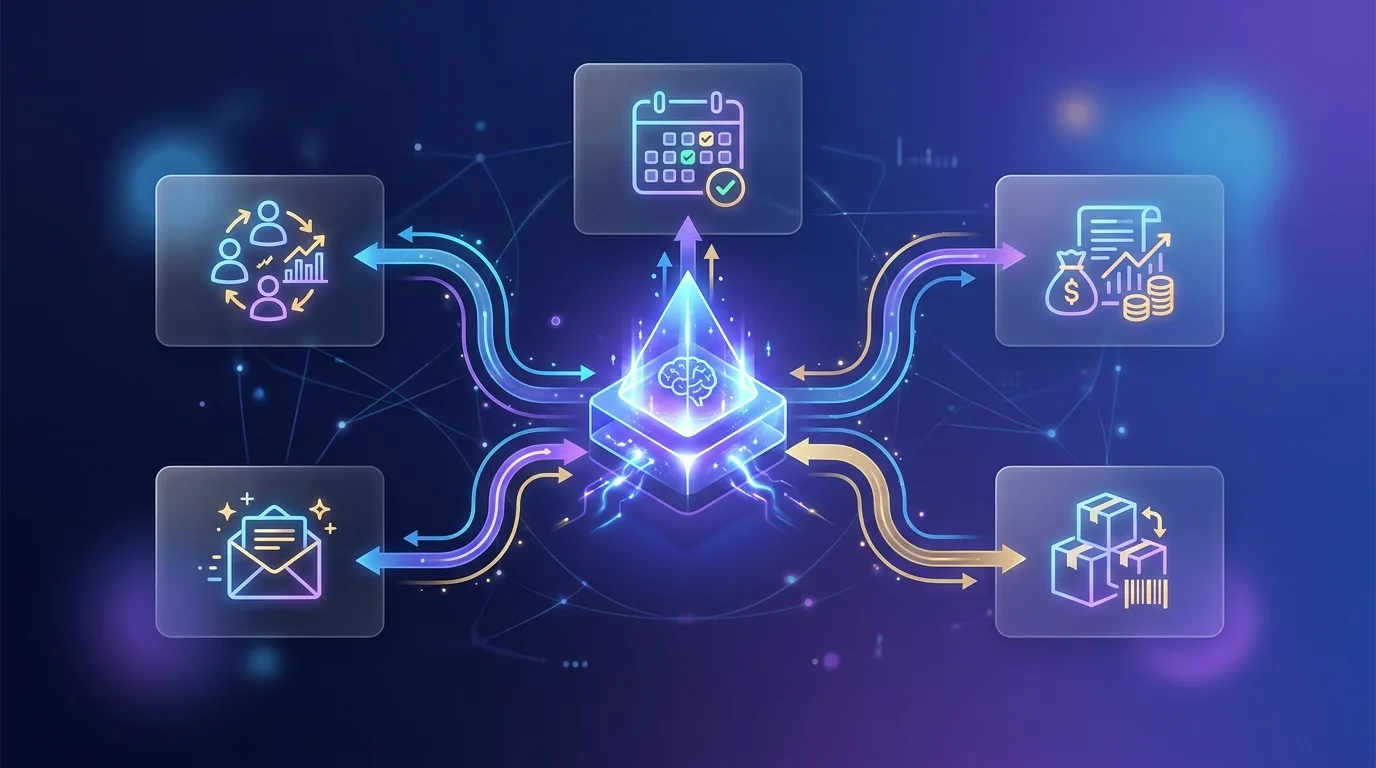 AI agent node sending automated commands to connected business systems including CRM, email, calendar, and billing platforms
Traditional automation is rule-based. You define exactly what should happen under exactly what conditions. If X, then Y. It works well for predictable processes, and it breaks the moment something doesn't fit the script.
AI agents operate differently. They interpret context, weigh options, and execute multi-step workflows, even when things don't go according to plan.
Here's a practical example. A customer asks for a return on a purchase made nine months ago. Your policy covers six months. A rule-based system either auto-approves or auto-rejects. An AI agent checks the customer's order history, sees that they've been a repeat buyer for three years, and approves the exception while flagging it in a review log. That's judgment, not just logic.
The capability gap matters for a few specific scenarios:
Unstructured data. Most business information lives in emails, PDFs, and free-text fields, not tidy database rows. Classic automation can't read an invoice that arrives as a scanned attachment. AI agents can extract the relevant data and act on it regardless of format.
Cross-system orchestration. Getting multiple tools to work together without building custom integrations has always been expensive. AI agents coordinate actions across your existing stack without requiring every system to have a direct connection to every other system.
Exception handling. The processes that eat the most time aren't the clean ones, they're the edge cases. AI agents handle gray area decisions that would otherwise sit in someone's inbox waiting for a human review.
Where Small Businesses Feel the Difference First
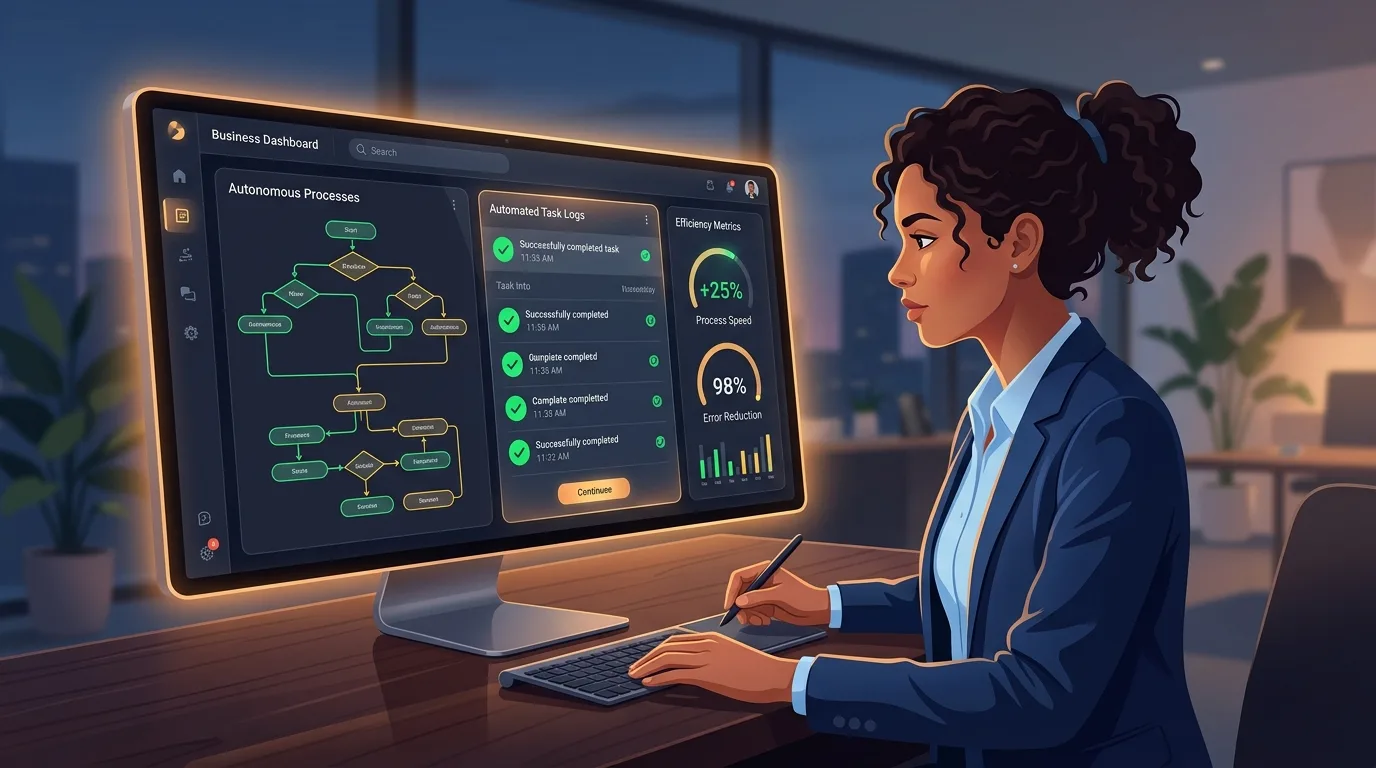 Business owner reviewing AI-generated workflow results on a premium dashboard showing automated task completions and efficiency metrics
Not every workflow is worth automating with agents. The ones that justify the investment share a few common characteristics: they happen frequently, they touch multiple systems, and they currently require manual judgment to complete.
Lead handling. For most small businesses, new leads go into a queue and wait. Someone reviews them eventually. By then, the prospect may have moved on. An agent can research, score, assign, and initiate outreach within minutes of a lead arriving, without anyone logging in.
Accounts payable. Invoice processing is tedious and error-prone. Different vendors send different formats. Matching invoices to purchase orders takes time. An AI agent handles the whole loop from inbox to approval routing, surfacing only the exceptions that need a human decision.
Customer support triage. When tickets pile up, simple issues get buried next to complex ones. Agents read each incoming ticket, categorize severity, check the customer's account history, and route accordingly. Password resets get auto-resolved. Technical escalations go straight to the right specialist. VIP customers get flagged before anything else.
Onboarding and follow-up. New clients, new hires, new vendors, onboarding sequences involve the same steps done slightly differently each time. Agents execute the sequence consistently and adjust for variations without anyone building a rigid flowchart.
The pattern is consistent: agents work best on processes where the steps are repeatable but the inputs vary. That describes a significant chunk of daily operations for most SMBs.
The Practical Starting Point
The businesses that get the most value from this shift don't try to automate everything at once. They pick one process that causes obvious, recurring pain, something where someone on the team visibly groans every time it comes up, and start there.
Map how a skilled person currently handles that workflow. Pay close attention to the decisions they make, not just the steps they follow. Where do they look things up? What do they check before deciding? What do they do when something unexpected appears?
That map becomes the agent's operating logic.
Start with the main path. Run the agent alongside a human for a few weeks. Review its decisions. Tune its behavior. Then gradually hand it more of the exception handling as confidence builds. Once that first workflow is running well, you'll see others that follow similar patterns. The second agent is always faster to deploy than the first.
The technology infrastructure to do this is more accessible than it's ever been. The costs have dropped. The tooling has matured. What used to require an enterprise budget and a dedicated engineering team is increasingly available to a 20-person company with a clear sense of what they need.
The main requirement isn't budget. It's knowing which workflows are worth tackling first.
Key Takeaways
- Business software is shifting from passive record storage to autonomous execution, agents that act, not just report
- AI agents handle unstructured data, cross-system orchestration, and exception handling that traditional automation can't touch
- The highest-impact starting points are high-volume workflows that currently require manual judgment to complete
- Start with one process, run the agent alongside a human first, and expand from there
Want to identify which workflows in your business are ready for this? Talk to us, we'll walk through your operations and find the starting point that delivers the fastest return.