Something Quietly Changed in Your Ads Manager
If you run Facebook or Instagram ads, you may have noticed a new "Tools" section in Ads Manager recently. That's Manus, an AI agent Meta acquired for over $2 billion and embedded directly into its advertising platform.
This isn't a minor UI tweak. Meta has publicly stated its goal is to fully automate ad creation with AI by the end of 2026.
That's a significant shift for any business owner running paid social campaigns. Some of it is genuinely useful. Some of it deserves a closer look before you hand over the keys.
What Manus Actually Does
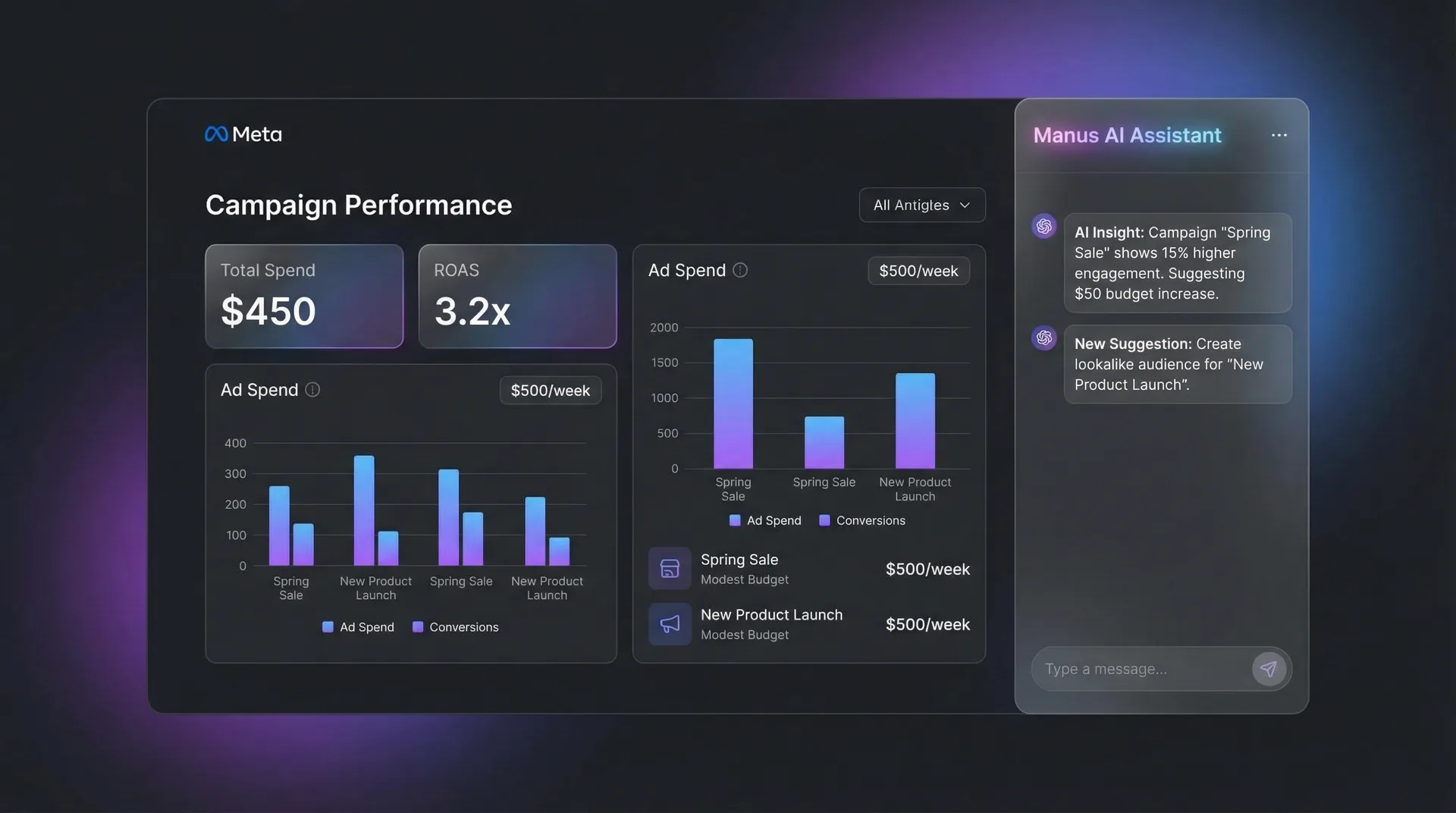
Manus isn't just an AI chatbot bolted onto the side of Ads Manager. It's an autonomous agent, software that can observe your campaign data, form a plan, and execute actions without you reviewing each step.
In practice, that currently means things like:
- Analyzing your campaign performance and surfacing recommendations
- Generating ad copy and creative variations based on your existing assets
- Identifying audience targeting adjustments based on engagement data
- Producing reports and insights from your account history without manual export and analysis
Mark Zuckerberg has framed it plainly: "A lot of what makes agents valuable is the unique context that they can see." Manus has access to your account history, your audience data, your conversion signals, and Meta's broader platform data. That combination is what makes it capable of more than generic suggestions.
The Real Opportunity for Smaller Advertisers
Here's the honest case for smaller businesses using this: the gap between what a well-funded marketing team can do and what a solo operator can do has historically been enormous. Ad optimization, audience testing, and creative iteration are time-intensive disciplines that often required either a dedicated employee or an expensive agency.
If Manus handles the mechanical layer, identifying underperforming ad sets, generating copy variations to test, catching budget inefficiencies, a business owner who previously couldn't afford to optimize properly gets a meaningful leg up.
HSBC-commissioned research published this week found that mid-sized firms actively embedding AI into their core operations are seeing roughly 4% more revenue per employee, not from cutting headcount, but from removing operational friction. Advertising efficiency is one of the cleaner places that math shows up.
The 93% of small business owners who've seen some positive results from AI tools, but haven't embedded it into daily operations, are leaving real leverage on the table.
What to Watch Out For
That said, autonomous doesn't mean infallible. A few things worth being deliberate about:
Understand what it's optimizing for. AI systems optimize for the goal you give them, or the goal the platform has set as the default. Meta's business model is built on ad spend. An autonomous agent that works inside that platform has built-in incentives you should be aware of. Review its recommendations critically rather than accepting them wholesale.
Keep your brand voice in check. Manus can generate ad copy, but it doesn't know your brand the way you do. Use its output as a starting point, not a finished product. Especially for service businesses where trust and tone matter, AI-generated copy needs a human review pass.
Watch your budget guardrails. Autonomous tools that can modify campaigns also have the ability to shift budget allocation. Make sure your daily spend caps and campaign structure give you room to catch changes before they compound.
Data quality is everything. The insights Manus surfaces are only as good as your conversion tracking. If your Meta Pixel isn't firing correctly or your customer list isn't fresh, you're feeding the agent bad inputs and it will optimize toward the wrong outcomes.
The Bigger Pattern Here
Meta isn't the only platform moving in this direction. Google has had AI-driven Performance Max campaigns for a while. TikTok, LinkedIn, and others are following the same trajectory. The advertising platforms themselves are becoming AI-native, and the era of purely manual campaign management is winding down.
For business owners, this creates two paths. One is to let the platform's AI do its thing and hope for the best. The other is to treat AI tools as leverage, use them to move faster, but stay in the loop on strategy and measurement so you can catch what the algorithm misses.
The businesses that will get the most out of this shift aren't the ones who fully automate and walk away. They're the ones who use AI to handle the repetitive operational work while keeping humans focused on the decisions that actually require judgment: what to offer, who to target, what your brand stands for, what success actually looks like for your business.
What This Means Practically
If you're already running Meta ads, log into Ads Manager this week and explore what Manus is surfacing. Look at its recommendations. Compare them to what you were already planning to do.
If you're not running paid social yet, the reduced operational overhead of AI-assisted campaign management does lower the barrier to starting. But the fundamentals haven't changed, clear offer, the right audience, and honest measurement still matter more than any automation layer.
And if you're wondering how this fits into a broader digital marketing or automation strategy for your business, that's worth thinking through systematically rather than reacting to each platform's latest feature announcement. The platforms will keep shipping AI tools. The competitive advantage comes from having a coherent approach to using them.
Want to think through how AI automation fits into your marketing and operations? Book a strategy call, we work with small and mid-size businesses to build systems that actually hold up.