Local Citations for Service Businesses: What to List and What to Skip
Which local citations a service business needs, which to skip, and how to keep your name, address, and phone consistent so buyers always call the right number.

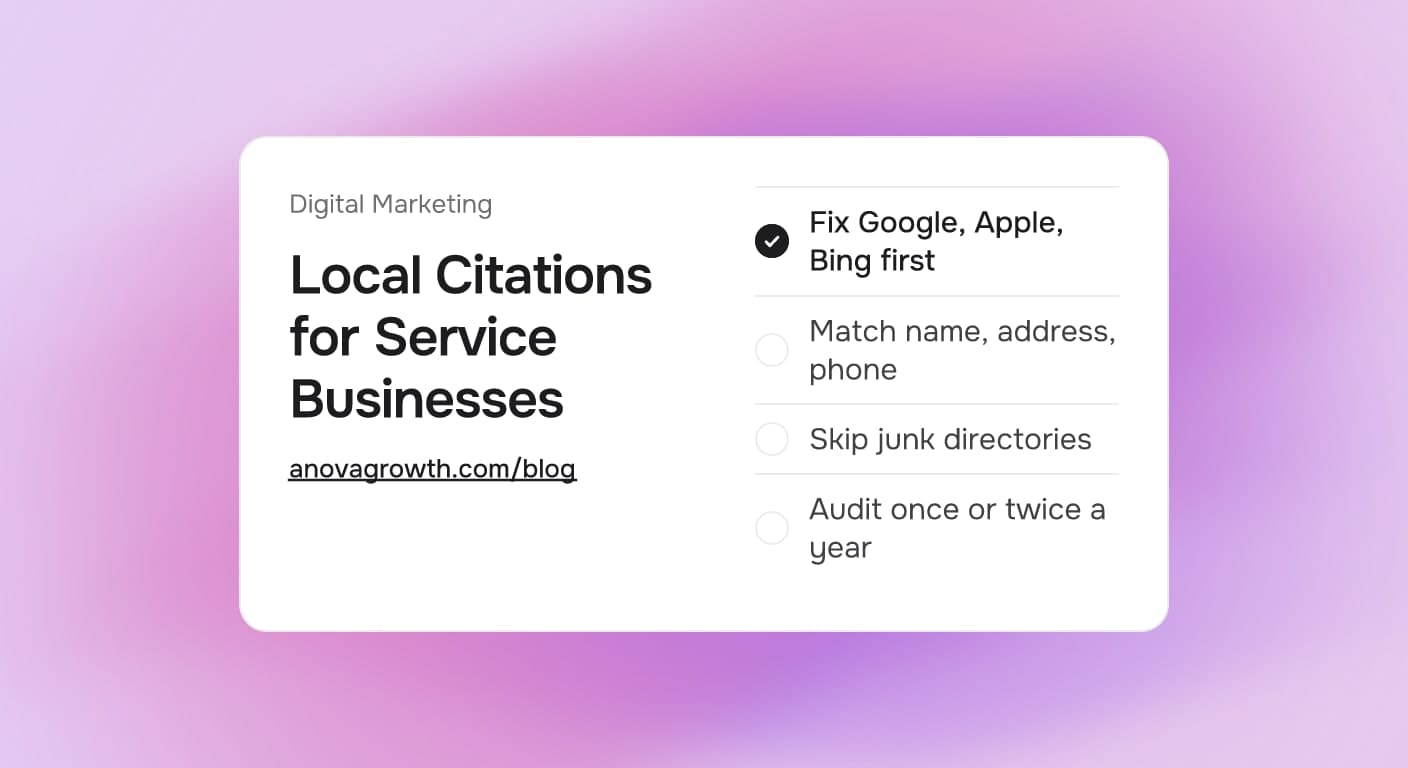
Type your company name into a map app and look at what comes back. For a lot of service businesses the answer is uncomfortable: two phone numbers, an address you moved out of two years ago, and a listing you never created in the first place. Every one of those wrong listings is a citation, and every one of them sends a ready-to-buy customer somewhere else or nowhere at all.
Citations are also one of the least glamorous parts of local visibility. The work is unglamorous, mostly matching text across sites, but it is one of the few local marketing jobs where a couple of focused days keeps paying every month afterward. This guide walks through what a citation actually is, which listings are worth your time, how to run a cleanup, and when a paid directory earns its fee.
Quick answer
A local citation is your business name, address, and phone number listed on another website. Fix Google Business Profile, Apple Maps, Bing Places, and Yelp first, keep every detail identical everywhere, and skip most paid directories unless you can trace real leads to them. Then audit once or twice a year so old phone numbers and addresses never resurface.
What a citation is, and what it is not
A citation is any mention of your core business details on another site. The classic shorthand is NAP: name, address, phone. A listing does not need a link back to your website to count; the mention itself is what map apps, voice assistants, and directory sites match against their own records.
Citations come in three layers:
- Primary platforms. Google Business Profile, Apple Maps, Bing Places, and Yelp. These are where buyers actually search, and they are the records smaller sites copy.
- Directories and aggregators. Industry sites, data companies that feed dozens of small apps, chambers of commerce, and city guides. Individually they matter less, but together they either reinforce your details or contradict them.
- Noise. Scraper sites and junk directories that auto-generate pages from other sources. You rarely need to touch them, because they mostly correct themselves once the primary platforms are right.
A citation is also not a backlink, and it is not a ranking cheat. Some citations come with links, some do not, and the practical payoff is simpler: buyers find correct details, and platforms treat your business as a real, verified, stable company. That stability is what supports your place in the map results alongside the work covered in our service area pages guide.
Which listings actually matter
Most service businesses do not need 50 listings. They need a handful of correct ones and a rule for everything else. Use this table to make the call:
| Listing | Priority | Notes |
|---|---|---|
| Google Business Profile | Do it first | Where most buyers find you. Verify it, then keep hours, services, and phone current |
| Apple Business Connect | High | Feeds Apple Maps, the default on every iPhone a homeowner carries |
| Bing Places | High | Quick setup, feeds Bing search and several assistant apps |
| Yelp | Claim it | Large traffic volume, and its reviews show up next to yours in search results |
| Facebook page | Claim it | Counts as a citation and often ranks for your company name |
| Niche directories for your trade | Situational | Worth it when your industry has a real marketplace there and you can trace leads to it |
| Chamber of commerce and city directories | Worth checking | Usually free, genuinely local, and easy to win |
| Random junk directories | Skip | Never pay for these. They add clutter, not customers |
| Paid lead sites (Angi, HomeAdvisor, Thumbtack) | Separate decision | That is a lead-buying decision, not a citation task. Judge them on cost per booked job |
The pattern: claim the free majors, be selective with trades that have their own proven marketplaces, and treat anything charging a monthly fee as advertising to be measured, not as local SEO.
Consistency rules that make or break citations
Citation value comes from agreement. Platforms compare records, and when they disagree about your phone number or address, confidence in all of them drops. Follow these rules:
- Pick one exact form of your business name and use it everywhere. Not one version on Google and a shorter version on Yelp.
- Write the address the post office way. Suite versus Ste, Street versus St, and unit numbers all count as mismatches to a matching algorithm.
- Use your main advertised phone number everywhere. Never submit a call-tracking number to a directory. If the tracking line ever dies, every listing that copied it dies with it. Our guide to call tracking for service businesses covers how to track calls without poisoning your listings.
- Fix hours and seasonal closures at the same time. Wrong hours are the fastest way to lose a buyer who already found you.
- Match your website footer. Your name, address, and phone in the site footer, in your schema markup, and in every listing should read identically. That gives every platform one unambiguous answer about who you are.
The common failure is drift, not one big mistake. A rebrand here, a new number there, an address change somewhere in between, and within a couple of years the internet holds four versions of your business. That is why the yearly audit below matters more than any single cleanup.
How to audit and clean up your citations
Run this sequence once at the start, then repeat the sweep once or twice a year:
- Search your company name, old phone numbers, and old addresses in quotes. Note every listing that appears and whether its details are right, wrong, or duplicated.
- Search your main phone number and address to catch businesses listed under them, which is common with shared offices and inherited numbers.
- Fix the big platforms by hand first: Google Business Profile, Apple Business Connect, Bing Places, Yelp, and Facebook. Claim anything unclaimed while you are in there.
- Sweep the rest in order of traffic, correcting the name, address, and phone to your single chosen format. Most sites have an edit or claim flow; use it rather than creating a duplicate.
- For stubborn wrong listings, use the platform's "suggest an edit" route, and for Google specifically, the business recovery and claim processes resolve most cases where an old listing outranks reality.
- Log what you fixed and set a calendar reminder for six to twelve months. Citations decay slowly, so the reminder is what keeps the work done.
Expect propagation to take days to weeks on some platforms. Do not judge the cleanup by next morning's results; judge it by whether the next quarterly check found fewer mismatches.
When a paid directory is worth the money
A paid listing can be worth it, but only under the same test you would apply to any ad:
- You can trace leads to it, through a labeled phone number in reports, a dedicated landing page, or codes buyers mention when they call.
- The marketplace is real for your trade. If homeowners in your industry genuinely use that site to find contractors, its fee competes with your cost per lead elsewhere.
- A direct competitor's visibility there is costing you jobs, and the listing would put you in front of the same buyers.
- Traffic evidence is shown to you, not promised. "Great for SEO" with screenshots of traffic is a maybe. Great for SEO with no numbers is a pass.
Everything else on the pitch sheet, the badges, the "premium placement," the bundles of 300 directories, is noise for a local service company.
How we handle citations at AnovaGrowth
We build and audit websites for service companies across the country, and citation drift shows up in almost every audit: the office moved, the owner changed numbers years ago, or a long-gone marketing agency submitted a tracking number that now lives on sites nobody remembers. So our sequence is fixed. On every new site we lock the footer details and schema to one exact name, address, and phone before launch, then claim and correct the five primary platforms so buyers and platforms meet one consistent record from day one.
On cleanup projects for existing businesses, we always start with the search-and-log sweep above instead of buying a directory bundle, because the audit reliably turns up the two or three listings that were actually costing calls. Fixing those beats adding fifty new ones. When the cleanup is done, the monthly Search Console routine is where we watch for the next drift: a sudden listing of a phone number or an address change in what buyers see is usually a citation problem, not a website problem.
Related questions
Do citations still matter when my Google Business Profile is already strong? Yes, but with smaller weight than years ago. The primary platforms drive discovery, and the long tail of directories mostly serves as corroboration. Buyers search more places than Google, and platforms compare records, so agreement across sites still protects the profile doing the heavy lifting.
How long do citation fixes take to show up? Google, Apple, Bing, and Facebook usually reflect direct edits within days to a couple of weeks. Aggregator-fed sites and apps can lag by weeks more. Judge the cleanup over a quarter, not over a weekend.
My business moved and the old address will not clear. What do I do? Update the website and schema first so every platform has one consistent current record, claim the old listing if it is unclaimed, and use each platform's edit or dispute flow. Recheck after a few weeks, because stale records often need a second pass to disappear everywhere.
Should I put a call tracking number in my listings? No. Submit your main advertised number, and if you want call tracking, run the tracking numbers through your website and ad campaigns only, where you control the display. Directories copy whatever you give them, and a dead tracking line can silently strand dozens of listings.
How many citations does a service business actually need? Fewer than most pitch decks suggest. Five to ten solid, consistent listings, plus any genuine local and industry directories, covers the practical need. Volume without consistency reads as spam to platforms and does nothing for buyers.
Key takeaways
- A citation is your name, address, and phone on another site, and it only helps when every copy matches.
- Claim and correct the majors first: Google Business Profile, Apple Maps, Bing Places, Yelp, and Facebook.
- Never submit call-tracking numbers or buy directory bundles that promise rankings instead of showing leads.
- Paid listings are advertising to be measured by cost per booked job, not local SEO.
- Run a citation sweep every six to twelve months, because drift, not one-time errors, is what quietly costs calls.
Conclusion
Citations reward boring consistency. Pick one exact version of your business details, lock the five primary platforms, decline everything that cannot show you leads, and put a recurring audit on the calendar. A weekend of matching text protects every marketing dollar you spend anywhere else.
Ready for a citation and local SEO cleanup? Contact us about an audit or a full local visibility pass.
Related articles
FAQ Pages for Service Businesses: What to Publish and What to Skip
Which questions belong on a service business FAQ page, where the answers should live on your site, and what to leave off so the page keeps earning attention.
Read the article: FAQ Pages for Service Businesses: What to Publish and What to Skip
Google Search Console for Service Businesses: The Monthly Checklist That Finds Missed Leads
Search Console shows which searches already find you. Run this monthly checklist to catch indexing breaks, ranking drops, and easy lead fixes.
Read the article: Google Search Console for Service Businesses: The Monthly Checklist That Finds Missed Leads
Service Area Pages for Local SEO: How Many to Build and What Makes Them Rank
How many service area pages to build, what each page needs to rank, and why thin doorway copies get ignored. A practical playbook for service businesses.
Read the article: Service Area Pages for Local SEO: How Many to Build and What Makes Them Rank
