Job Handoff Between Office and Field Crews: How to Pass Work Without Losing Details
A job handoff is a structured transfer of scope, schedule, and site details between office and field. Here is how to make them survive a busy Monday.
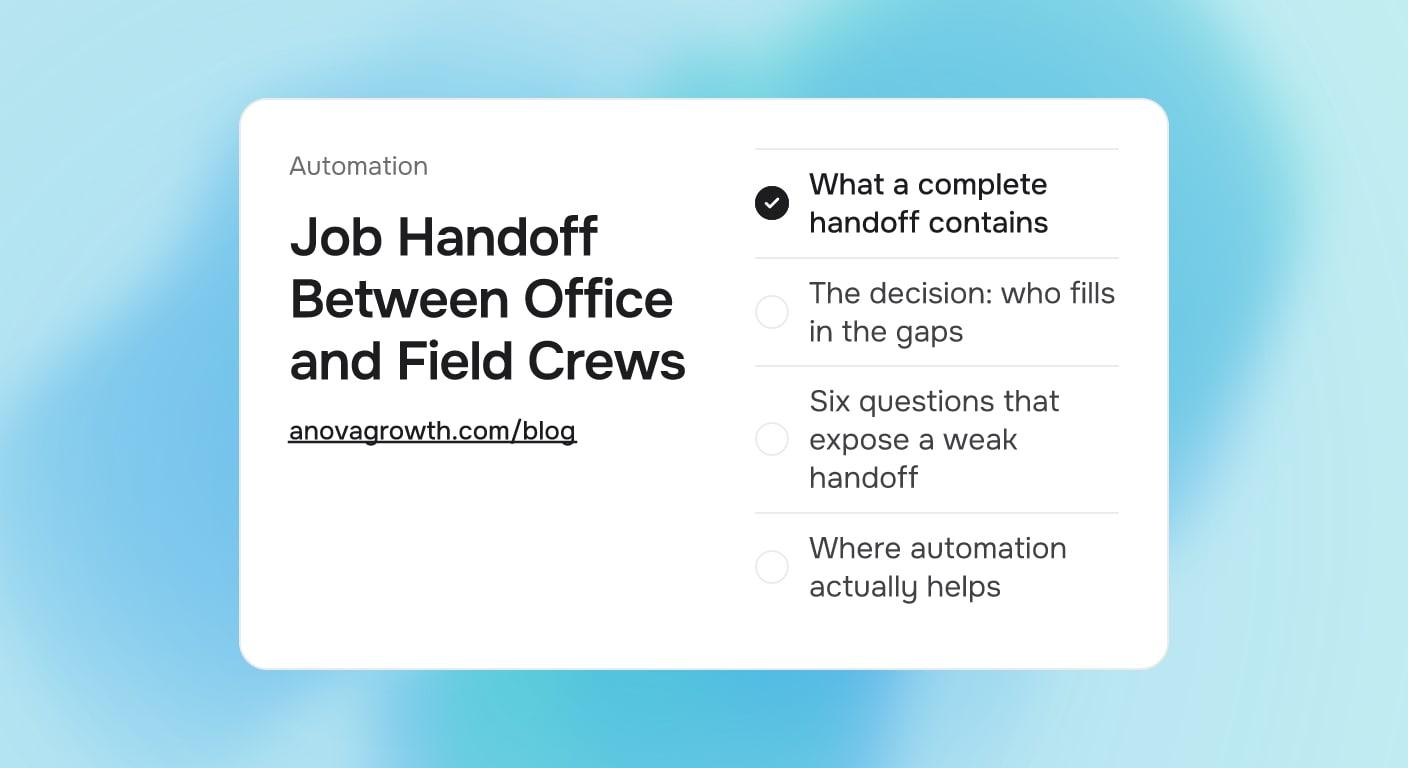
Quick answer: a job handoff is the structured transfer of a sold job from the office to the crew that performs it. It should carry scope, pricing commitments, site access notes, customer expectations, and materials status in one record. When handoffs run through verbal updates and loose texts, details vanish at exactly the wrong moment.
Why the handoff is where jobs go sideways
Most service businesses do not lose jobs at the sale or during the work. They lose them in the gap between the two. The person who sold the job knows the customer wanted the gate latch fixed while they were on site. The technician who shows up only sees the work order line item. Nobody wrote the gate latch down, so it never happens, and the customer remembers.
The pattern repeats across trades:
- The estimator promised the crew would arrive before 10 a.m., but the schedule already shows an afternoon window.
- A customer mentioned a dog in the backyard. The tech climbs the fence and gets surprised.
- The quote covered two HVAC systems, but the dispatch record only lists one address unit.
Each miss is small. Together they are why customers quietly stop calling back.
What this looks like in practice: the office treats "I told the tech about it" as documentation. There is no record. The tech treats "I figured it out on site" as normal. There is no comparison against what was promised. The gap is invisible until a callback, a refund, or a bad review surfaces it.
What a complete handoff contains
A handoff record should answer every question a crew member would otherwise text the office about. At minimum:
- Scope as sold. Line items, quantities, and any verbal add-ons captured in writing before dispatch.
- Commitments made to the customer. Arrival windows, price promises, timeline statements. These are contractual whether or not anyone intended them that way.
- Site details. Access instructions, gate codes, parking, pets, hazards, unit numbers.
- Materials status. What is staged, what is on order, what needs pickup.
- Customer history. Past issues, prior complaints, warranty status on earlier work.
If your current process covers only items 1 and 3, the handoff is incomplete. Items 2, 4, and 5 are the ones that create callbacks and refund conversations.
The decision: who fills in the gaps
There are three workable models. Pick based on volume and office staffing:
| Model | How it works | Best fit |
|---|---|---|
| Sales-owned | Whoever sold the job completes a handoff checklist before dispatch | Small teams, owner-led sales |
| Office-owned | A dispatch role interviews the sales record and assembles the packet | Dedicated office staff, higher volume |
| System-owned | Automation assembles the record from CRM, quotes, and call notes; a human reviews | Any team drowning in manual prep |
The third model is where most businesses land eventually. It does not remove the human check. It removes the copying. The CRM record, the signed quote, and the call notes already contain the details. An assembly step that pulls them into one view takes minutes instead of an afternoon.
Six questions that expose a weak handoff
Ask these against your last ten jobs. Honest answers tell you more than any audit.
- Could a new technician complete the last job you dispatched using only the work order? If they would need to call someone, write down what they would ask about.
- Where do verbal promises from the sales visit live? "Somewhere in the thread" is the same as nowhere.
- How does the crew learn about a promise the office did not witness? If the answer is "they don't," you have a liability, not just an inconvenience.
- What happens when the assigned tech is out sick? A good handoff record means any qualified crew member can pick the job up cold.
- How often does the office field a mid-job "wait, what did the customer say?" call? Count it for one week. The number is usually higher than expected.
- After the job, does anyone compare what was delivered against what was promised? This one check catches most problems before the customer does.
Where automation actually helps
The useful automation here is not a chatbot reading work orders aloud. It is three small, boring pieces:
- Capture at the source. Call transcription and quote tools already record what was said and sold. A prompt at quote approval asking "any verbal commitments?" is cheap and catches the gate-latch class of problem. Our work on AI call transcription and summarization for service businesses showed most missed details live in the first two minutes of the sales call, before anyone starts taking notes.
- Assembly without copying. A workflow that combines the CRM record, quote, and site notes into one packet per job. Tools like the ones compared in Zapier vs Make vs n8n for service businesses handle this without custom software.
- Confirmation both ways. The crew acknowledges the packet before the truck rolls. A one-tap acknowledgment in your dispatch or field app is enough. Unacknowledged handoffs are the ones that fail.
What does not help: building a handoff process in a document nobody opens. The record needs to live inside the tool the crew already uses to see the day's schedule. A separate "handoff document" is where details go to die.
What we tell our own clients
At AnovaGrowth, this is the first workflow we look at when a service business says "communication is bad between the office and the field." The symptom always sounds like a people problem. It is almost never a people problem. It is an information problem: the details exist, but they exist in four places and no one assembles them.
One of the fastest wins we have shipped is a rule borrowed from aviation: the person receiving the handoff reads it back. The dispatcher or tech confirms the scope and commitments out loud or in writing before the job starts. It sounds trivial. It surfaces a wrong address, a missed line item, or an unapproved discount before the truck moves, when the fix is free.
The teams that resist structured handoffs usually believe their jobs are too custom for a checklist. They are partly right. Every job is custom. But the questions never change: what did we promise, what does the site need, what is ready. That is the whole checklist.
A 30-day rollout that sticks
- Week 1: Audit the last ten jobs. List every detail that lived only in someone's head or a text thread.
- Week 2: Define the handoff packet fields for your trade. Keep it to one screen.
- Week 3: Run it manually on every new job. Expect friction. Fix field definitions, not people.
- Week 4: Automate assembly from your CRM and quotes, add read-back confirmation, and review one week of completed jobs.
If week 3 exposes that your quote and CRM do not talk to each other, that is the real project, and it is worth doing. Start with the questions in CRM pipeline stages for service businesses to see whether the records are structured enough to support the handoff at all.
The next step
Pull one recently dispatched job and rebuild its handoff record from scratch using the field list above. Time yourself. If it takes more than ten minutes, or you cannot fill it in completely, your handoff process is costing you jobs quietly. We build these workflows for service businesses as a standard engagement: capture at the source, assemble in your CRM, confirm before dispatch. Contact AnovaGrowth for a walkthrough of what that looks like with your current tools.
Related articles
What Not to Automate in a Service Business: A Decision Framework
Which tasks to hand to software and which to keep human, a four-question test for any automation, and the mistakes that quietly cost service businesses money.
Read the article: What Not to Automate in a Service Business: A Decision Framework
Rain Delay Scheduling for Exterior Contractors: Automate the Weather Day
When rain kills tomorrow's jobs, who calls everybody? The rain day workflow exterior contractors can automate, from trigger to reschedule to refill.
Read the article: Rain Delay Scheduling for Exterior Contractors: Automate the Weather Day
Phone Calls Flagged as Spam: How Service Businesses Fix Caller ID Reputation
Carriers can show your number as Spam Likely before anyone answers. Learn what triggers flags, how to fix caller ID reputation, and what to watch weekly.
Read the article: Phone Calls Flagged as Spam: How Service Businesses Fix Caller ID Reputation
