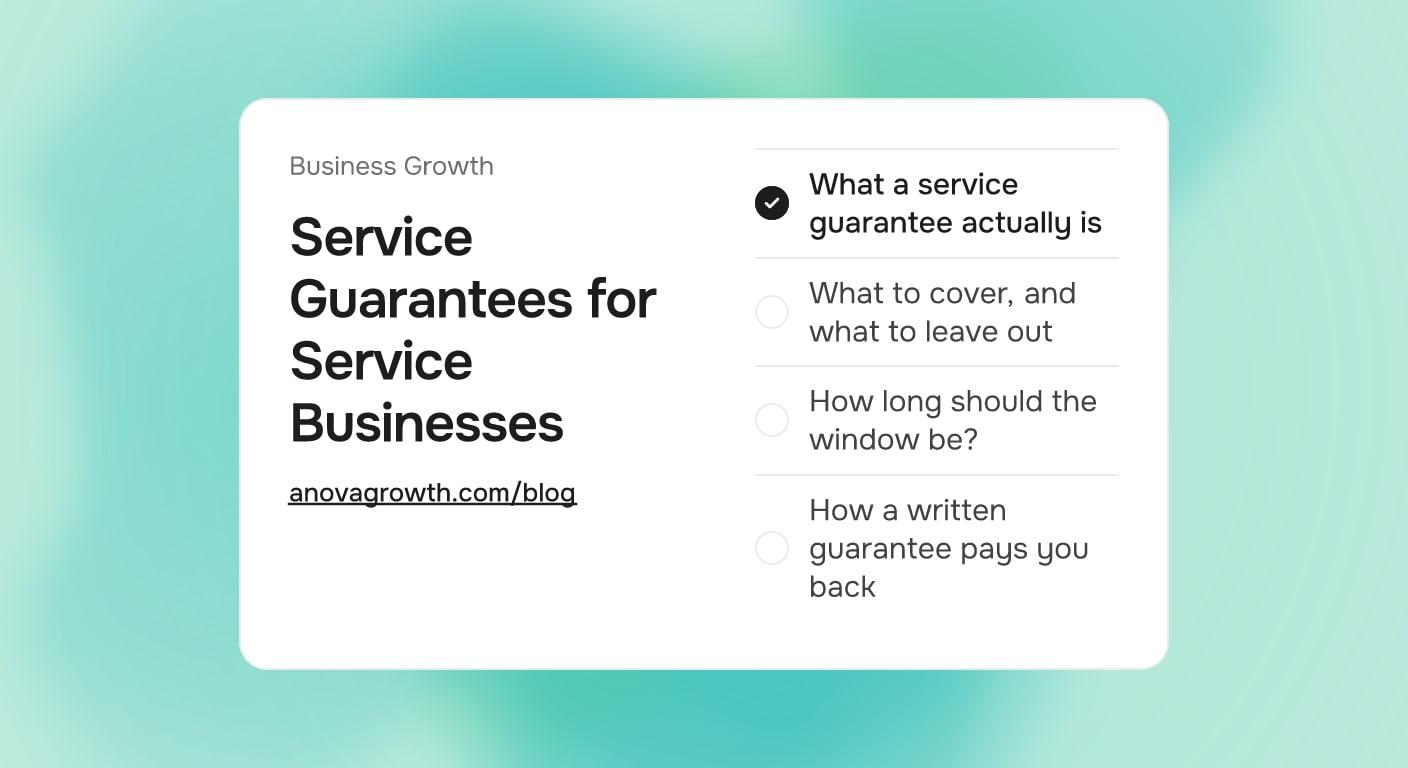
Service Guarantees for Service Businesses: What to Promise and How to Honor It
A work guarantee is a written promise to fix what goes wrong. Here is what to cover, how long to promise, and how to run claims without a spreadsheet.

A guy re-roofs a house in March. In September the owner calls: valley flashing failed, ceiling stain spreading. Is it covered? Who decides? If the answer lives in the owner's head or a folded paper copy, the business eats the callback, or worse, it argues with the customer in front of a review audience.
A written guarantee fixes the disagreement before it starts. It tells the customer what is covered and for how long, and it tells your team what to do when a claim comes in. This guide covers what to promise, what to leave out, and how to run the process without drowning in it.
What a service guarantee actually is
A guarantee is a promise: if something specific goes wrong within a specific window, the business makes it right at no charge or at a reduced charge. A warranty usually refers to the work itself, while a satisfaction guarantee refers to whether the customer feels the job was done right. Both work the same way operationally: a defined trigger, a defined window, and a defined fix.
Most service businesses already honor callbacks informally. "If something goes wrong, just call us." The problem with informal is that it only works while the owner answers the phone. The moment you have office staff, a second crew, or a slow month, the informal promise gets applied unevenly, and customers notice.
What this looks like: a remodeling company writes "All workmanship is guaranteed for two years. If something fails because of our installation, we fix it free. Manufacturer defects follow the maker's warranty, and we handle the claim paperwork for you." That is three sentences, and it settles the September ceiling-stain call in ten seconds.
What's the difference between a guarantee and a warranty?
For a service business, you can treat them as one thing: a written promise attached to completed work. The line that matters is who is responsible. Workmanship problems are yours. Product defects are the manufacturer's, and your promise is to help file that claim, not to eat the part cost. Writing that split down is what keeps a $40 part from becoming a free $4,000 redo.
What to cover, and what to leave out
Keep the promise narrow enough to survive a bad quarter. A guarantee you quietly resent honoring is worse than a smaller one you stand behind.
Cover this:
- Defects in your own installation or workmanship
- Repeated failures of the same component you touched
- Your crew's damage to customer property (broke a tile, scratched a door) if it slipped past punch-out
Leave out, or handle in separate terms:
- Manufacturer and product defects, covered by the maker's own warranty
- Customer misuse, neglect, or third parties who worked on the system after you
- Normal wear items: filters, batteries, blades, seals designed to be replaced
- Jobs the customer self-performed changes on, even small ones
- Cosmetic preferences discovered weeks later that were visible and accepted at walkthrough
Decision table:
| Situation | Covered by you? | Why |
|---|---|---|
| Valve you installed leaks at 8 months | Yes | Workmanship defect |
| Same valve failed because the municipal supply ran dirty | No | External cause; document and help the customer |
| Water heater unit fails at year 3 | Maker's warranty | You file the claim, customer pays nothing for the part if covered |
| Customer repainted the wall and covered your access panel, now wants it reopened free | No | Third-party change |
| Crew cracked a windowpane during service, reported 2 days later | Yes, quickly | Your damage, honor it fast |
The fastest way to kill a guarantee's marketing value is to fight obvious claims. The second fastest is to promise everything in writing and later discover you promised the unfixable. Keep the scope narrow, honor it completely.
What should I not put in a service guarantee?
Anything you cannot verify or measure. Avoid promises like "lifetime" on work where you cannot prove the install date, "100% satisfaction" that obligates you to redo jobs over preference disagreements, and coverage of parts whose failure you cannot tell apart from wear. Also avoid vague verbs. "Guaranteed to your satisfaction" is a promise to negotiate. "We will re-run the scope listed on your invoice at no charge within 12 months" is a promise you can execute.
How long should the window be?
Match the window to how long your work actually holds and what your industry's customers expect. Common ranges by trade:
| Trade | Typical workmanship window |
|---|---|
| Roofing, siding, exterior | 2 to 10 years |
| HVAC installs | 1 to 2 years on labor, 10 on equipment (maker) |
| Plumbing | 1 to 2 years on labor |
| Electrical | 1 to 2 years |
| Cleaning, lawn care, recurring services | Satisfaction check within 24 to 48 hours per visit, not a long window |
| Home remodeling | 1 to 2 years, per room or whole project |
Two rules override any table. First, never promise longer than the longest job you would still be in business to honor. A 10-year roof guarantee from a 3-year-old company reads as a bluff. Second, an unexpected window is a marketing asset. If every roofer in your county says two years and you can honestly say three, say three and put a date-stamped card in every invoice.
Is a one-year guarantee any good?
If a year genuinely covers your failure modes, yes. For most trades, workmanship defects show up in the first year, so a one-year window catches nearly all real claims. Two things make one year stand out: stating it in writing on every invoice when local competitors do it verbally, and answering claims fast. A one-year guarantee answered in 48 hours beats a ten-year guarantee answered in ten days.
How to run the claim process without chaos
This is where most businesses stall. The guarantee document exists, customers occasionally call, and each claim gets handled by whoever picked up the phone. Six steps turn that into a procedure instead of a favor.
- Issue the guarantee in writing, tied to the invoice. A PDF or printed card listing scope, window, and claim steps. Attach it to the invoice record so it follows the customer, not a drawer.
- Log the completion date automatically. The window starts at job completion or final payment, whichever your guarantee says. If that date lives in accounting and the guarantee lives in someone's memory, you are already losing. This is the same rule that makes automated warranty tracking worth running: every claim gets judged against a recorded date, not a guess.
- Give the customer one channel to report a claim. A link, a form, an email address, or a phone extension. Any one route works; three routes do not.
- Triage within one business day. Confirm receipt, ask for a photo or short description, tell them when a tech arrives. Speed here matters more than the guarantee text, because the claim is when trust gets tested.
- Verify before promising a fix. Check install date, scope, and what changed since completion (third-party work, misuse). Approve it, decline it with the reason in writing, or route it to the maker's warranty.
- Close the loop and log the cause. Repair done, date completed, root cause. Six months of claim data is a training document for your crews, and repeated causes point at a process problem, not a bad tech.
What happens if a customer files a claim outside the window?
Say no kindly, and in writing, with the reason. "Your install was completed March 2024 and the workmanship guarantee runs 24 months, so this one falls outside it. Here is what the repair would cost, and here is a 10 percent courtesy discount for being a past customer." You keep the customer, you keep the precedent, and you did not silently extend a promise you cannot scale. Logging declined claims with reasons also protects you from a pattern of informal yeses that eventually harden into the real policy.
How a written guarantee pays you back
The direct payoff is fewer arguments and clearer pricing on callbacks. The indirect payoff is bigger:
- Sales tool. "Two-year workmanship guarantee, in writing, on every invoice" answers the customer's risk question before it gets asked. It removes a reason to pick the cheaper quote across the street.
- Review defense. When something fails, a fast honored claim turns a potential one-star review into a customer who tells the story of how you fixed it.
- Quality pressure that helps you. Logged claim causes surface the crew, the supplier, or the step where defects start. Fix that and callbacks drop, which is cheaper than any guarantee.
- Pricing confidence. Businesses that fear callbacks price defensively. A scoped guarantee with real claim data lets you price on actual risk instead of vague fear.
The trade is simple. Without a written guarantee, every claim is a conversation and every conversation is a gamble. With one, the decision happens in seconds and the relationship survives.
AnovaGrowth note: this is a small automation for us, not a custom software project. The pattern is: your invoice or estimate tool records the completion date, a form catches claims, notifications route to the right person, and a simple log tracks cause and cost. We have set up versions of this running on tools the business already pays for, with automated job status notifications keeping the customer informed while the claim is open.
Key takeaways
- Write it down: scope, window, one claim channel.
- Separate workmanship (yours) from product defects (the maker's; you help file).
- Pick a window you can honestly honor. The number matters less than answering claims fast.
- Start the clock from a recorded completion date, not memory.
- Log every claim and its root cause. That data improves crews and pricing more than the marketing improves sales.
Next steps
If you want the guarantee and the claim path running without someone babysitting it, contact us and we will scope it against the tools you already use. Useful companions: automated job status notifications keep customers updated while a claim is open, automated job costing shows what callbacks really cost you, and digital job checklists stop a lot of defects before they turn into claims.
Ready to make your guarantee something you can actually honor? Contact us to discuss how we can help your business.
Related articles
The Owner Playbook: Turn What Is in Your Head Into a Business Asset
If the business only works when you are present, it has a ceiling. An owner playbook captures decisions, scripts and steps so the team runs without you.
Read the article: The Owner Playbook: Turn What Is in Your Head Into a Business Asset
The Quarterly Business Review: A 90-Minute Cadence for Service Business Owners
Most service business owners review numbers only when something breaks. A quarterly review cadence catches problems while they are still cheap to fix.
Read the article: The Quarterly Business Review: A 90-Minute Cadence for Service Business Owners
Standard Operating Procedures for Service Businesses: What to Document First
Turn the work that lives in the owner's head into short SOPs the team can run. Which processes to document first, what to skip, and how to keep them current.
Read the article: Standard Operating Procedures for Service Businesses: What to Document First
