Jacksonville Pearl Square Growth: Build Business Workflows Before Downtown Demand Arrives
Pearl Square is moving forward after Jacksonville approved a revised incentive package. Build the intake and follow-up workflows downtown growth will require.

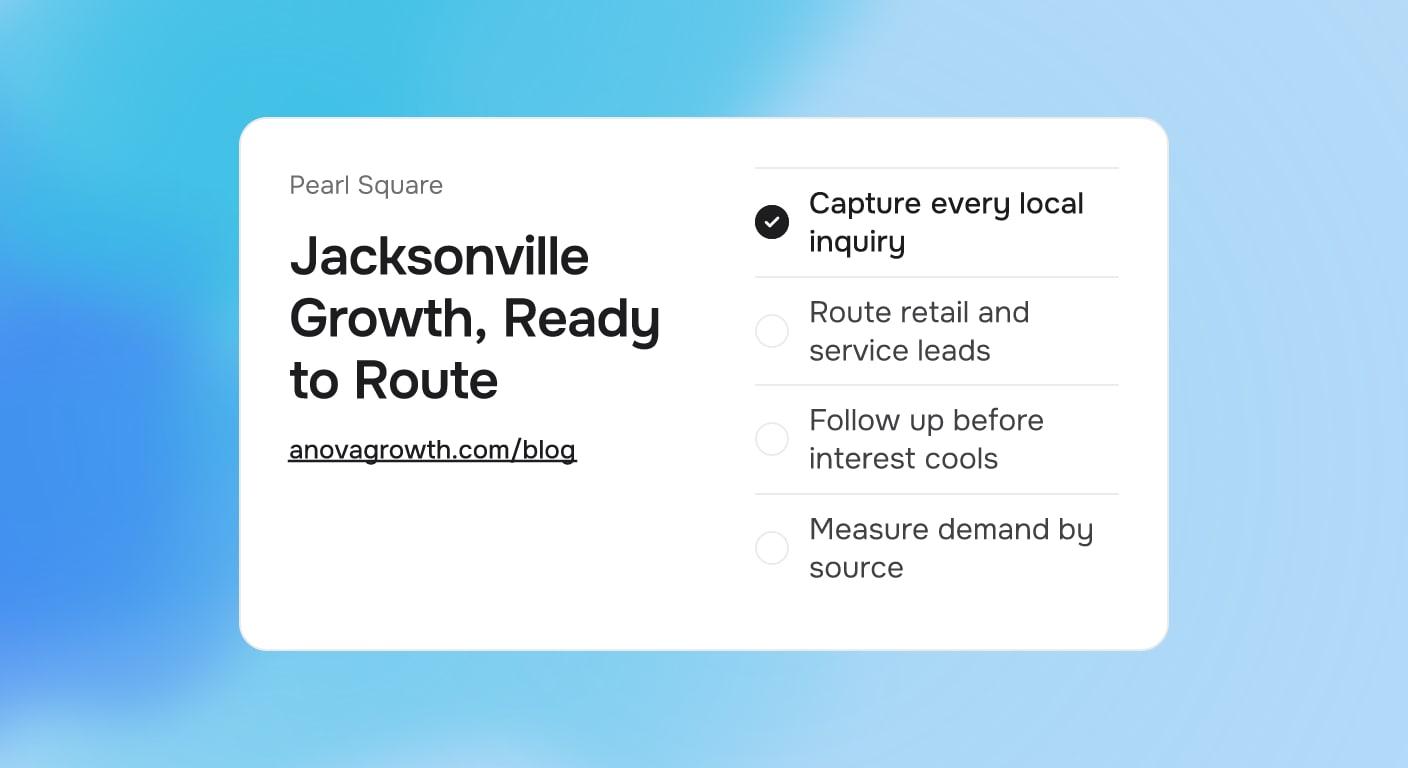
Quick answer: Jacksonville City Council approved a revised incentive package for the Pearl Square development on November 11, 2026. That does not make every future building, tenant, or opening date certain. It does mean downtown businesses should prepare for more inquiries, bookings, leasing conversations, vendor requests, and customer questions with a website and workflow system that can capture, route, and follow up on demand.
The useful question for a Jacksonville business is not whether Pearl Square will change downtown overnight. It is whether your operation can handle the next wave of attention without letting good inquiries sit in an inbox.
What the Pearl Square decision means for local operators
Jacksonville City Council approved a compromise package tied to Gateway Jax's Pearl Square project in an 11-8 vote, according to Jacksonville Today. The reported plan includes a Publix-anchored mixed-use building with apartments and retail space. The Downtown Investment Authority's project overview describes Pearl Square as a multiphase downtown neighborhood with housing, retail, dining, offices, parks, plazas, and pedestrian-oriented public space.
Those are development signals, not a promise that every component will open on a specific date. Plans, approvals, financing, leasing, construction, and tenant operations still move on different timelines. For local businesses, the practical takeaway is simpler: prepare the systems that make it easy to respond when residents, visitors, property managers, retailers, and partners start asking questions.
The Jacksonville businesses most likely to feel the change first
Pearl Square's growth will not affect only the businesses inside the project. It can create new demand for the surrounding network of operators that serve downtown residents and visitors.
- Retailers and restaurants need location pages, menus, booking paths, event updates, and fast answers to common questions.
- Hospitality and wellness businesses need inquiry capture, appointment scheduling, confirmation messages, and no-show follow-up.
- Contractors, builders, and commercial service companies need bid intake, site-visit scheduling, proposal follow-up, and project documentation.
- Property managers, brokers, and leasing teams need lead routing, showing requests, document collection, and handoffs between agents.
- Professional firms and vendors need a credible website that explains their Jacksonville service area and makes the next step obvious.
This is where the Jacksonville page's focus on healthcare, maritime, logistics, construction, and real estate operations matters. The market already depends on scheduling, documentation, and handoffs. Downtown growth adds more volume and more parties to coordinate.
Four workflows to build before demand spikes
1. Turn every inquiry into a trackable record
An email address on a contact page is not a lead system. A useful intake form asks what the person needs, where the work is located, when they need an answer, and which category fits the request. It then creates a record in the right pipeline instead of sending an unowned message to a shared inbox.
For a downtown contractor, that might mean separating tenant improvements, property maintenance, and new-construction bids. For a restaurant or wellness operator, it might mean separating reservations, private events, catering, and partnership requests. The categories should reflect how the business actually assigns work.
2. Route the next action to a real owner
The workflow should assign the next step and store the contact. A retail partnership inquiry can go to business development. A service request can go to operations. A leasing question can go to the broker responsible for that property.
The first version does not need a complex platform. It needs clear ownership, a response target, and an escalation when the target is missed. A simple CRM connection can do more for a growing Jacksonville business than another disconnected dashboard.
3. Build a website that answers before the phone rings
As downtown search demand grows, local businesses will compete on more than having a map listing. Their websites need clear service pages, current locations, useful FAQs, strong mobile performance, and forms that work on the first attempt.
An operator should be able to answer five questions quickly:
- What do you do for people in Jacksonville?
- Which neighborhoods or property types do you serve?
- What happens after someone contacts you?
- How soon will a person respond?
- What proof shows that you can handle this kind of work?
Our web development service is built around that conversion path. A redesign should preserve working URLs, forms, analytics, and local search signals while making the next action easier to take. The service-business website redesign checklist covers the launch risks worth checking before a new site goes live.
4. Follow up while the request still has momentum
Interest fades quickly when a person asks for a quote, tour, reservation, or consultation and receives no clear next step. A short confirmation can set expectations immediately. A second message can answer the most common question. A staff task can flag the request if nobody has followed up.
That is a good use of workflow automation. It does not mean handing every customer conversation to a bot. It means letting software handle the predictable reminders and routing while a person takes over when judgment, negotiation, or a sensitive decision is involved.
A practical Pearl Square readiness test
Before buying another tool, run five recent inquiries through your current process. Use a real request from a potential customer, vendor, renter, event host, or commercial partner and measure:
- How long it takes to reach the right person.
- Whether the request is categorized correctly.
- Whether the contact receives a clear confirmation.
- Whether the next follow-up is scheduled.
- Whether the owner can see the source, status, and value of the opportunity.
If two or more answers depend on somebody remembering what to do next, the bottleneck is not a lack of effort. It is an unfinished workflow.
At AnovaGrowth, our operating view is that the best first automation is usually the handoff people repeat every day: form to CRM, CRM to owner, owner to calendar, calendar to confirmation, and confirmation to follow-up. That sequence creates a visible path from local attention to booked work.
What Jacksonville businesses should do now
Pearl Square is a reason to prepare, not a reason to publish promises about an unfinished project. Start with the parts your business controls:
- Update the Jacksonville pages that explain your services, neighborhoods, and industries.
- Make the primary inquiry path work on a phone without extra steps.
- Connect forms to a pipeline with clear ownership and response targets.
- Add confirmations and follow-up tasks for requests that do not book immediately.
- Track calls, forms, bookings, and qualified inquiries by source.
The businesses that benefit most from downtown growth will not be the ones with the loudest prediction. They will be the ones that can respond when a new resident, visitor, retailer, property manager, or partner raises a hand.
Ready to make your Jacksonville operation easier to find and easier to run? Book an AI Operations Audit and bring the workflow that currently eats the most time.
Related articles
Charlotte CLT Beyond: Build Workflows Before Airport Growth
Charlotte's proposed CLT Beyond program points to more commercial activity. Local operators should fix lead, quote, and follow-up workflows before demand arrives.
Read the article: Charlotte CLT Beyond: Build Workflows Before Airport Growth
Columbia Riverfront Growth: Build Hospitality Workflows Before Demand Arrives
Columbia's Congaree Riverfront plan is still a draft. Hospitality and real-estate operators can prepare now with better booking, follow-up, and guest workflows.
Read the article: Columbia Riverfront Growth: Build Hospitality Workflows Before Demand Arrives
Customer Deposits for Service Businesses: When to Collect and How Much
Deposits protect your schedule and your cash flow. Here is how much to ask for, when to collect it, and how to automate the payment step.
Read the article: Customer Deposits for Service Businesses: When to Collect and How Much
