After-Hours Calls for Service Businesses: Capture the Work You Sleep Through
Emergency callers who reach voicemail call the next company. Here is how to capture after-hours demand without hiring a night receptionist.

Quick Answer
Most after-hours calls are emergencies, and emergency callers hang up on voicemail within seconds. The fix is not a 24/7 call center. It is a short chain: a missed-call text back within a minute, an automated intake that asks three to five qualifying questions, and a morning handoff that puts anything urgent at the top of the queue. Set up properly, you capture the job without paying for a receptionist who never sleeps.
Why After-Hours Calls Matter More Than They Look
Two patterns collide in every service business we work with:
- Emergency demand skews off-hours. Water heater failures, lockouts, broken AC in July, a dead compressor at a restaurant before dinner service. These calls arrive at 9pm on a Friday, not at 10am on a Tuesday.
- Emergency callers do not leave voicemail. They hang up, dial the next search result, and hire whoever answers or replies first. Voicemail conversion on urgent calls is close to zero in practice.
That means your voicemail greeting is not a safety net. It is a donation to your competitors.
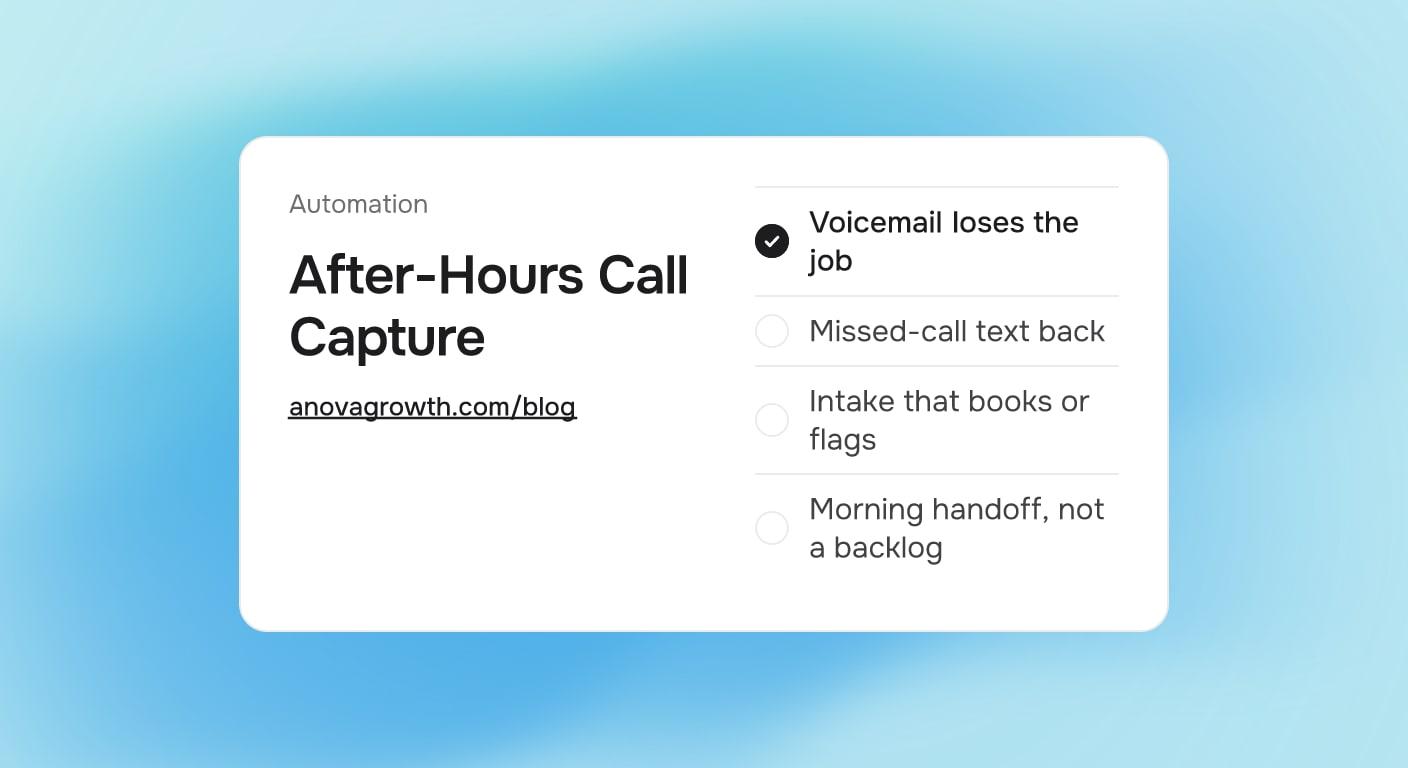
The Capture Chain: What to Automate and in What Order
A single magic tool does not exist. What works is a short, boring chain where each step catches what the last one missed.
Step 1: Missed-call text back, within one minute
The moment a call goes unanswered, an automated text fires to that number:
"Sorry we missed you. Reply here and tell us what you need and a rough location, and we will get back to you fast, even before the office opens."
This one message does most of the work. It converts a silent lost caller into a written, timestamped lead with the first details already collected. Many automation platforms support this out of the box, but it must be paired with A2P 10DLC registration or the texts may never deliver.
Step 2: Intelligent intake for the conversations that follow
When the caller replies, a scripted intake (AI agent or decision-tree) asks only what your dispatcher actually needs:
- What is the problem, in the caller's own words
- Is anyone in danger or is water actively flowing (safety and damage triage)
- Property address or ZIP
- Is this the owner, tenant, or property manager
- When do they need it handled
Three to five questions max. The output lands in your CRM as a lead with priority set. You can read more about structuring that pipeline in our CRM pipeline stages guide.
Step 3: Triage rules that decide tonight vs. tomorrow
Not every after-hours contact is a 2am dispatch. The intake result should feed simple rules:
| Signal | Handling |
|---|---|
| Active water, gas smell, lockout, no heat below 40F | Wake-the-owner alert by call plus text |
| Urgent but stable (next-day AC out, non-flowing leak) | Flagged for first slot in the morning schedule |
| Price shopper, non-resident landlord, off-area ZIP | Goes to the normal queue, no alert |
| Spam or solicitation | Logged and muted |
The point of the table is not specific thresholds. It is that you decide the rules once, in daylight, instead of every night at 11pm by whoever happens to see the phone.
Step 4: A morning handoff, not a backlog
Every night's contacts should produce a single digest: what came in, what got booked, what is flagged urgent, what needs a callback. Two minutes of reading beats reopening an inbox of scattered threads. Pair this with the follow-up habit from our 12-month lead nurture sequence so after-hours leads that don't close tonight still get worked.
What This Looks Like in Practice
AnovaGrowth runs a small service business of its own scale, and we have built intake chains for contractors who were bleeding after-hours jobs to competitors. The pattern that shows up every time:
- About half of missed calls never redial you, whatever you may hope.
- The ones the text back reaches usually answer in a couple of minutes, on their phone, in plain text.
- Owners routinely sleep through the first urgent alert because the alert goes to the wrong channel. If it is not a phone call plus text and it cannot wake you, it is not an alert.
We also see the failure mode clearly: businesses bolt on an AI agent that handles everything, gets the address wrong, and books jobs in the wrong service area. That is why the chain above keeps a human decision at the very top of the funnel. Automation collects and routes; it does not decide whether you send a tech out at 1am.
Related Questions We Get Asked
Should I hire an answering service instead? Maybe, if your call volume is high and complex. Answering services cost hundreds per month and vary in quality. For most small operators, the text-back plus intake chain captures most of the same jobs for a fraction of the cost, and you keep the data in your own CRM.
Can the intake actually book appointments overnight? Yes, if you feed it your real availability and service area rules. Two-way calendar sync, covered in our calendar sync guide, prevents it from double-booking against what your techs already have on the schedule.
What about spam calls triggering the whole chain? Filter by caller behavior before the text fires: ignore known spam patterns and short ringouts. Intake questions also filter human spam cheaply.
Do I need a new phone system to do this? Usually no. Most VoIP and business phone platforms expose webhooks or simple integrations that fire on missed calls. What matters is that the trigger is fast and the CRM connection is reliable.
How do I keep this from feeling robotic to customers? Writing. The text should sound like a person, not a form. Admit the miss, promise a fast reply, ask two easy questions. Speed buys you enormous forgiveness; nobody expects prose at 10pm.
What legal or compliance items matter for automated texting? Register your number under A2P 10DLC rules for US texts, honor stop requests, and keep records. We outline the registration issue in our A2P guide.
Next Step
If your after-hours path today is "voicemail and hope," the cheapest possible improvement is the missed-call text back with a human-sounding reply. Build the intake and triage on top of that once you trust the foundation. If you want help designing the chain for your specific trade and CRM, contact us and we will map it with you.
Key takeaways:
- Emergency callers will not leave voicemail, so voicemail is a competitor donation.
- A fast missed-call text back converts silent losses into written, qualifying leads.
- Written triage rules made in daylight beat improvised decisions at midnight.
- A single morning digest keeps the night's work actionable instead of scattered.
Related articles

Quote-to-Close Automation for Service Businesses: Close More Jobs Without the Follow-Up Marathon
Service businesses lose jobs in the gap between sending a quote and getting a yes. Automate your quote-to-close pipeline and stop leaving revenue on the table.
Read the article: Quote-to-Close Automation for Service Businesses: Close More Jobs Without the Follow-Up Marathon
Zapier vs Make vs N8N vs Custom Code: How to Choose the Right Workflow Automation Platform for Your Service Business in 2026
Service businesses waste $20K to $180K picking the wrong automation stack. Choose between no-code, low-code, and custom code with this 4-tier framework.
Read the article: Zapier vs Make vs N8N vs Custom Code: How to Choose the Right Workflow Automation Platform for Your Service Business in 2026
Automated Maintenance Reminders and Tune-Up Scheduling for Service Businesses: Stop Waiting for the Customer to Remember
Automated maintenance reminders cut no-show rates 40-60% and lift tune-up bookings 25-35%. The four-touch sequence we install for service businesses.
Read the article: Automated Maintenance Reminders and Tune-Up Scheduling for Service Businesses: Stop Waiting for the Customer to Remember
