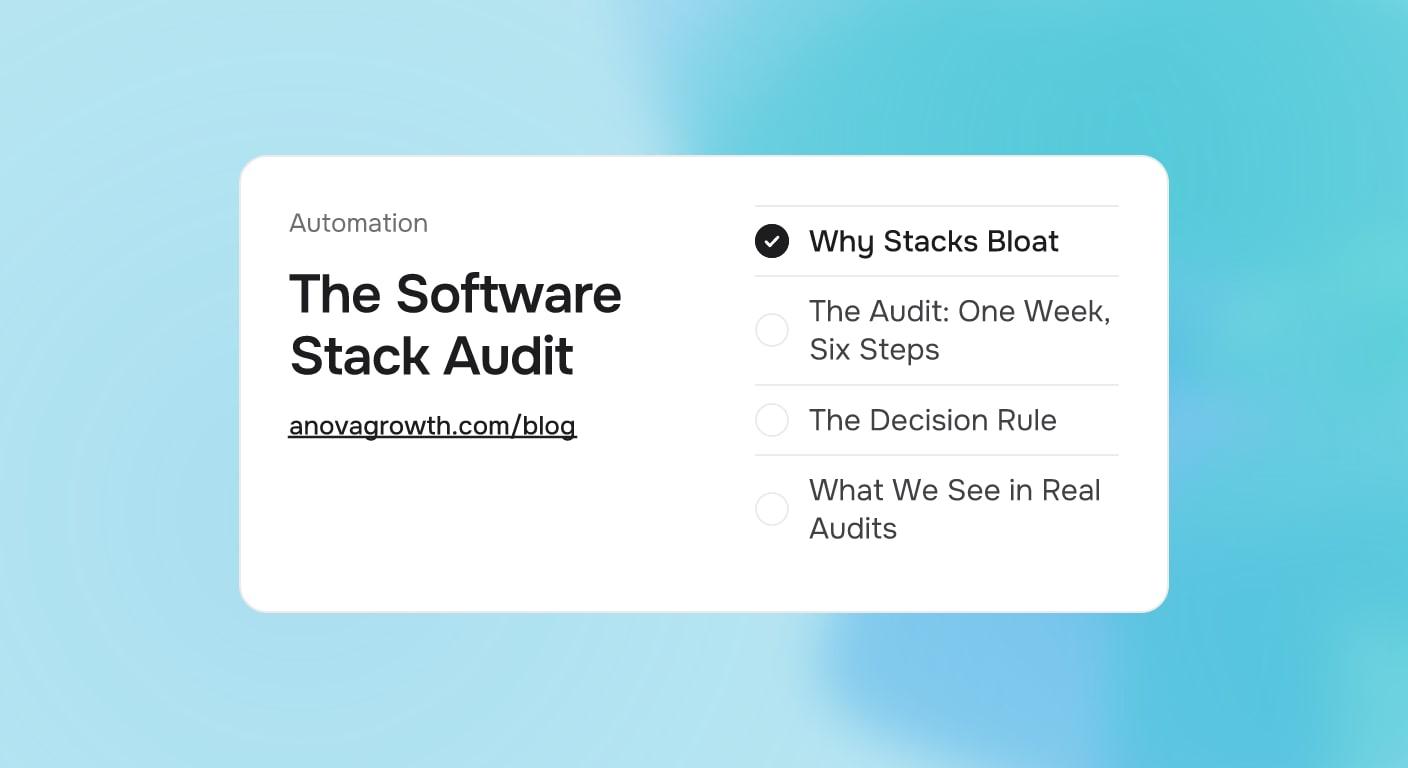
The Software Stack Audit: How Service Businesses Decide What to Keep, Cut, and Combine
A practical audit for service business owners: list every tool you pay for, score what it actually earns, and decide keep, cut, or combine before renewal season.

Quick Answer
Most service businesses run 8 to 15 paid tools when 4 or 5 would do the job. A stack audit means listing every subscription, scoring each one against the job it actually does, and giving it a verdict: keep, cut, or combine. Run it once a year, 30 days before your biggest renewal dates. The typical outcome is two or three cuts that pay for one integration that removes the duplicated data entry between the survivors.
Why Stacks Bloat
Nobody decides to have 12 tools. Each one gets added by a real problem: a spreadsheet breaks, a technician texts a photo that gets lost, a customer asks if you take card payments. A tool solves that one problem, the pain fades, and the subscription survives.
The problem is that tools added this way never get compared to each other. Your field app, your quoting tool, and your CRM all hold customer names. Your scheduler and your calendar app both send reminders. Each tool was a good decision in isolation. Together they cost you twice: in subscription fees and in the copy-paste labor of keeping records in sync.
There is a third cost that shows up later. When you eventually want automation, say lead capture flowing straight into job scheduling, fragmented tools make the wiring brittle. Every extra system is another API that can break, another login that can lapse, another place data can disagree with itself.
The Audit: One Week, Six Steps
Day 1: List every subscription. Pull the last 12 months of statements from every card and account the business uses. Search for recurring charges. Include the $9 tools, the annual plans that renew quietly, and anything a former employee set up. Most owners find at least one subscription they did not know existed.
Day 2: Record what each tool actually does. Not the marketing description. What job does it perform today, who touches it weekly, and what breaks when it is down? If nobody on the team can answer the last question in under a minute, the tool is probably decorative.
Day 3: Score each tool. Use the table below.
Day 4: Assign a verdict. Every tool gets one of three outcomes.
| Verdict | Criteria | Typical examples |
|---|---|---|
| Keep | Core to scheduling, quoting, invoicing, or customer records. High usage, single source of truth | CRM, field service app, accounting |
| Combine | Overlaps another tool on data or function | Second reporting dashboard, standalone SMS tool, old quoting spreadsheet |
| Cut | Unused in 60 days, replaceable by an existing tool, or owned by nobody | Trial never converted, competitor's app someone tested, per-seat tools for departed staff |
Day 5: Price the combination. For every "combine," write down the manual labor the overlap creates. If quoting feeds invoicing by hand two hours a week, that is roughly 100 hours a year. Price that honestly against the cost of connecting the tools properly.
Day 6 and 7: Plan the cuts. Check each contract for notice periods and auto-renewal dates. Calendar the cancellations. Do not cancel anything that holds customer data until you have exported it.
The Decision Rule
When two tools overlap, ask one question: which one is the system of record? Customer data should live in exactly one place. Every other tool should either read from it, write to it through an integration, or get cut.
A practical test we use with clients: pick any customer and trace their history. If you have to open three apps to answer "when did we last work for them and did they pay," your stack is costing you more than its subscriptions. Consolidating to a single system of record, with quoting and messaging connected to it, is usually the single highest-return change in the whole audit.
What We See in Real Audits
When we run these audits with service business clients, the same patterns come up repeatedly:
- A marketing tool nobody on the team can log into, still billing monthly since a trial from a year or more ago
- Two schedulers, one adopted by the office and one by the field, each with different versions of the same calendar
- A standalone review-request or SMS tool duplicating what the CRM already includes
- Annual renewals for seat-based tools still counting employees who left
- The spreadsheet that "handles the edge cases" and quietly defeats the purpose of the tool it shadows
The audits that produce the most savings are not the ones that cut the most tools. They are the ones that pick one overlap, typically quoting-to-invoicing or scheduler-to-CRM, and connect it properly. That one integration usually eliminates an hour or more of daily double entry, which is worth more than the subscription savings by itself.
Fan-Out Questions
How often should I audit my software stack? Once a year is enough for a full audit, timed 30 to 60 days before your big annual renewals. Add a 15-minute check whenever you sign up for any new tool: write down what problem it solves and what happens if it fails.
What about free tools, do they need auditing? Yes, but score them on complexity instead of cost. Free tools still fragment your data and still need logins and training. A free tool that duplicates a paid one is often the more expensive choice.
Should I consolidate into an all-in-one platform? Sometimes. All-in-one field service platforms reduce wiring, but they lock you into their limitations. The audit first: if your overlap is mostly messaging and reporting, connecting two good tools may beat migrating everything into one average one.
How do I get the team on board with a cut? Ask who actually uses the tool and what breaks without it, in writing. If nobody can name a concrete breakage, cut it on a trial basis and set a review date. Real objections surface fast; imaginary ones never do.
What tools should stay separate no matter what? Accounting and your CRM want to stay distinct and connected rather than merged, so your books stay clean and portable. Same for anything compliance-sensitive. Integration is not the same as consolidation.
Is this something worth doing before automating? Before, always. Automation built on a bloated stack multiplies its failure points. Cut and combine first, then automate the leaner stack. The wiring is cheaper, and it breaks less.
Next Step
Put an hour on the calendar this week and just do Day 1: pull 12 months of statements and list every recurring charge. That list alone usually motivates the rest. If you want a second pair of eyes on the verdicts, or help wiring the integration that replaces the double entry, contact AnovaGrowth and we will walk the stack with you.
Ready to get started? Contact us to discuss how we can help your business.
Related articles

Lead Source Tracking for Service Businesses: Know Where Every Job Came From
Tag every inbound lead with where it came from, follow it to closed revenue in your CRM, and stop spending on channels that never close a job.
Read the article: Lead Source Tracking for Service Businesses: Know Where Every Job Came From
Technician Utilization Tracking for Service Businesses: Find the Hours You Never Bill
Technician utilization tracking shows how many hours your crews bill versus idle, travel, admin, and windshield time. Here is how to set it up and use it.
Read the article: Technician Utilization Tracking for Service Businesses: Find the Hours You Never Bill
Customer Health Scoring for Service Businesses: Spot At-Risk Customers 60 Days Before They Leave
Service businesses that score customer health on five signals catch 70-80% of churn 60-90 days before it happens. Here is the model, the math, and the workflow.
Read the article: Customer Health Scoring for Service Businesses: Spot At-Risk Customers 60 Days Before They Leave
