Jacksonville Port Upgrade: The Automation Playbook for Logistics Teams
Jacksonville logistics teams can use JAXPORT's latest berth upgrades as a trigger to automate intake, dispatch, and customer updates before peak volume hits.

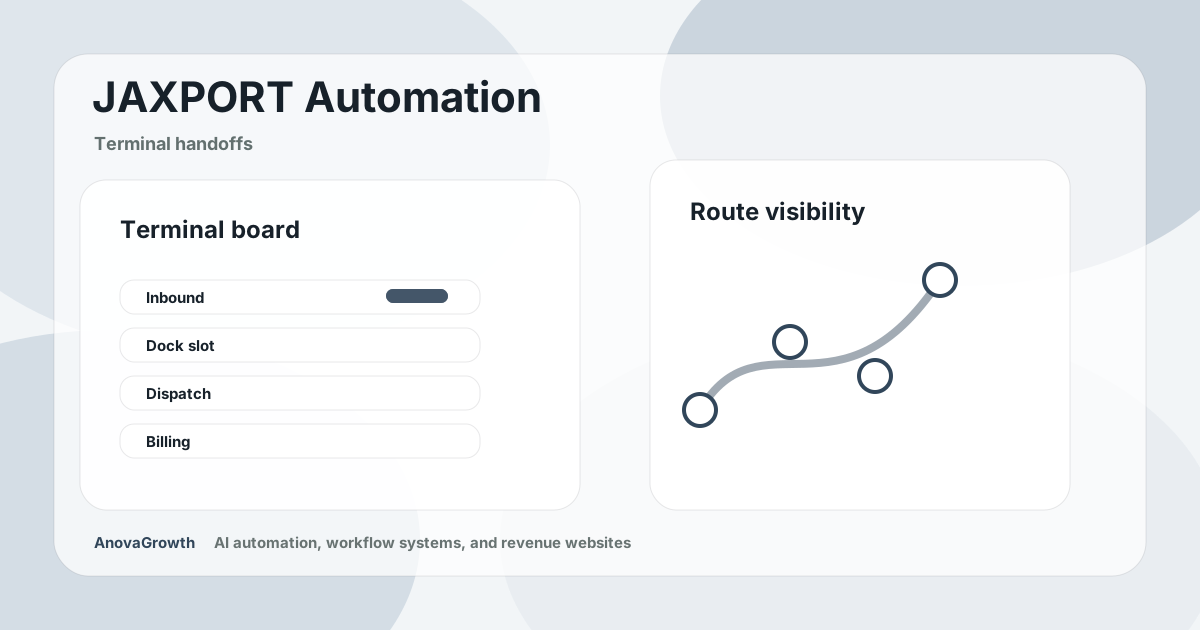
Jacksonville logistics operators should treat this month’s JAXPORT berth rehabilitation and infrastructure push as a timing signal: if cargo velocity rises while your intake, dispatch, and customer updates stay manual, margin gets squeezed fast. The practical move is to automate three choke points now, before peak-cycle volume compounds small process delays.
What Happened in Jacksonville This Month
Two local signals matter for operations teams right now:
- JAXPORT’s board approved berth rehabilitation work at Blount Island on April 28, 2026, with work starting in early May. This directly supports terminal reliability and throughput. Source: Jax Daily Record.
- JAXPORT highlighted broader infrastructure progress and long-term capacity strategy at the 2026 State of the Port, reinforcing that Northeast Florida logistics demand is not slowing down. Source: JAXPORT.
For First Coast freight brokers, 3PLs, and port-adjacent service businesses, this is less about headlines and more about execution speed.
Where Most Jacksonville Logistics Teams Lose Time
Manual handoffs are still the biggest drag:
- New load requests arrive across phone, email, and forms with no unified queue.
- Dispatch updates depend on one person remembering to notify customers.
- Exception handling lives in inbox threads instead of a tracked workflow.
- Sales follow-up for new shipper accounts gets delayed during busy weeks.
These are exactly the workflows we rebuild on Jacksonville automation projects: fewer inbox bottlenecks, faster updates, cleaner accountability.
Decision Table: What To Automate First
| Workflow | Manual pattern | Automation target | Primary business impact |
|---|---|---|---|
| Lead and load intake | Request details copied from email to CRM by hand | Structured intake + automatic CRM record + priority routing | Faster first response and fewer dropped opportunities |
| Dispatch communication | Driver/ops updates relayed ad hoc | Event-based status messages by SMS/email | Fewer client check-in calls and clearer ETAs |
| Exception management | Delay/issue resolution buried in threads | Triggered escalation workflow with owner + SLA clock | Lower service failure risk during volume spikes |
| Account follow-up | New shipper onboarding delayed by ops load | Automated onboarding sequence and task creation | Better conversion from first shipment to repeat business |
If you only do one thing this quarter, automate intake and dispatch together. Splitting them usually creates a new bottleneck instead of removing one.
Market Fit: Why Jacksonville Is Different
Jacksonville’s mix of maritime growth, healthcare scale, and regional distribution density creates a specific operations profile:
- Port-connected businesses need real-time status visibility.
- Multi-county service footprints make response speed a competitive edge.
- Hiring pressure makes labor-only scaling expensive.
That is why our local delivery mix usually combines workflow automation, AI automation, and selective custom software instead of a single tool patch.
Four Questions Teams Should Answer Before Summer Peak
- Where does a new shipment request get delayed first today?
- How many client status updates are still typed manually each day?
- Which exception type burns the most manager time each week?
- How quickly can sales and operations see the same account context?
- What breaks first when weekly volume jumps by 15-20%?
If those answers are unclear, your operating system is likely too manual for the next demand cycle.
A Practical 30-Day Execution Plan
Week 1: Workflow Audit
Map intake, dispatch, and exception paths end to end. Identify every point where work pauses for human follow-up.
Week 2: Routing and Trigger Design
Define automation triggers, ownership rules, and escalation windows by workflow type.
Week 3: Integration Build
Connect CRM, messaging, and internal tasking so updates move automatically between teams.
Week 4: Pilot and Tune
Run a controlled lane or account segment, measure response-time improvement, then expand.
For additional context on port-adjacent automation strategy, see our related breakdown for another Southeast logistics market: Atlanta's Inland Port Shift: The Automation Playbook for Faster Operations.
Bottom Line
Jacksonville’s current port investment cycle is a clear signal to tighten operational execution. The teams that automate intake, dispatch communication, and exception workflows now will protect margin and win repeat business while competitors are still firefighting in inboxes.
If you want a local-first implementation plan, start with our Jacksonville page and we can scope a fixed-pricing rollout around your current stack.
Related articles
Wilmington Port Cyberattack 2026: Build Manual-Proof Workflows
Wilmington businesses tied to the port should use August's cyberattack disruption to tighten intake, routing, and backup workflows before the next slowdown.
Read the article: Wilmington Port Cyberattack 2026: Build Manual-Proof Workflows
Richmond Code Refresh 2026: Fix Government Workflows Before the Fall Vote
Richmond teams touched by Code Refresh should use the August draft launch to clean up intake, document routing, and public-facing workflows before fall review.
Read the article: Richmond Code Refresh 2026: Fix Government Workflows Before the Fall Vote
Savannah's New Port Connector: The Automation Playbook for Faster Freight Ops
Savannah operators should use July's Brampton Road Connector opening to tighten freight handoffs, yard workflows, and ERP reporting before port volume rises.
Read the article: Savannah's New Port Connector: The Automation Playbook for Faster Freight Ops
