Custom Software vs Off-the-Shelf: When Custom Actually Saves Money
Learn how custom software ROI can transform your business operations and bottom line.

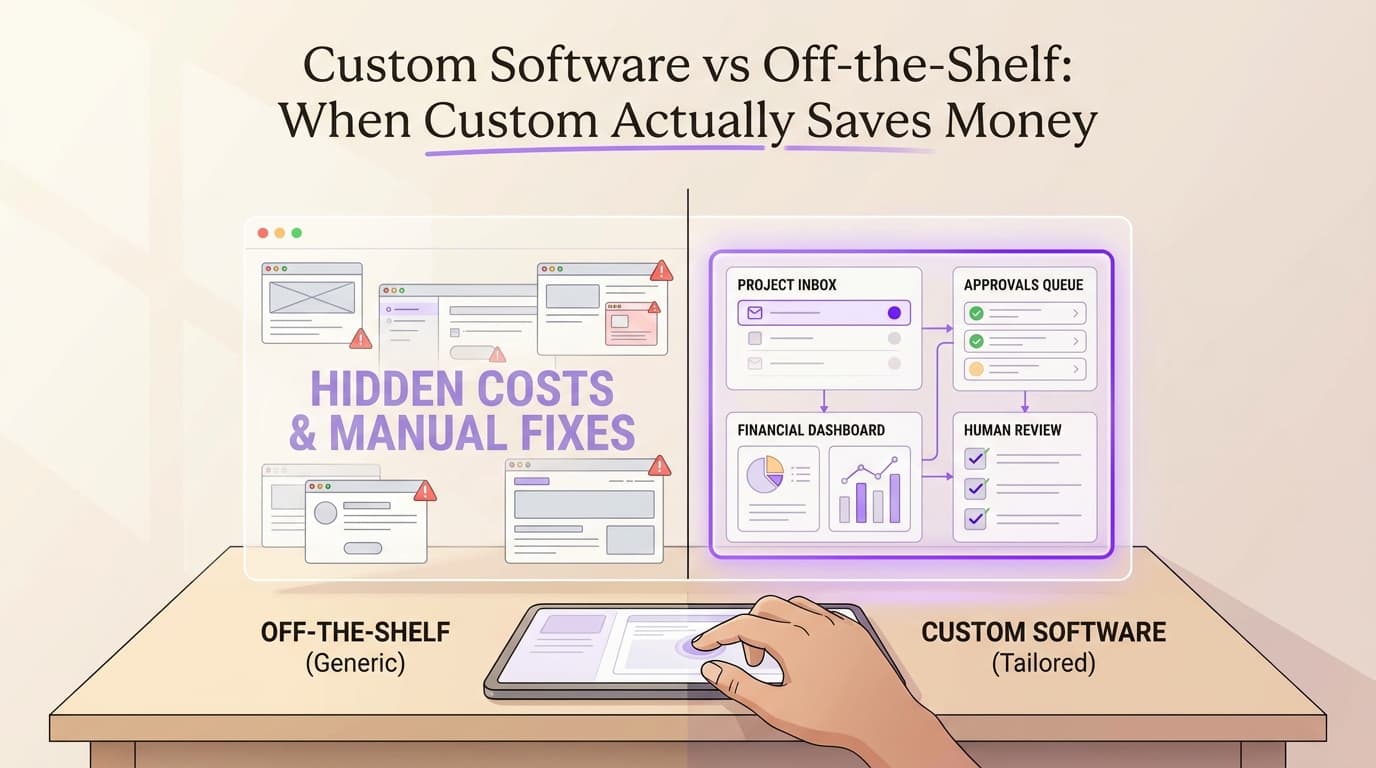
You signed up for a project management tool. Then a CRM. Then a separate invoicing system. Then a reporting dashboard because none of the others gave you what you needed. Three years later, you're paying for five subscriptions, manually moving data between them every week, and your team still complains the tools don't fit how you actually work.
Sound familiar? You're not alone. The average organization now manages 305 SaaS applications, and total SaaS spending rose 8% last year even when companies weren't adding new tools, according to Zylo's 2026 SaaS Management Index. The tools got more expensive, not better.
But here's the part most articles skip: sometimes building custom software costs less than buying more subscriptions. The question isn't whether custom is always cheaper. It's whether the math works for your specific situation over a realistic timeline.
The Real Question: What Does Ownership Cost Over Time?
When people compare bespoke software vs SaaS, they usually look at the upfront price. SaaS wins on day one. You pay your subscription, you get access, you're done.
But ownership has a longer tail.
Over three to five years, your true cost with off-the-shelf software includes more than licenses. You're paying for seats that sit empty. You're paying for workarounds your team builds to fill gaps. You're paying for the time employees spend toggling between tools that don't talk to each other. You're paying for the next renewal increase when the vendor knows you're locked in.
A Retool survey of 817 builders in February 2026 found that 35% had already replaced at least one SaaS tool with a custom build. Another 78% expected to build more custom tools in 2026. These aren't hobbyists. Sixty percent had built software outside IT oversight in the prior year, and 51% had shipped it into production use. The build-versus-buy calculation is happening in real companies right now, and it's not driven by ideology. It's driven by math.
Gartner forecasts worldwide software spending to reach $1.433 trillion in 2026, up 15.2%, with AI features directly contributing to higher costs. When your existing vendors raise prices to cover their AI development, your subscription costs don't stay still. Your five-year plan, built on steady-state pricing, quietly expires.
How to Run the Numbers: Your Break-Even Worksheet
Here's the framework we use with clients. You can run this yourself in a spreadsheet.
Calculate your current annual SaaS cost:
- License fees and seat costs for the tools you're considering replacing or supplementing
- Annual implementation or onboarding fees
- Integration costs (third-party connectors, Zapier fees, developer time to wire systems together)
- Duplicate functionality (if you have two tools doing overlapping work)
- Workaround labor: hours your team spends compensating for gaps, manually entering data, or running parallel systems
Multiply by three years for a realistic comparison window. Many software decisions look fine on a one-year view but fall apart over three to five years.
Calculate your custom software cost:
- Initial build (get realistic estimates from vendors, not just "it'll be cheap")
- Annual hosting and infrastructure
- Security and compliance maintenance
- Ongoing support and bug fixes
- Change requests and feature additions
At AnovaGrowth, we've seen clients break even on custom builds against accumulated SaaS costs in 18 to 36 months when they had strong overlap, high workaround costs, or workflows that competitors could copy if they stayed on generic tools.
When to Buy: Standardized Capabilities Stay on the Shelf
Custom software ROI doesn't happen in a vacuum. The most important decision rule is this: don't build what you can buy reliably.
Accounting software, basic email marketing, standard project tracking, payroll processing, customer support ticketing. These are solved problems. The vendors have years of edge case handling, regulatory updates, and integrations that would cost you far more to replicate. Buy the subscription. Use the vendor's support line when things break.
The Zylo data shows that 61% of organizations cut projects because of unplanned SaaS cost increases. That means teams are already rationing their tool sprawl. The answer isn't to replace every tool with custom code. It's to be surgical about which gaps actually hurt your business enough to justify building.
If your workflow is standard and your team can buy a SaaS product that fits 90% of their needs, buy it. You're not going to out-engineer Intuit on accounting or Salesforce on CRM for most use cases. The math only works when the problem is specific enough and the pain is big enough.
When to Build: Differentiating Workflows Deserve Custom Attention
Now flip the equation. Where does custom software make genuine sense?
When your workflow is your competitive advantage. If you run logistics, healthcare scheduling, manufacturing quality control, or any operation where the steps your team follows are meaningfully different from the standard process, a generic tool forces you to work around its assumptions. Every workaround is wasted time. Those hours compound.
When you own data that should stay yours. Some businesses generate insights that become their moat. If your customer interaction data, operational patterns, or industry-specific analytics live better in a system you control, custom software keeps that asset yours instead of enriching a platform you rent.
When integration costs are killing you. If your team spends significant time moving data between systems, or you're paying for multiple integration platforms to wire together off-the-shelf tools, that ongoing friction has a real cost. A custom system that holds your data and exposes what you need to other tools can eliminate that overhead permanently.
When the SaaS option would hand your process to competitors. We've written before about how healthcare AI chatbots and customer self-service portals are areas where early movers building custom systems are establishing positions that generic tools won't let followers replicate. If your operational excellence comes from a specific workflow, building it yourself means competitors can't buy the same system and catch up.
Start Narrow, Measure Honestly
If the break-even math works in your favor, don't start with a massive custom build. The Retool data shows that shadow IT and unauthorized building happens, but so does the problem of building something nobody maintains, tests properly, or takes ownership of when it breaks.
Start with a narrow pilot. Pick one painful workflow. Define what success looks like before you start: specific time savings, error reduction, revenue unlocked. Build that one piece. Measure it against your projections. If it works, expand. If it doesn't, you've learned something cheap.
The 51% of teams shipping production software without formal IT oversight also means more technical debt and more unpatched vulnerabilities. Your custom software needs the same security attention, testing, and maintenance plan as anything else you put in front of customers or critical operations. Budget for it. Plan for it.
Custom software saves money when ownership costs align with genuine business advantage. For everything else, the subscription probably wins.
Key Takeaways
-
Calculate three-to-five-year total cost, not just first-year license fees. Include implementation, integrations, duplicate tools, and workaround labor when you tally your SaaS spending.
-
Build only where your workflow, data, or competitive position genuinely differs from the standard. Generic problems have generic solutions; buying off-the-shelf wins every time for solved problems.
-
Watch for the shadow IT pattern in your organization. Retool found 60% of builders created software outside IT oversight. Unmanaged custom tools create security and maintenance risks that undercut any cost savings.
-
Pilot narrow before you commit wide. Define success metrics upfront, build one painful workflow first, measure honestly, and expand only when the numbers hold.
-
Factor in price escalation. Gartner projects 15.2% software spending growth in 2026, driven partly by AI feature costs. Subscription pricing that looks stable today may not be stable in year three.
The Bottom Line
The build-versus-buy question deserves a real answer, not a default. If you've been stacking SaaS subscriptions, duct-taping workflows together, and absorbing workaround costs, you owe yourself an honest look at what ownership actually costs over the long run.
If your operation runs on standard processes and your team can work within the constraints of good off-the-shelf tools, keep buying. You'll spend less and avoid maintenance headaches.
But if you have a workflow that sets you apart, data that should stay yours, or integration costs that keep climbing, custom software ROI isn't theoretical. Run the numbers. The break-even might be closer than you think.
Ready to get started? Contact us to discuss how we can help your business.
Related articles

Custom Software Maintenance and Support for Service Businesses: The Hidden Costs Most Owners Never See
Custom software for service businesses does not stop costing money after launch. Here is what maintenance actually costs, who pays for it, and how to build a support plan that keeps your system alive.
Read the article: Custom Software Maintenance and Support for Service Businesses: The Hidden Costs Most Owners Never See
Custom Software Replacement: A 90-Day Migration Playbook for Service Businesses
Replace custom software in 90 days without losing data or breaking operations. A six-step playbook for service businesses ready to move on.
Read the article: Custom Software Replacement: A 90-Day Migration Playbook for Service Businesses
Custom Software for Service Businesses: When to Build, When to Buy, and How to Scope It Right
Service businesses waste $50K+ on custom software that misses the mark. Here is how to decide if you need it, scope it, and ship it without the common pitfalls.
Read the article: Custom Software for Service Businesses: When to Build, When to Buy, and How to Scope It Right
