The Manufacturing Problem Nobody Talks About
You already run sophisticated operations. You're managing inventory, coordinating suppliers, keeping machines running, tracking lead times, and trying to quote jobs accurately enough to win work without leaving money on the table. The problem isn't that you're not working hard, it's that most of your processes are still held together by spreadsheets, phone calls, and tribal knowledge nobody has ever bothered to write down.
That's the gap AI automation is designed to close for small and midsize manufacturers. Not by replacing your team, but by removing the repetitive drag that eats up their time.
Where AI Automation Delivers Real ROI in Manufacturing
1. Production Scheduling and Job Tracking
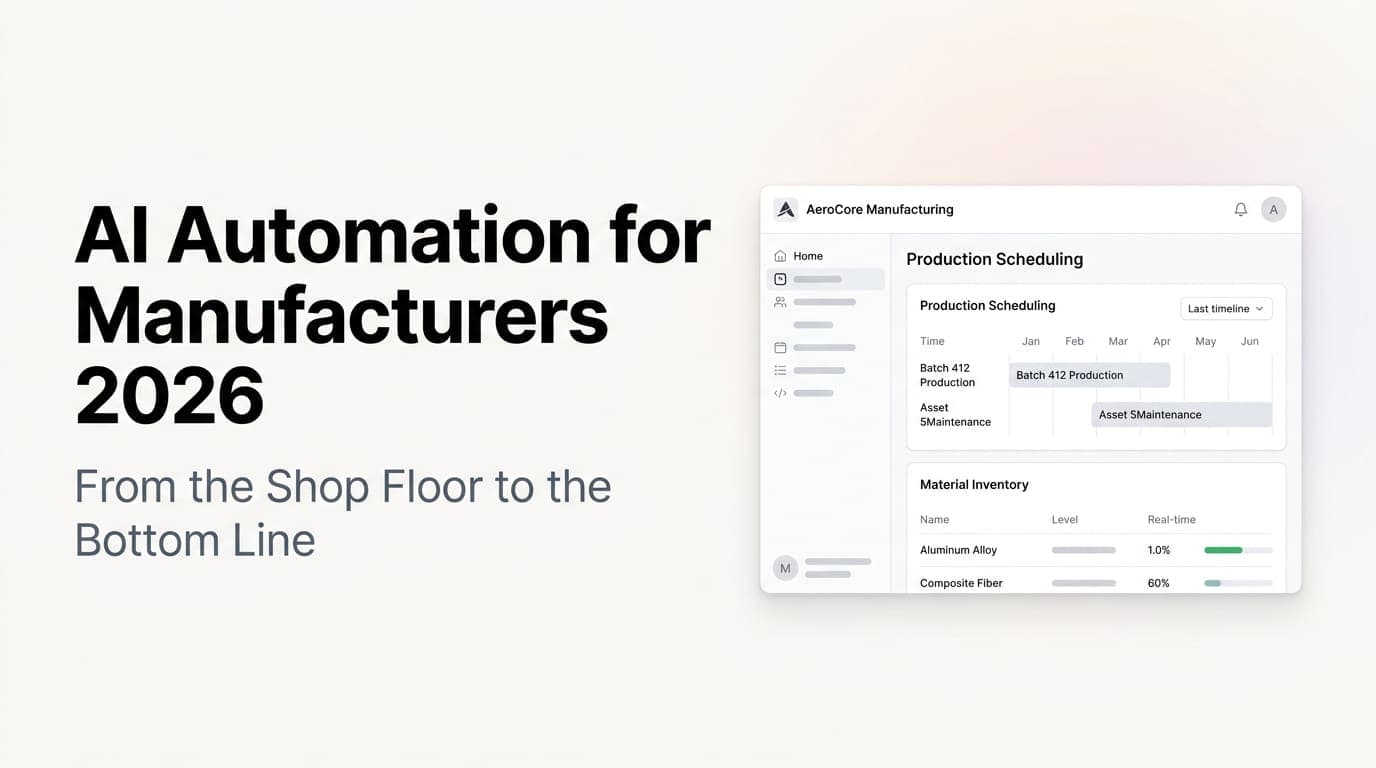
Job shop manufacturers live and die by scheduling. Every day you have dozens of jobs competing for the same machines, operators, and setup time. A well-configured AI scheduling tool looks at your current backlog, changeover times, operator availability, and delivery deadlines, and produces a schedule that actually works.
The difference isn't marginal. Manufacturers who've implemented AI-driven scheduling report 10 to 20 percent improvement in on-time delivery and meaningful reductions in overtime. You're not guessing which job to run next. The machine is doing that math in real time as conditions change.
Key capabilities to look for:
- Real-time rescheduling when a job runs long or a machine goes down
- Integration with your existing ERP or job tracking system
- Visibility across the shop floor so operators know what's coming
2. Quote and Estimate Automation
If you're still building quotes by hand, you're either over-quoting and losing work or under-quoting and winning jobs that hurt your margins. AI-assisted quoting tools can pull historical job data, factor in material costs, labor rates, and setup times, and generate a defensible quote in minutes instead of hours.
For repetitive job types, machined parts, fabricated components, assembly work, the AI learns from your actual job costs over time. Your quotes get more accurate the longer the system runs.
3. Predictive Maintenance and Machine Monitoring
Unexpected machine downtime is one of the most expensive problems in manufacturing. When a CNC router or injection molding press goes down unexpectedly, you're not just fixing a machine, you're losing production, missing ship dates, and burning overtime to catch up.
AI-based monitoring systems analyze vibration data, temperature trends, cycle times, and other sensor inputs to flag machines showing early signs of wear, before they fail. You move from reactive repairs to scheduled maintenance on your terms.
The ROI math is straightforward. One unplanned downtime event on a critical machine can cost more than a full year of AI monitoring software.
4. Inventory and Supply Chain Intelligence
Running too much inventory ties up cash. Running too little kills production. AI systems that track usage patterns, lead times, supplier performance, and demand signals help you optimize stock levels without manual counting and guesswork.
For manufacturers dealing with volatile material costs or uncertain supply chains, this kind of intelligence isn't a luxury, it's a competitive advantage.
Why Manufacturers Are Finally Moving on AI Now
Three things have changed in the last 18 months that make AI automation practical for shops with 20 to 500 employees:
The cost of entry has collapsed. Five years ago, a serious AI scheduling system required six-figure software contracts and months of integration work. Today, cloud-based tools with monthly subscriptions have brought the starting cost down by 70 to 80 percent. You can get meaningful automation running for less than your current CAD software license.
Integration has gotten easier. Modern AI platforms connect to QuickBooks, NetSuite, SAP, and other ERPs without custom API work. If your data lives in a reasonably modern system, an AI tool can read it.
The technology has matured. The AI models underpinning these tools are not experimental prototypes. They're production systems running in thousands of facilities. The rough edges from early deployments have been worked out.
What AI Can't Fix (And What That's Actually Good News For)
AI automation handles repetitive, data-driven decisions well. What it doesn't do well, and likely won't for a while, is navigate the ambiguous judgment calls that come up every day on a shop floor.
A machine goes down and you need to decide whether to reroute a job, wait for the repair, or send it out for a quick-turn subcontractor. That requires understanding relationships with vendors, the specific customer's flexibility on delivery, and the real cost of overtime. That's still a human decision.
Understanding what AI handles well sets realistic expectations. Manufacturers who expect AI to run their shop without oversight will be disappointed. Manufacturers who expect AI to eliminate the administrative overhead that's been dragging their team down will be happy with the results.
Getting Started: A Practical Sequence
Don't try to automate everything at once. Pick the problem that's costing you the most right now.
Step 1: Pick your biggest pain point. Is it scheduling chaos? Slow quoting? Machine downtime? Identify one specific process before you start evaluating software.
Step 2: Audit your data. AI learns from data. If your job tracking is a mix of Excel files and paper tickets, start there. Clean, accessible historical data is the foundation everything else builds on.
Step 3: Start with one workflow. Choose the tool that solves your specific pain point and run it alongside your existing process for 30 days. Measure the delta before you commit.
Step 4: Expand to a second workflow. Once the first is working reliably, add the next. Most manufacturers find that AI tools generate momentum once the team sees real results.
Key Takeaways
- AI scheduling tools deliver 10 to 20 percent improvements in on-time delivery for job shop manufacturers
- Quote automation significantly reduces the time from customer request to submitted bid
- Predictive maintenance pays for itself with one prevented downtime event
- Cloud-based AI tools have dropped in cost and are now accessible to shops with 20 to 500 employees
- Start with your single biggest pain point, not everything at once
Ready to See What AI Can Do for Your Shop?
Most manufacturers we talk to have the same conversation: "I know we could be doing this better, but I don't have bandwidth to evaluate fifteen different tools." We can help you map the right sequence for your operation, connect the tools that make sense, and get the first automation running without disrupting what you've already got in place.
Talk to our team about what a manufacturing AI automation engagement looks like, no sales pressure, just a practical conversation about where to start.