The Quarterly Business Review: A 90-Minute Cadence for Service Business Owners
Most service business owners review numbers only when something breaks. A quarterly review cadence catches problems while they are still cheap to fix.

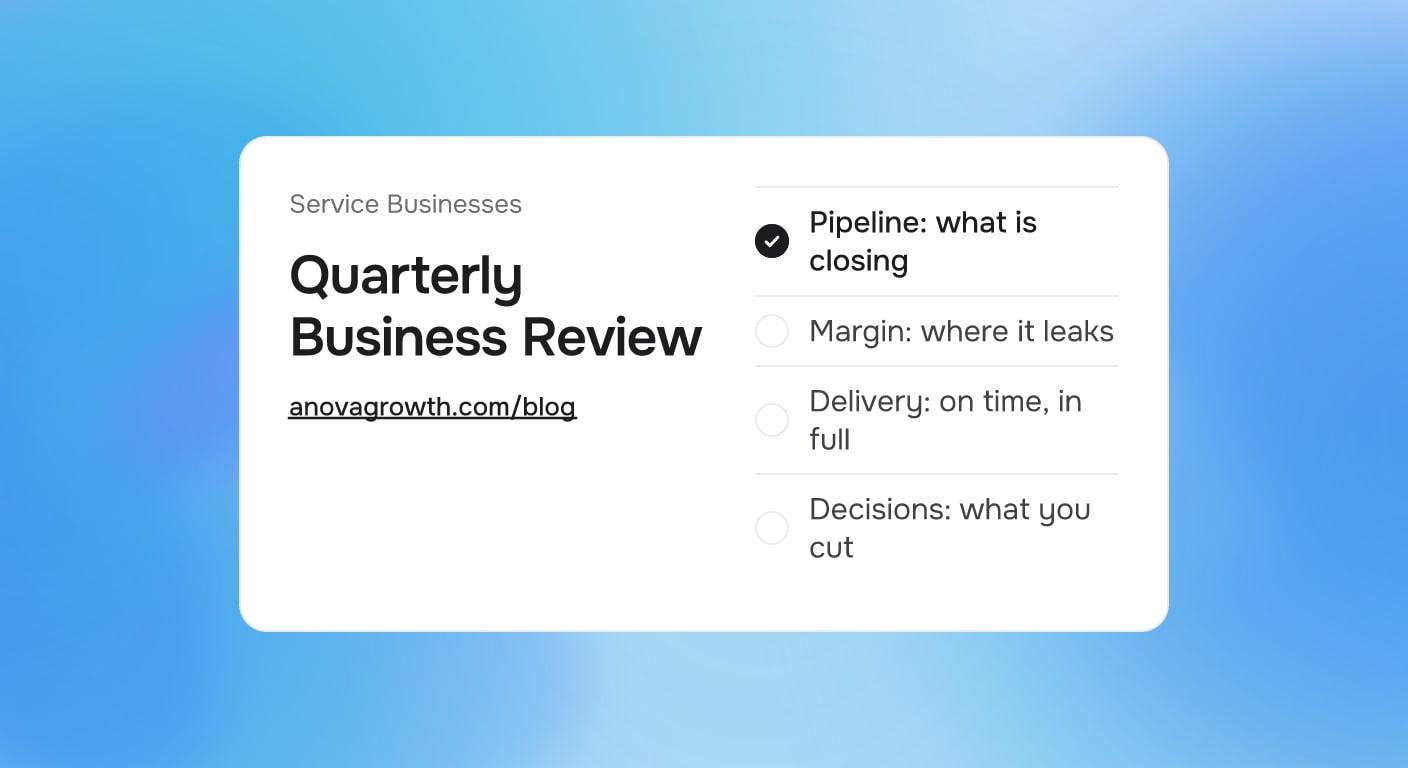
Quick answer
A quarterly business review is a fixed 90-minute session, held every 13 weeks, where you check five things: pipeline, margin, delivery performance, cash runway, and team capacity. It works because it forces the same questions on a schedule, so problems surface in weeks, not quarters. Owners who run one consistently stop making pricing and hiring decisions from gut feel.
Why most owners never review anything
You are the bottleneck in a service business. Estimates, dispatch, hiring, the cranky client email, all of it lands on you. So reviews never happen, and the business runs on reactions. You find out margin slipped when the P&L arrives two months late. You find out leads stalled when someone finally mentions the unanswered forms.
I have run this pattern myself at AnovaGrowth. Between client work and the day job, it is easy to go a full quarter without sitting down and asking what actually worked. The fix was not more willpower. It was a shorter, dumber, more repeatable checklist.
The 90-minute agenda
Five blocks. Timer on. No email.
| Minutes | Block | Question |
|---|---|---|
| 20 | Pipeline | What came in, what converted, what stalled? |
| 20 | Margin | Which services made money, which lost it? |
| 15 | Delivery | On-time rate, callbacks, rework, reviews |
| 15 | Cash | Runway, unpaid invoices, upcoming commitments |
| 20 | Decisions | What do we stop, start, or price differently? |
The last block is the whole point. A review that produces no decisions was a history lesson. Every quarter should end with at least one dropped item, one fix, and one number you commit to checking monthly.
The five numbers that matter
1. Pipeline conversion rate
Leads in this quarter versus jobs closed. If conversion is falling while lead volume holds, the problem is usually response speed, price positioning, or fit. Slow follow-up kills more deals than pricing does, and it is the easiest thing to automate. Our own tracking showed the same pattern: forms answered in under five minutes convert at multiples of those answered the next day.
2. Gross margin by service line
Not overall margin. Margin per service. In most service businesses, one or two offerings carry the profitability while a popular service quietly loses money on every job. That discovery changes what you upsell and what you raise prices on.
3. On-time, in-full delivery
Percentage of jobs delivered when promised, without a callback. This is your future reputation. It also predicts churn on any recurring service agreements before churn shows up as a cancellation email.
4. Cash and collections
Runway in months, and the aging on unpaid invoices. A profitable service business can still drown in receivables. A follow-up schedule that runs without you does most of this work. We wrote a full breakdown of the unpaid invoice follow-up schedule that pairs directly with this block.
5. Capacity
Billable hours per person versus load over the next 90 days. This is the hiring trigger. Deciding to hire from a spreadsheet you looked at quarterly beats deciding from a week of chaos.
The four fan-out questions worth tracking
- Which weekly metrics predict this quarterly number? Set no more than three weekly checks so the quarterly meeting reviews trends, not surprises.
- Who owns each block if you are unavailable? Delegating margin review before delegating pipeline review usually fails; margin data needs context.
- What did you decide last quarter, and did it happen? Keep a one-page log. No follow-through means the cadence is theater.
- What can be automated out of the review entirely? Pipeline counts, invoice aging, and delivery stats can all be pulled automatically or assembled automatically.
Automating the data pull
The review should not involve opening six tabs. Each dashboard refresh is ten minutes of friction, and friction is why the cadence dies in month two.
Here is what we run at AnovaGrowth, and what we build for clients:
- Analytics and lead forms feed one metrics sheet automatically, so pipeline numbers are current on arrival.
- Invoicing, estimates, and time tracking push into the same sheet where possible, either through native integrations or scheduled scripts.
- A scheduled summary lands the morning of the review. You open one document, not five tools.
This is mostly workflow automation and a bit of custom glue code. For clients on a CRM pipeline stage model, the CRM is already the source of truth and the pull is trivial. If the data lives in spreadsheets no one maintains, clean that up first. Our CRM data hygiene guide covers the cleanup order.
Common ways this fails
First, scheduling it "when things calm down." It will not calm down. Put it in the calendar the same day as the next client meeting.
Second, dragging in 40 metrics. Five numbers, plus whatever is currently on fire. More metrics means less deciding.
Third, no decision log. Write down last quarter's decisions at the top of the meeting. If you skipped two of them, that is the conversation.
Fourth, making it a solo ritual forever. The goal is to delegate block by block so the review continues during your vacation.
Getting started this week
- Block 90 minutes on the calendar for the first week of next quarter.
- Pick your five numbers and find where each one currently lives.
- Kill the manual pulls: connect the data or have someone else assemble it.
- Run the first review and write down exactly three decisions.
If the data part is the blocker, that is the part we build first. Contact us and we will tell you honestly whether your systems are ready or whether cleanup comes before dashboards.
Ready to get started? Contact us to discuss how we can help your business.
Related articles

Automation ROI Calculator for Service Businesses: Run the Numbers Before You Build
Most service businesses guess at automation ROI and get it wrong. This calculator framework gives you the three numbers that actually matter and shows you how to run them.
Read the article: Automation ROI Calculator for Service Businesses: Run the Numbers Before You Build
Service Business Weekly Operations Meeting: The 30-Minute Cadence That Keeps a Small Service Company on Track
A 30-minute weekly ops meeting turns scattered owner reactions into one predictable cadence. Most service companies under 50 people can run it themselves.
Read the article: Service Business Weekly Operations Meeting: The 30-Minute Cadence That Keeps a Small Service Company on Track
Service Business Year-End Planning Playbook: Q4 Tax Prep, Operations Tune-Up, and the Setup That Wins Q1
Most service businesses lose Q4 to last-minute scramble and limp into Q1 with bad books. A 90-day Q4 plan fixes tax, cash, hiring, and ops in one sweep.
Read the article: Service Business Year-End Planning Playbook: Q4 Tax Prep, Operations Tune-Up, and the Setup That Wins Q1
