Customer Financing for Service Businesses: Close Big Jobs Without Price Stalls
Big-ticket jobs stall on price. Offer financing at the quote, automate the application and follow-up, and turn stall-outs into signed contracts.

A customer says the work sounds great, then goes quiet after seeing a five-figure number. The job was right, the crew was ready, and the customer wanted it done. The only thing missing was a way to pay for it over time. That stall is one of the most expensive gaps in a service business, and it sits between a good quote and a signed contract.
This guide covers customer financing for service businesses: what it is, when it makes sense, and how the application and follow-up steps fit into a quote workflow most shops already run. The goal is simple. A serious buyer should never walk away from a job they wanted because of how the invoice was structured.
The Quick Answer
Customer financing lets a homeowner or commercial client pay for a large job over time through a lender while you still get the job. The move that works for most shops: put a monthly payment option on the same page as the total, send the application with the quote, and automate the follow-up while the application is pending. Then track approvals and close rates weekly like any other funnel.
Why Big Jobs Stall on Price
On a small repair, price is rarely the blocker. On a full system replacement, a roof, or a commercial buildout, cash flow is the blocker, and the customer rarely volunteers it. Nobody wants to say a number is too big for their savings, so they say they need to think about it, and the quote dies in silence.
Financing answers that objection without anyone having to raise it. The customer sees the total, then sees a monthly figure next to it, and now has two honest ways to say yes. You did not discount the job. You changed how it can be paid.
What this looks like in practice: a roofing company sends strong quotes and loses most of its five-figure jobs to silence. Every quote lists a total and payment due at completion, and nothing else. After the company adds a monthly payment line to quotes above a set size, some customers pick the terms instead, and quotes that used to stall start moving again. The work, the crew, and the price never changed. The path to pay did.
When Financing Makes Sense
Use the table below to decide where a financing offer belongs in your own price range. The bands are examples, not rules. Set your own threshold based on your average ticket and what your customers tell you in the sales conversation.
| Situation | What to offer | How to present it |
|---|---|---|
| Small jobs near your minimum charge | Standard invoice | Skip financing. Extra steps cost more than they earn at this size |
| Mid-size repairs and installs | Monthly payment option | One line beside the total on the quote |
| Big-ticket replacements and builds | Financing as a first-class option | Lead with the total and the monthly path together |
| Commercial or B2B clients | Contract payment terms | Consumer financing is usually the wrong tool. Confirm terms in your contract |
One honest note. Financing only pays off inside a working sales process. If the pipeline itself is the problem, fix that first with a systematic sales playbook, then layer the payment option on top.
How the Workflow Fits Into Your Quote Process
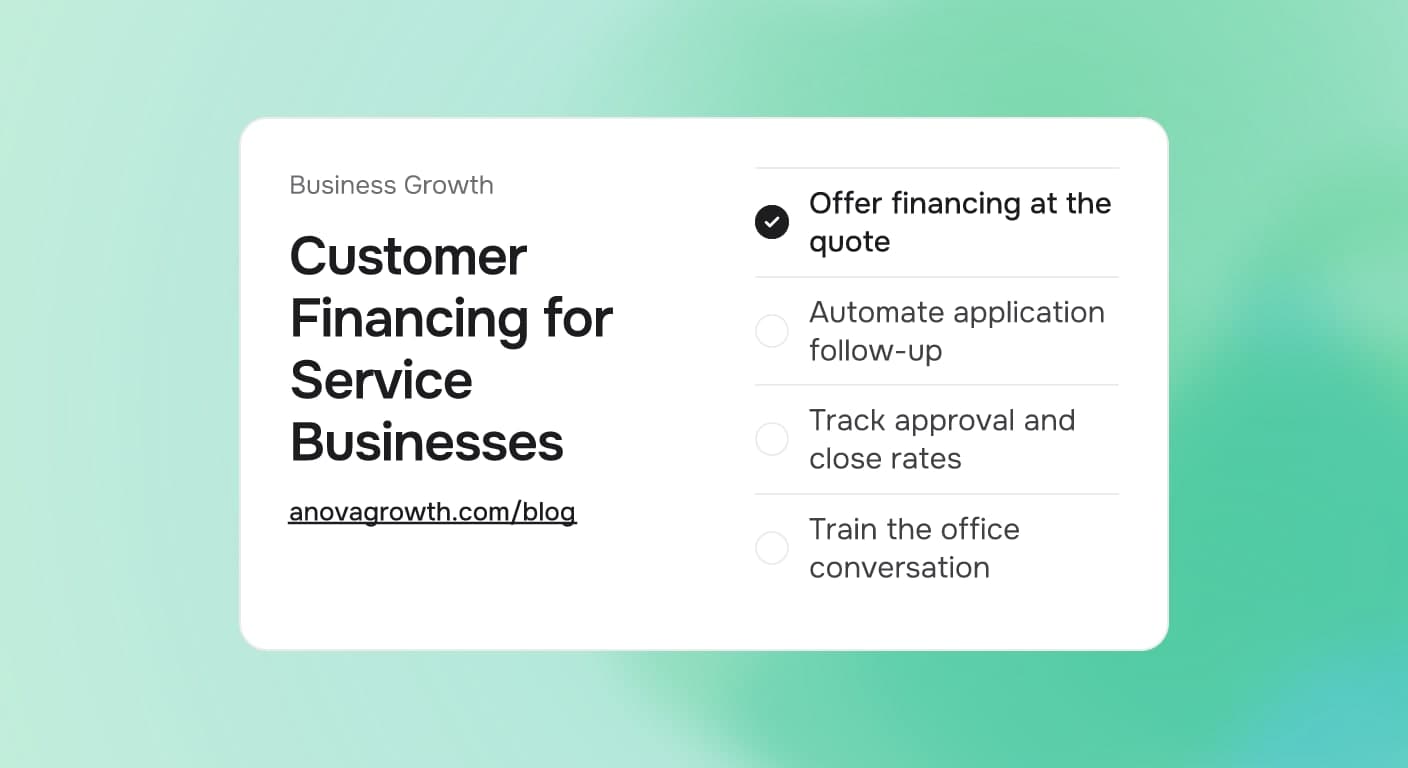
- Pick your route to offer it. Many estimating and field service platforms carry partner lenders built in, which keeps the application close to the quote. If your tools do not, a tracked application page you control works too. The short form matters more than the brand on it.
- Put the payment option on the quote itself. Show the total plus the monthly figure from the lender's payment calculator. One screen, both numbers. A homeowner should not need a phone call to learn the second number.
- Send the application with the quote. The customer should not have to call the office, dig up documents twice, or wait for another email to start. Every extra step between interest and application costs completions.
- Automate the pending follow-up. An application that sits for a couple of days gets a reminder, then a task for the closer. This is the highest-return automation in the whole flow, and it belongs to the same family as your quote follow-up sequence.
- Close, sign, schedule. On approval, e-signature and job scheduling run exactly like a cash job. On a decline, the office gets one clear next action: call with a payment plan, split the scope, or hold the crew date and revisit.
- Review the funnel weekly. Which step leaks? Quotes never opened, applications abandoned, approvals that did not close. The leak names the fix, and the fix is usually one message, not a reorg.
The Numbers to Watch
- Quote open rate on big tickets. How many five-figure quotes are actually opened rather than only sent.
- Quote-to-application rate. Of viewed big quotes, how many start an application.
- Application completion rate. Started versus submitted. Drop-off here points to form friction, not price pain.
- Approved close rate. Approved applications that become signed, scheduled jobs.
- Stalled quotes over seven days. The pile a fresh payment-option message can reopen.
Review these in the same meeting where you walk your quote win rate so financing shows up in context next to your normal pipeline numbers. One caution. If jobs are signed but invoices lag, that is a collection problem, not a financing one. Automated receivables follow-up is the fix for money already earned.
What We Do in Our Own Shop
We build quote and approval workflows for service businesses, and two rules came out of that work. First, automate the reminder, never the decision. A pending application reminder is a computer problem. The conversation with a customer weighing payment terms is a human problem, and handing it to a template is how a yes turns into a no.
Second, keep payment options on the same screen as the total. Whatever tool we wire up, we put the monthly path in front of the customer's eyes at the moment they see the price, not inside a portal login they will use once. Every click between a homeowner and the payment decision costs signed jobs, so we keep the path short and put automated follow-up behind anything a busy human would forget.
Common Fan-Out Questions
Does offering financing make my business look cheap?
No. Payment plans are standard on large purchases in every industry your customers already buy from. What makes an offer feel cheap is discounting, and financing is how you avoid doing that. Present it as a standard option on big jobs, not as an apology.
What happens when an application is declined?
Treat it as information, not a dead end. Programs differ, so do not quote decision times you have not verified with your own lender. A decline usually describes the customer's current file, not your job. Have a next move ready: a smaller scope, a split payment schedule, or a short hold so the customer can revisit later.
Can I add financing to quotes I already sent?
Usually yes, and it is worth doing. Send a short, plain email: the quote is still active, and it can now be paid monthly. Put the application link in exactly one place. Then watch reply and close rates before and after, because reopened quotes with a new payment path are about as cheap as pipelines get.
Should the technician or the office bring it up?
Whoever owns the price conversation in your sales process. If estimators sell face to face, they should be able to say the monthly figure out loud without fumbling. If the office sends quotes by email, the payment line belongs in that email from day one. One owner, one script, every quote.
What does automation actually handle here?
The boring parts: sending the application link with the quote, reminding when it sits untouched, notifying the closer on approval or decline, and updating the pipeline record so nothing rides on memory. A human still makes the payment conversation happen. That split is the whole design.
Key Takeaways
- Big jobs stall on price, and the customer will rarely tell you that cash flow was the reason.
- Put the monthly payment option on the same page as the total on every quote above your chosen size.
- Automate the pending-application reminder and the approval handoff, and keep the payment conversation human.
- Track quote-to-application, application completion, and approved close rates beside your normal pipeline numbers.
- A decline is a next-step prompt, not a lost customer, so keep a fallback offer ready.
Next Steps
If a recurring share of your large quotes ends without a signed job, add the financing path before you touch your pricing or trim crew costs. Start small: one quote template, one application route, one reminder automation. We build quote workflows, application handoffs, and follow-up systems for service businesses. Talk to us about your quote process, or start with our guide to quote follow-up automation.
Related articles
Tampa Bay Digital Infrastructure: Build Workflows Before Growth
Tampa Bay is planning for digital infrastructure and maritime growth. Local businesses can prepare by connecting the workflows behind every customer.
Read the article: Tampa Bay Digital Infrastructure: Build Workflows Before Growth
Panama City Tourism Growth: Build a Booking System That Keeps Up
Panama City Beach tourism is growing. Here is how Bay County hospitality and service businesses can turn more visitor demand into booked work.
Read the article: Panama City Tourism Growth: Build a Booking System That Keeps Up
Scalable Service Business Operations: How to Build a Company That Grows Without Growing Pains
Most service businesses scale revenue and multiply problems at the same rate. Here is how to build operations that handle growth without adding chaos.
Read the article: Scalable Service Business Operations: How to Build a Company That Grows Without Growing Pains
