AI Is Entering Revenue Workflows Faster Than Most Teams Can Govern It
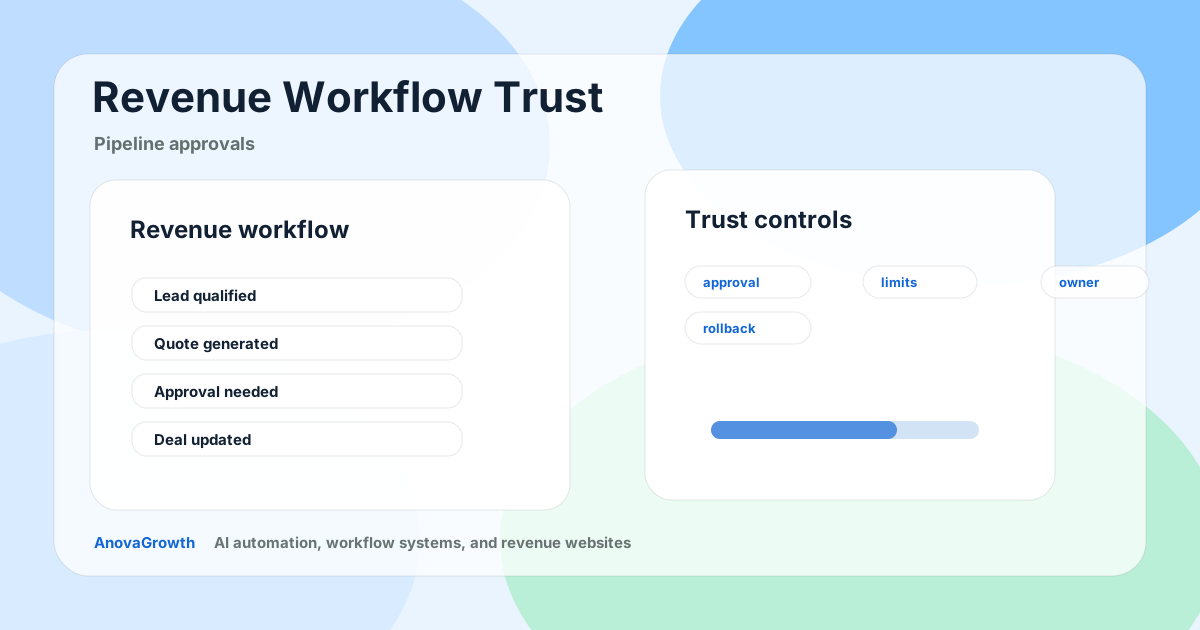
This week’s releases show AI moving directly into pipeline and execution workflows. The winners will pair speed with clear trust controls.

AI adoption is changing this month in a way business owners can actually feel.
For the last year, most teams used AI as a side tool for writing, summarizing, and brainstorming. In the last seven days, the bigger signal is different: AI is being pushed into workflows tied to pipeline creation, system execution, and day-to-day delivery.
That creates real upside. It also raises the risk of process errors, security gaps, and hard-to-trace decisions if controls stay vague.
Five Signals From the Last 7 Days
1) OpenAI + Dell: Codex into hybrid and on-prem systems
OpenAI and Dell announced a partnership on May 18 to bring Codex into the hybrid and on-prem environments where enterprise data and workflows already live.
Why this matters for smaller teams: the enterprise market is prioritizing AI where real systems of record already exist, not in isolated demos.
2) Microsoft: open agentic stack + governance primitives
At Open Source Summit North America on May 18, Microsoft outlined open agentic stack work, including governance primitives and interoperability focus.
Source: From open source to agentic systems: Microsoft at Open Source Summit North America 2026
Why this matters: portability and governance are becoming baseline buying criteria, not advanced features.
3) AWS: agents now creating partner opportunities via natural language
On May 15, AWS announced that Partner Central agents now accelerate opportunity creation through natural-language conversation.
Source: AWS Partner Central agents now accelerates opportunity creation
Why this matters: this is not just internal productivity. Agentic workflows are being applied directly to pipeline velocity.
4) PwC + Anthropic: scaled alliance around agentic operating models
On May 14, PwC and Anthropic announced an expanded alliance with emphasis on real client operating-model execution across functions.
Source: PwC and Anthropic expand alliance for agentic AI
Why this matters: large operators are moving from AI planning decks to repeatable delivery programs.
5) Google Android Show: Gemini moving deeper into daily surfaces
On May 12, Google’s Android Show highlighted Gemini Intelligence and broader agentic experiences across Android and Chrome surfaces.
Source: The Android Show: I/O Edition 2026
Why this matters: user expectations are rising. Faster, context-aware responses are becoming normal behavior, not premium behavior.
The Shared Pattern
AI is moving from tool access to workflow accountability.
The practical gap is no longer "Can we use AI?" It is "Can we trust what the workflow is doing when no one is watching every step?"
That gap usually shows up in four places:
- Unclear approval boundaries
- Weak logging and audit history
- No fallback when automation fails
- No owner responsible for workflow outcomes
What Business Owners Should Do in the Next 30 Days
1) Pick one revenue-linked workflow
Start where timing directly affects revenue: lead routing, first response, quoting, or follow-up.
If you need a starting framework, use Small Business Automation: Where to Start.
2) Define action boundaries before rollout
Document what AI can do automatically, what needs approval, and what is never autonomous.
3) Add lightweight observability
Track each key action with timestamp, source data, and outcome. If something breaks, you need a readable trail within minutes.
4) Keep a human escalation path
Every workflow should have a fast handoff path to a person for exceptions, compliance questions, or edge cases.
5) Measure outcomes weekly
Track response time, close rate, error rate, and rework hours. Keep or kill the workflow based on measured change, not enthusiasm.
Bottom Line
The last seven days reinforced a clear reality: AI is being wired into revenue and execution layers faster than most teams are defining trust controls.
You do not need a giant AI program to respond. You need one governed workflow that produces measurable gains and does not create hidden risk.
That is the difference between an impressive demo and a reliable growth system.
Want help deploying one high-trust AI workflow this month? Review our AI automation services or contact us for a practical rollout plan.
Related articles

The Dispatch Bottleneck Slowing Down Your HVAC Business
Routing problems, mid-job phone calls, and manual invoicing drain HVAC margins. AI dispatch automation fixes the backend.
Read the article: The Dispatch Bottleneck Slowing Down Your HVAC Business
AI Lead Qualification and Follow-Up for Service Businesses: Stop Calling Everyone and Start Closing More
Most service businesses call every lead the same way. AI lead qualification scores your prospects so your team focuses time on the jobs that actually close.
Read the article: AI Lead Qualification and Follow-Up for Service Businesses: Stop Calling Everyone and Start Closing More
AI Client Portal Self-Service for Service Businesses: Cut Phone Volume and Get Paid Faster
AI client portals let service business customers book, pay, and track jobs without calling you. Here is what separates the portals that actually get used from the ones that collect dust.
Read the article: AI Client Portal Self-Service for Service Businesses: Cut Phone Volume and Get Paid Faster
