AI Fleet Management for Service Businesses: Track Vehicles, Cut Downtime, and Reclaim Margin
AI fleet management for service businesses replaces clipboards and spreadsheets with live vehicle health, mileage, maintenance, and route data in one place.


Quick answer: AI fleet management for service businesses replaces the clipboard, the spreadsheet, and the "I thought Tommy had the keys" routine with a live operating picture. It tracks vehicle health, mileage, fuel, maintenance schedules, and route deviation in one place, then flags the trucks that need attention before they break down on a job. The result is less unplanned downtime, fewer missed service windows, and a real answer to the question every owner asks: where is the truck, and is it ready for tomorrow's first call?
The Hidden Cost Sitting in Your Parking Lot
Most service businesses do not track their fleet. They use it. Trucks leave the lot at 7 a.m., come back at 5 p.m., and the owner only notices something is wrong when a van does not come back at all.
The cost of that blindness is bigger than it looks. A 2024 Verizon Connect survey of light commercial fleets estimated that unplanned downtime costs service and construction fleets roughly $448 to $760 per day per vehicle, and most fleets bleed one or two of those days every month without naming it. Add missed appointments, customer credits, and the technician watching the road instead of the laptop, and a 12-truck operation quietly loses $50,000 to $120,000 a year to fleet issues that nobody tracked.
The owners who fix this do not start with new software. They start with the question AI is uniquely good at answering: which vehicle is about to cause the next problem, and what should we do about it this week?
What "AI Fleet Management" Actually Means for a Service Business
Forget the enterprise telematics pitch for a second. For a service business with 5 to 75 trucks, AI fleet management is a thin layer that sits on top of the tools you already pay for and turns scattered data into a few clear actions.
The layer pulls from four sources:
- Vehicle data: OBD-II or hardwired GPS units report mileage, engine hours, fault codes, fuel level, and idle time.
- Job data: The dispatch board or CRM tells the system which truck was assigned to which job, where, and for how long.
- Maintenance logs: Service invoices, oil change records, and warranty claims feed the historical picture of each vehicle.
- Driver input: A short mobile form or text message captures photos, notes, and quick "this feels off" flags from the field.
The AI does three things with that data, and only three things worth caring about:
- Predicts which vehicle is likely to fail or fall behind on maintenance in the next 30 days.
- Connects that prediction to the schedule, so the recommended work window lines up with a slow day.
- Communicates the action to the right person, in the right system, with the parts and labor already estimated.
That is the whole product. No maps with dancing truck icons. No dashboards nobody opens. Just a quiet assistant that flags the radiator hose before it bursts and books the slot for it.
The Five Things AI Watches Better Than the Office Manager
A service business with 10 trucks sees almost 100 signals a day from its fleet. A human can track the oil changes. AI can track the rest.
| Signal | What AI watches | Why it matters |
|---|---|---|
| Fault code patterns | Repeated CEL codes, low-voltage alerts, aftertreatment warnings | A code that resets itself three times is usually a code that strands the truck in three weeks |
| Idle and route deviation | Engine idling over 15 minutes, unplanned stops, off-route miles | Idle time and unauthorized stops are the top hidden fuel costs in field service |
| Hard events | Harsh braking, fast acceleration, cornering g-forces | Hard events predict tire, suspension, and insurance claims within 90 days |
| Maintenance drift | Miles past service interval, calendar days past service, parts replacement ratio | Drift is the leading indicator of a roadside breakdown |
| Driver-to-vehicle fit | Which drivers have the most fault codes, the most complaints, and the lowest fuel economy per route | Some vehicles are in the wrong hands. The data will show it. |
The value is not in any single signal. It is in the pattern across all five. A truck with two minor fault codes, 18 percent idle time, and an overdue oil change is a much higher risk than a truck with only one of those flags. AI ranks the risk so the office manager fixes the right truck first.
What to Automate vs. What to Keep Human
| Fleet task | Automate | Keep human review |
|---|---|---|
| Mileage and engine hour logging | Pull from GPS/OBD, write to fleet record | Rounding exceptions, vin swaps, fleet buyouts |
| Service interval reminders | Trigger by miles, hours, or calendar, whichever comes first | Warranty work, recall coordination, dealer disputes |
| Driver behavior alerts | Auto-message the driver on harsh events, idle over 15 min | Coaching conversations, write-ups, termination calls |
| Maintenance scheduling | Suggest slots based on dispatch forecast, parts on hand, and tech availability | Final approval, customer-facing reschedules |
| Fuel and spend reporting | Monthly roll-up by vehicle, route, and driver | Anomaly explanation, vendor disputes, fraud review |
| Replacement planning | Age, miles, repair cost trend, downtime days | Buy vs. lease decision, brand selection, financing |
The hard calls, replacing the truck, coaching the driver, defending a warranty claim, stay human. Everything that follows a clear rule should leave the office in seconds, not days.
How to Build the Fleet Layer in 30 Days
You do not need telematics from scratch. You need three connections, one new habit, and one weekly review.
Week 1: Get the live data flowing
Install a GPS/OBD device on every truck. Modern units cost $15 to $30 per vehicle per month and pay for themselves the first time they catch an idling driver or an unscheduled personal trip. For a service business with 10 trucks, the total hardware cost is typically under $3,000.
The two units that actually work for service fleets:
- Hardwired GPS + OBD-II for newer trucks and vans. Live health data, no driver interaction.
- Plug-in OBD-II with cellular for older vehicles. Five-minute install, no shop downtime.
Pick a platform that exposes its data through an API or a Zapier/Make connector. If the dashboard is the only output, you are stuck reading dashboards. The whole point is to push the data into the systems your team already uses.
Week 2: Connect the signals to the schedule
Hook the GPS data into two existing systems:
- The dispatch board so the dispatcher sees whether the assigned truck is healthy, fueled, and on route before the day starts.
- The maintenance log so every fault code creates a ticket in the system the shop already uses.
A simple Make or Zapier flow does this in an afternoon. If a truck throws a check engine light at 9:14 a.m., the dispatcher sees a yellow flag at 9:15 a.m. and the shop sees a work order at 9:15 a.m. The truck is still on the road. The fix is already queued.
Week 3: Add the maintenance and inspection layer
Connect two more things:
- A mobile form for drivers to submit a 60-second pre-trip check, with photos of any damage. The photos go into the vehicle record, not the dispatcher's inbox.
- A service interval engine that triggers work orders based on miles, hours, or calendar, whichever comes first. Service intervals for service trucks are usually 5,000 miles or 250 engine hours for oil, 30,000 miles for transmission fluid, and seasonal for tires, batteries, and coolant.
The maintenance engine is where most operations save the first $20,000. The number of vehicles drifting past their service interval in a typical 10-truck fleet is almost always higher than the owner expects.
Week 4: Run the first weekly review
The owner or operations manager sits down for 30 minutes every Monday with one question: what is the fleet going to need from us this week?
The review needs only four numbers:
- Vehicles currently past service interval: the urgent list.
- Vehicles within 7 days of service interval: the planning list.
- Vehicles with active fault codes older than 48 hours: the unresolved list.
- Total estimated downtime cost avoided in the last 30 days: the proof number.
If the first number is more than two vehicles, the system is working. If it is zero, the intervals are wrong. If it is ten, the office manager stopped trusting the data and needs help.
AnovaGrowth Operating Insight
When we map a service operation, the fleet almost always shows up as the silent line item. Nobody is angry about it. Nobody is proud of it. It just absorbs cash and attention.
The pattern is the same every time. The trucks were purchased when the company was smaller. Maintenance was reactive. The office manager ran the fleet on memory and a whiteboard. By the time the company crossed 8 to 12 trucks, the operation had outgrown the system but kept the system because replacing it felt like more work than tolerating it.
AI is the cheap way out of that trap. The owner does not need a $40,000 enterprise telematics platform. The owner needs a $300-a-month hardware layer, two or three well-built automations, and one weekly review that someone actually holds. The fleet layer should be boring. If it is exciting, you overspent.
The single largest dollar we have seen recovered by a fleet layer is not from a broken truck. It is from the slow, quiet bleed of fuel and idle time across the whole fleet. One plumbing company we worked with was losing $1,400 a month to idle time on a single truck. The driver was using it as a charging station and a break room. The fix was a single text reminder that turned off the engine, and a small dashboard that made the pattern visible. Took two days to deploy. Saved $16,000 a year.
Proof Example: A 14-Truck HVAC and Electrical Company Cuts Downtime 62%
A residential and light commercial HVAC and electrical company with 14 trucks had a downtime problem that everyone on the team could feel but nobody could name. They were averaging 3.8 truck-days of unplanned downtime per month, mostly from breakdowns that happened on the way to a job or in the middle of one.
The breakdown of the problem:
- 41 percent of breakdowns came from missed maintenance, mostly fluids and belts
- 27 percent came from tire and battery failures that had warning signs in the data
- 19 percent came from driver-reported issues that disappeared into personal text messages
- 13 percent came from incidents and accidents, the random category that nobody expects to fix
The owner deployed three changes with no new hires:
- A GPS/OBD-II layer on every truck with live fault code capture
- A Monday review of the four numbers above, run by the operations manager
- A short pre-trip mobile form with three photos, required before the first job of the day
After 90 days, unplanned downtime dropped from 3.8 truck-days per month to 1.4 truck-days per month, a 62 percent reduction. The shop also caught two chronic problem vehicles early, before they became roadside tow jobs, and retired one truck that was costing more in repairs than its replacement payments.
The owner did not become a better mechanic. The office gained a system that surfaced the right repair before the truck became a customer-facing problem.
Common Mistakes That Keep Fleets Bleeding
Replacing the white board with a different white board. A spreadsheet with live conditional formatting is not AI fleet management. It is the same spreadsheet with a price tag. The value is in the predictions and the connected actions, not the cells.
Tracking only GPS location. Knowing where the truck is right now is the cheapest signal and the least useful. The expensive signals are miles, hours, codes, idle, and driver behavior. A GPS-only system is a $20,000 camera on a problem nobody needs to see that often.
Letting the driver app become a chore. If the pre-trip form takes more than 90 seconds, drivers will skip it or fill it out in the parking lot. Keep it to the five questions that actually catch the next breakdown.
Ignoring the soft signals. A driver who reports "this truck feels off" three weeks in a row is telling you the truck is going to fail. Capture the soft signals and score them. The pattern is the data.
Treating fleet management as a capital project. The hardware is cheap, the integrations are not, and the integrations are what create the value. Spend the budget on the connection layer, not the units.
No weekly review. A fleet system without a review is a recording device. The review is where the money shows up. 30 minutes, four numbers, every Monday.
Related Questions Service Owners Ask
- How much does AI fleet management cost for a small service business?
- What GPS or OBD devices work best for HVAC and plumbing trucks?
- Should fleet management be a separate system or part of the CRM?
- How do you measure fleet ROI without a complex dashboard?
- What is the difference between fleet management and telematics, and which do I need?
- How do you handle driver privacy and union concerns when adding GPS tracking?
Next Steps
Start with the question, not the software. Walk the lot and ask: which truck do I worry about, and what would I do about it if I had a week of warning? If the answer is, "I would not know where to start," that is the gap AI fills first.
AnovaGrowth can map your current fleet process, connect the GPS and OBD layer to your dispatch and maintenance systems, and build the weekly review that turns vehicle data into fewer surprises. Start with the AI automation services overview, review your CRM integration options, and contact AnovaGrowth when you are ready to scope the first build.
Related reading: AI Truck Stock Optimization for Service Businesses covers the parts side of the same fleet problem. Automated Dispatch and Route Optimization for Service Businesses shows how fleet data feeds the daily schedule. AI Predictive Maintenance for Service Businesses explains the equipment-level version of the same operating discipline.
Related articles

AI Quote Acceptance Prediction for Service Businesses: Score Every Estimate Before You Send It
Predict which quotes will close before you send them. Score every estimate on acceptance probability and act on the low scores.
Read the article: AI Quote Acceptance Prediction for Service Businesses: Score Every Estimate Before You Send It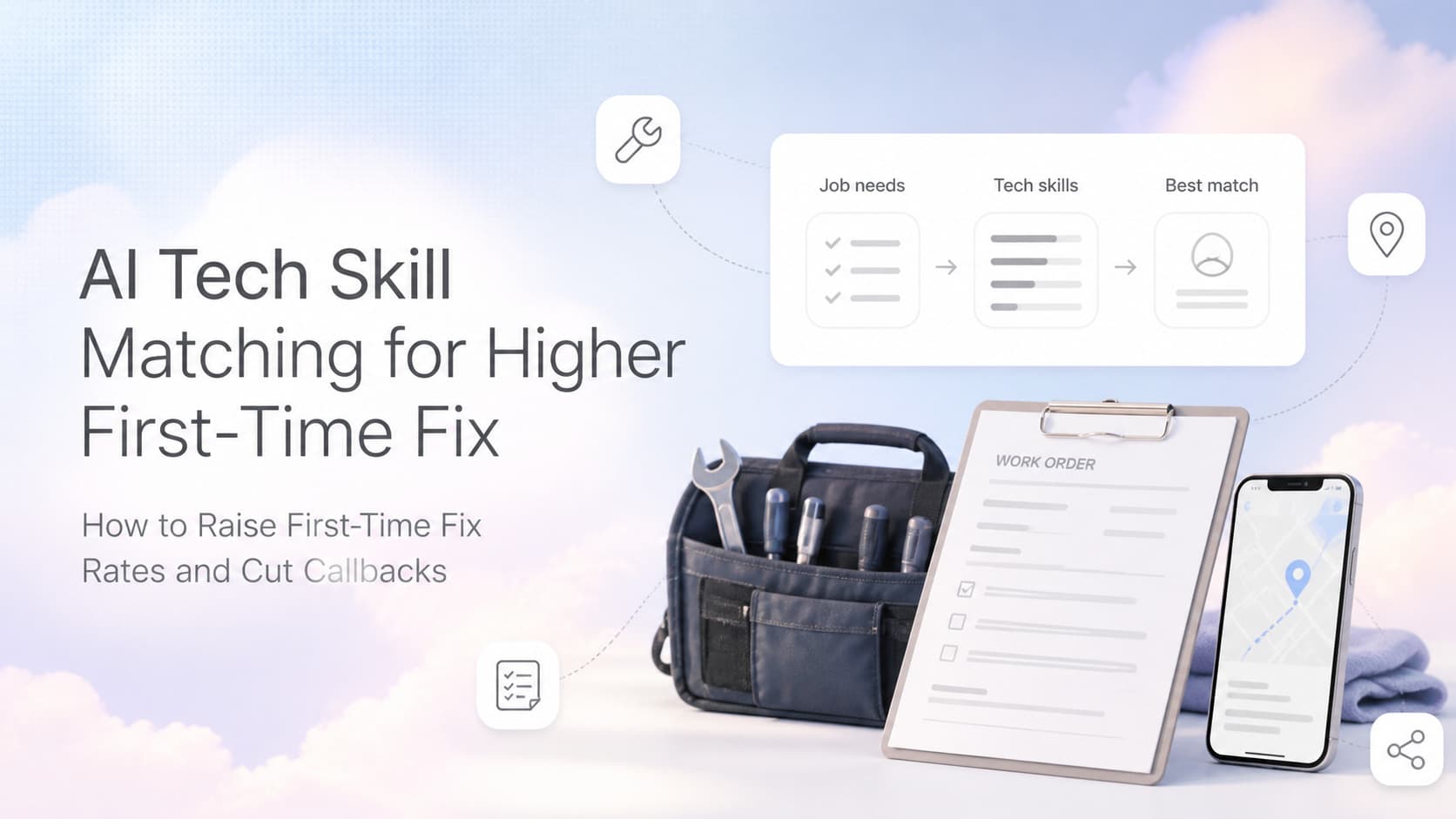
AI Tech Skill Matching for Field Service: How to Raise First-Time Fix Rates and Cut Callbacks
AI tech skill matching raises first-time fix rates 8 to 15 points and cuts callbacks 30 to 50 percent in 90 days. The model and the workflow.
Read the article: AI Tech Skill Matching for Field Service: How to Raise First-Time Fix Rates and Cut Callbacks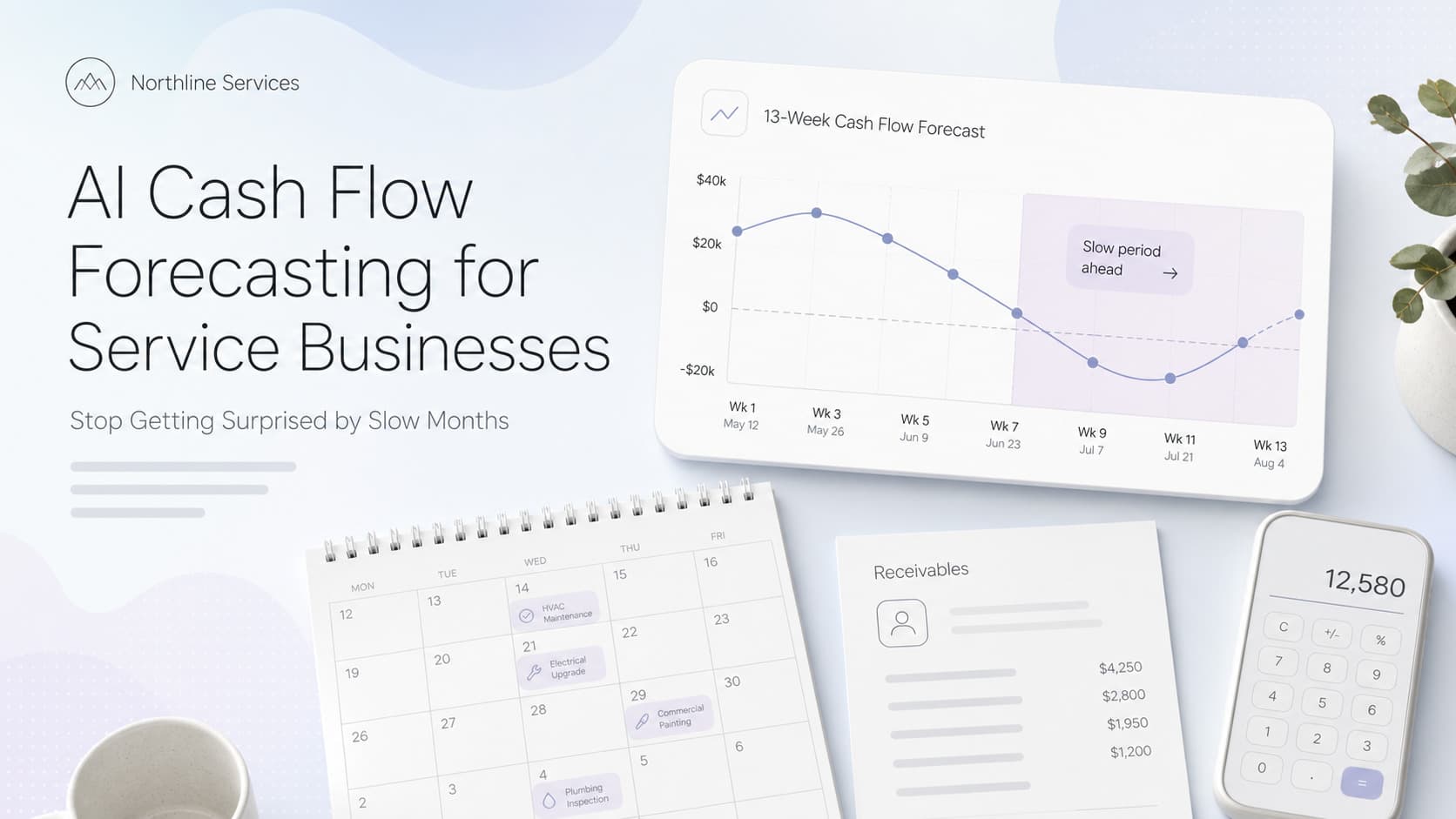
AI Cash Flow Forecasting for Service Businesses: Stop Getting Surprised by Slow Months
Most service businesses run blind on cash. A 13-week rolling forecast predicts slow months 60-90 days out so you can act before the dip.
Read the article: AI Cash Flow Forecasting for Service Businesses: Stop Getting Surprised by Slow Months
