Birmingham AL Business Automation for Manufacturers
Birmingham's manufacturing and industrial base runs on processes that haven't changed in decades. Here's how automation closes the gap.

Birmingham's Industrial Economy Is Ready for an Upgrade
Birmingham was built on steel. That identity shaped the city for over a century, and the industrial DNA still runs deep. Today, the metro area is home to hundreds of manufacturers, industrial suppliers, and trades companies, everything from metal fabrication shops to chemical processors to automotive parts suppliers feeding the Mercedes plant in Tuscaloosa, Honda in Lincoln, and Hyundai in Elmore County.
But walk into most of these operations and you'll find something surprising. The machines on the floor might be modern. The back office? Still running on spreadsheets, paper forms, and phone calls.
The gap between how these companies manufacture products and how they manage the business around those products is widening. Production technology has leapt forward. Administrative and operational processes are stuck in 2010.
That gap is where automation fits. Not as a replacement for skilled workers, but as the connective tissue that makes everything move faster, with fewer errors, and less wasted time.
What Process Automation Looks Like on a Factory Floor
When manufacturers hear "automation," they think robots. Assembly line arms. CNC machines. That's mechanical automation, and most Birmingham shops already have it where it makes sense.
Process automation is different. It's about the information flow around production, the data that tells you what's happening, what went wrong, and what needs to happen next.
Production tracking
Most mid-size manufacturers still track production status manually. A shift supervisor updates a whiteboard or fills out an end-of-shift report. By the time that information reaches management, it's already hours old.
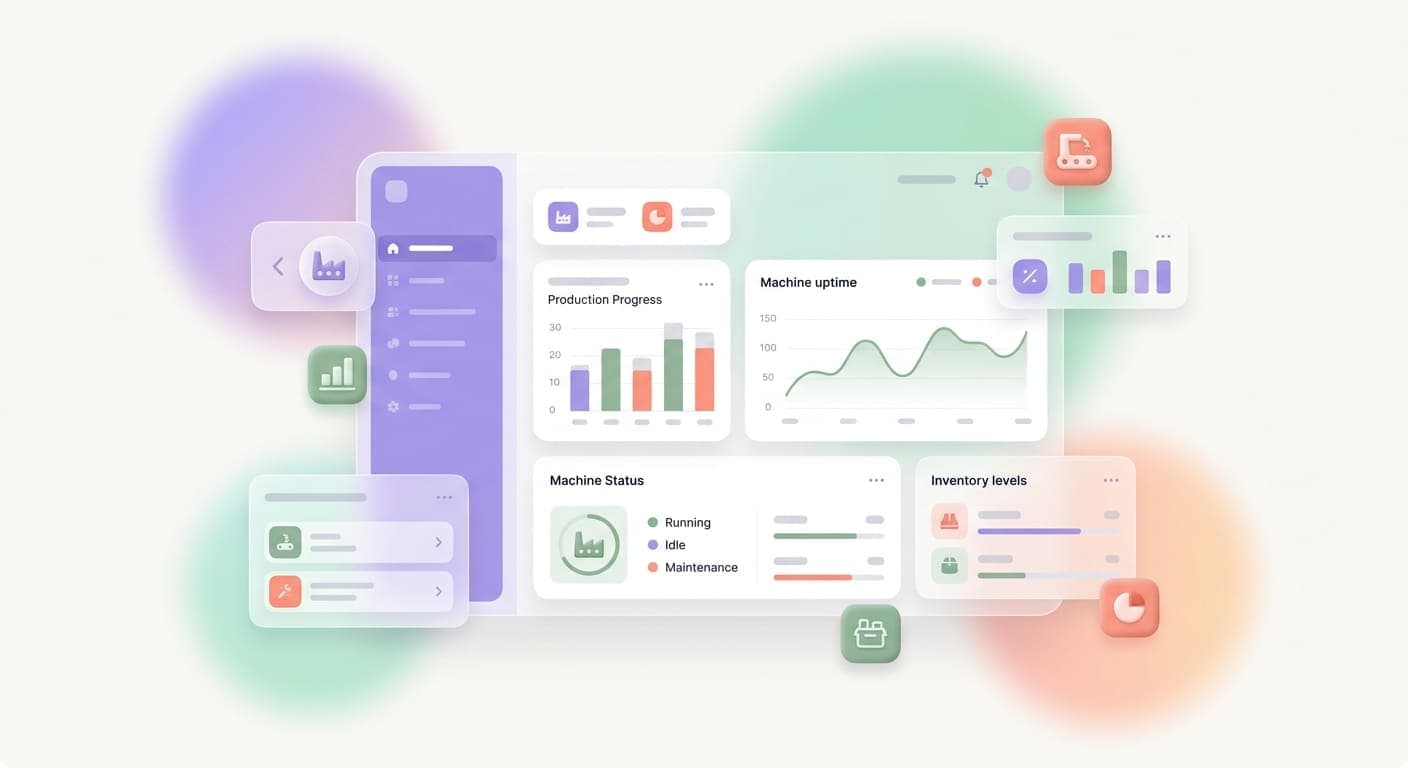
Automated production tracking pulls data directly from machine sensors, barcode scans, or operator inputs and pushes it to a live dashboard. You see real-time output, cycle times, and throughput rates without waiting for someone to compile a report. When a line falls behind target, the system flags it immediately, not at tomorrow's morning meeting.
Quality alerts
Quality issues caught late in the process cost exponentially more than issues caught early. Automated quality tracking lets operators log defects as they happen, triggers alerts when defect rates exceed a threshold, and routes quality holds to the right person without manual handoffs.
A Birmingham metal fabrication shop running three shifts can't rely on shift-change conversations to communicate quality problems. An automated system ensures nothing slips through the cracks at 2 AM.
Downtime reporting
Unplanned downtime is one of the most expensive problems in manufacturing. When a machine goes down, every minute of lost production counts. Automated downtime tracking captures the start and end of each event, categorizes the cause (mechanical, material, operator, changeover), and builds a history that reveals patterns.
After three months of automated tracking, you might discover that 40% of your downtime comes from one machine's tooling changeovers, and that a $5,000 quick-change fixture would pay for itself in two weeks. You can't make that call if your downtime data lives in a paper log that nobody analyzes.
Back-Office Automation for Industrial Companies
The factory floor gets all the attention, but the back office is where industrial companies bleed the most time. These are processes that every manufacturer deals with and almost none have automated well.
Invoice processing
A typical Birmingham industrial supplier handles hundreds of invoices per month from dozens of vendors. Someone opens each email, downloads the PDF, types the data into the accounting system, matches it against a purchase order, routes it for approval, and schedules payment.
Automated invoice processing reads the document (whether it's a clean PDF or a scanned image), extracts line items, matches them against POs, flags discrepancies, routes approvals based on dollar amount, and schedules payment. The whole cycle that took 20 minutes per invoice now takes seconds, with a human reviewing only the exceptions.
For more on how this type of workflow automation scales, check out our workflow automation services.
Vendor management
Tracking vendor performance, on-time delivery rates, quality scores, pricing trends, is critical for procurement decisions. But when that data is scattered across emails, spreadsheets, and ERP entries, nobody has a clear picture.
Automated vendor scorecards pull delivery data from your receiving system, quality data from your inspection records, and pricing data from your PO history. They compile it into a dashboard that updates itself. When it's time to renegotiate a contract or qualify a new supplier, you have the data in front of you instead of spending two days pulling it together.
Compliance documentation
Birmingham manufacturers serving automotive, aerospace, or defense customers know the compliance burden. ISO documentation, material certifications, lot traceability, customer audit responses, the paperwork is relentless.
Automation doesn't eliminate compliance requirements, but it makes them manageable. Document management systems with workflow automation ensure that every certification is filed correctly, every expiration date triggers a renewal notice, and every audit request can be answered from a searchable archive instead of a filing cabinet.
Healthcare and Biotech Automation Near UAB
Birmingham's economy isn't just manufacturing. The UAB (University of Alabama at Birmingham) corridor has built one of the Southeast's largest concentrations of healthcare, biotech, and medical research operations. These organizations face their own automation challenges.
Patient intake and scheduling
Medical practices in the Birmingham metro area handle thousands of patient interactions per week. Automated intake systems let patients fill out forms before they arrive, verify insurance eligibility in real time, and slot appointments based on provider availability and procedure type. No more clipboard handoffs and manual data entry at the front desk.
HIPAA-compliant workflows
Healthcare automation requires strict data handling. Every automated workflow that touches patient information needs encryption in transit and at rest, role-based access controls, and audit trails. Off-the-shelf tools don't always meet these requirements. A custom-built solution ensures compliance is baked into the workflow, not bolted on afterward.
Research administration
UAB's research ecosystem generates enormous administrative overhead, grant applications, IRB submissions, equipment procurement, study coordination. Automated workflows route documents through approval chains, track deadlines, and generate status reports without manual follow-up. Researchers spend more time on research and less time chasing signatures.
Construction and Trades: Automating Bids, Permits, and Scheduling
Birmingham's construction industry is booming. New commercial developments, residential projects, and infrastructure work are keeping contractors busy. But the administrative side of construction hasn't kept up with the demand.
Bid management
A general contractor responding to five RFPs a week spends hours assembling bid packages. Automated bid management pulls cost data from recent projects, populates proposal templates, calculates material and labor estimates based on historical rates, and packages everything into a professional document. The estimator reviews and adjusts instead of building from scratch every time.
Permit tracking
Permit applications across Jefferson County, Shelby County, and surrounding municipalities each have their own requirements and timelines. An automated tracking system logs every application, monitors status changes, sends deadline reminders, and alerts you when a permit is approved or needs additional documentation. No more surprises at the job site because a permit fell through the cracks.
Crew and job scheduling
Coordinating crews across multiple job sites is a logistics problem that most contractors solve with whiteboards and group texts. Automated scheduling tools factor in crew availability, travel time between sites, equipment requirements, and weather conditions to build optimized schedules. When a job gets delayed, the system automatically reshuffles the calendar and notifies affected crews.
The time savings here are real. Contractors who automate scheduling typically recover 10-15 hours per week in administrative coordination, hours that go directly back into billable work.
If you haven't mapped your current process to find automation opportunities, our beginner's guide to small business automation is a solid starting point.
Choosing an Automation Partner vs. DIY Tools
Birmingham businesses have two paths to automation, and each fits different situations.
DIY tools (Zapier, Make, Power Automate)
These platforms let you connect apps and build basic workflows without writing code. They work well for:
- Simple, two-step integrations (form submission triggers an email)
- Standard data routing between common apps
- Low-stakes processes where occasional errors are acceptable
- Companies testing automation before committing to a larger investment
The limitation: DIY tools hit a ceiling fast. Complex logic, error handling, custom data transformations, and integrations with legacy systems push beyond what no-code platforms handle gracefully.
Custom-built automation
When your process doesn't fit neatly into a template, a custom solution fills the gap. This means:
- Workflows tailored to your exact process, not a generic version of it
- Integration with older ERP systems, proprietary databases, or industry-specific software
- Advanced logic, exception handling, and multi-step decision trees
- Scalability that grows with your operation
The upside: it does exactly what you need. The investment: higher upfront, but the ROI on a custom system that eliminates 20+ hours of weekly manual work pays back fast.
Most Birmingham manufacturers end up with a mix. DIY tools handle the simple stuff. Custom automation handles the high-value, high-complexity workflows that actually move the needle. For a deeper look at how to measure that return, our guide to AI implementation ROI breaks down the numbers.
Start With a Process Audit
Here's the pattern we see with Birmingham industrial companies: the owner knows automation would help, but doesn't know where to start. There are too many processes, too many tools, and too much conflicting information about what to do first.
The answer is a process audit. Walk through every operational workflow, from lead intake to invoicing to production to delivery, and identify three things:
- Where are people doing repetitive, predictable work? These are your low-hanging fruit. Automate them first.
- Where do errors and delays happen most often? These are your highest-cost problems. Automation here delivers the biggest financial impact.
- Where are decisions bottlenecked by one person? These are your scalability constraints. Automating the information flow around those decisions lets your business grow without adding headcount for every new contract.
Birmingham's industrial sector is strong. The companies that automate the work around their core expertise, the data entry, the follow-ups, the compliance paperwork, the scheduling coordination, will be the ones that scale. The ones that don't will spend more time managing processes than building products.
You can learn more about our approach on our Birmingham AL page or explore the full scope of our workflow automation services.
Ready to find where automation fits in your Birmingham operation? Talk to our team, we'll run a process audit and show you the three highest-ROI automation opportunities in your business.
Related articles

Wilmington Port Cyberattack 2026: Build Manual-Proof Workflows
Wilmington businesses tied to the port should use August's cyberattack disruption to tighten intake, routing, and backup workflows before the next slowdown.
Read the article: Wilmington Port Cyberattack 2026: Build Manual-Proof Workflows
Richmond Code Refresh 2026: Fix Government Workflows Before the Fall Vote
Richmond teams touched by Code Refresh should use the August draft launch to clean up intake, document routing, and public-facing workflows before fall review.
Read the article: Richmond Code Refresh 2026: Fix Government Workflows Before the Fall Vote
Savannah's New Port Connector: The Automation Playbook for Faster Freight Ops
Savannah operators should use July's Brampton Road Connector opening to tighten freight handoffs, yard workflows, and ERP reporting before port volume rises.
Read the article: Savannah's New Port Connector: The Automation Playbook for Faster Freight Ops
