AI Content Marketing for Service Businesses: Create Content That Actually Generates Leads
Service businesses waste time on content that doesn't generate leads. AI content marketing helps create blog posts and landing pages that drive calls.

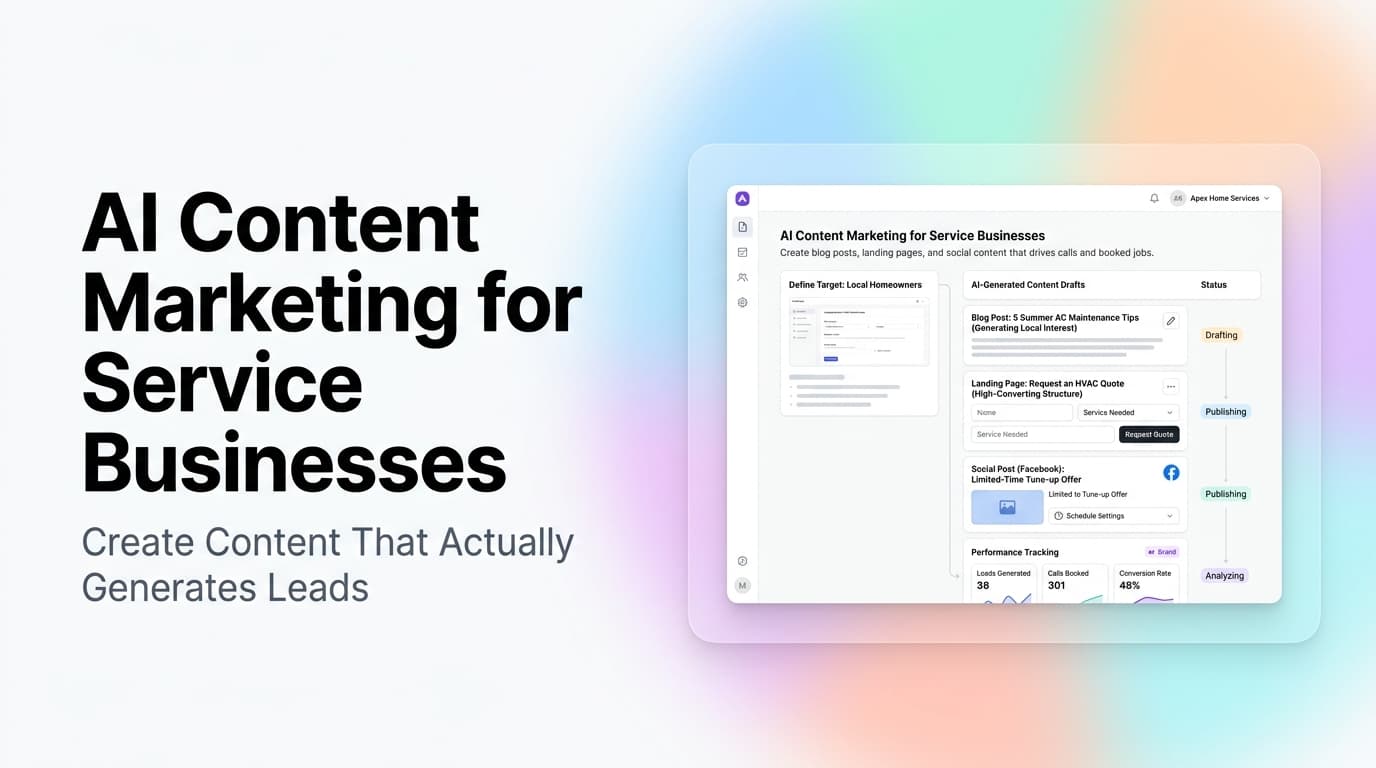
What Is AI Content Marketing for Service Businesses?
AI content marketing means using AI tools to research, write, optimize, and distribute content that brings in leads for your service business. Instead of spending 8 hours on a blog post that nobody reads, you spend 2 hours on a post that ranks, converts, and books jobs. The goal is not to replace your voice. It is to remove the bottleneck that stops you from publishing consistently.
Quick answer: AI content marketing helps service businesses create blog posts, landing pages, and social content that generates leads. Use AI for research, drafting, and optimization. Keep your expertise and editing in the loop. Publish consistently on topics your customers actually search for. Expect 3-5x more content output with the same time investment.
Why Most Service Business Content Fails
Service business owners face a specific content problem. You know your industry inside out. You can explain why a customer needs a new water heater or why their HVAC system is short-cycling. But translating that knowledge into content that ranks on Google and converts readers into callers is a separate skill.
The three failures we see most often:
| Problem | What It Looks Like | The Cost |
|---|---|---|
| Inconsistent publishing | One post in January, nothing until June | Google ignores your site. No organic traffic builds. |
| Wrong topics | Writing about industry news instead of what customers search for | High bounce rate. No calls from the content. |
| No conversion path | Great article, no call to action, no phone number, no booking link | Readers leave. They don't call. They don't book. |
At AnovaGrowth, we have worked with HVAC contractors, plumbers, electricians, and home service companies that had excellent websites and zero blog traffic. The content was there. The topics were wrong, the publishing was sporadic, and there was no mechanism to turn a reader into a lead.
AI content marketing fixes all three problems. Not by writing for you. By removing the friction that stops you from doing it right.
How AI Changes the Content Workflow for Service Businesses
The traditional content workflow for a service business looks like this:
- Think of a topic (5 minutes)
- Research what to write (30 minutes)
- Write the post (3-4 hours)
- Edit and format (1 hour)
- Add images and meta tags (30 minutes)
- Publish and promote (15 minutes)
Total: 5-6 hours per post. At one post per week, that is 20-24 hours per month. Most service business owners do not have 20 hours per month for content.
The AI-assisted workflow:
- Research customer search terms with AI (10 minutes)
- Generate a detailed outline with AI (10 minutes)
- Write the post using your expertise + AI draft (1 hour)
- Edit for voice and accuracy (30 minutes)
- Generate images and meta tags with AI (10 minutes)
- Publish and promote (15 minutes)
Total: 2-2.5 hours per post. Same quality. More consistent publishing. More leads.
The key difference is that AI handles the research, structuring, and first draft. You handle the expertise, editing, and final polish. Your knowledge is what makes the content valuable. AI just makes it faster to produce.
What Topics Actually Generate Leads for Service Businesses
Not all content is equal. The topics that generate leads for service businesses fall into three categories.
Problem-Aware Content
These are posts for people who know they have a problem and are searching for answers. They are not ready to buy yet, but they are gathering information.
Examples:
- "Why Is My AC Blowing Warm Air?"
- "How to Tell If Your Water Heater Is About to Fail"
- "Signs Your Electrical Panel Needs an Upgrade"
These posts rank for high-intent search terms. When someone searches "why is my AC blowing warm air" in July, they are not browsing. They have a problem and they need a solution. If your post shows up and you explain the likely causes and when to call a pro, you get the call.
Solution-Aware Content
These are posts for people who know they need a service and are comparing options.
Examples:
- "New AC Installation Cost in 2026: What to Expect"
- "Tankless vs Tank Water Heaters: Which Is Right for Your Home"
- "How Much Does Electrical Panel Replacement Cost?"
These posts capture people who are ready to buy. They are comparing prices, reading reviews, and deciding who to call. Your post should include clear pricing context, decision criteria, and a direct path to a quote or consultation.
Authority-Building Content
These are posts that establish your expertise and help with local SEO.
Examples:
- "Why Regular HVAC Maintenance Saves You Money"
- "The Importance of Licensed Electricians for Home Safety"
- "How Often Should You Service Your Water Heater?"
These posts build trust and improve your site's topical authority. They do not convert immediately, but they make your site more likely to rank for the high-intent terms above.
The rule: Publish 2 problem-aware posts for every 1 solution-aware post and 1 authority post. This mix captures people at every stage of the buying journey.
How to Use AI to Write Content That Sounds Like You
The biggest fear service business owners have about AI content is that it will sound generic. That is a valid concern. Most AI-generated content does sound generic. But that is a prompt problem, not a tool problem.
Here is the process we use at AnovaGrowth:
-
Feed the AI your existing content. Give it your best blog posts, your service page copy, and your about page. Tell it to analyze your voice, your sentence structure, and the words you use.
-
Write a detailed brief. Do not ask AI to "write a blog post about AC maintenance." Give it the angle, the key points, the customer objections to address, and the call to action. The more specific your brief, the better the output.
-
Edit for expertise. AI does not know your specific market. It does not know that summer in Rome, GA means 95-degree days with 80% humidity. It does not know that your customers tend to call on Monday mornings after a weekend of broken ACs. You add that context. That is what makes the content yours.
-
Read it out loud. Before you publish, read the post out loud. If it does not sound like something you would say to a customer, rewrite it. AI content that passes the "would I say this to a customer?" test converts better.
The Content-to-Call Pipeline
Content does not generate leads by accident. You need a pipeline that turns a reader into a caller.
Every blog post needs these elements:
- A phone number in the first 200 words (for mobile readers who want to call immediately)
- A clear call to action at the end (not "contact us" but "call us for a free estimate")
- A related service page link in the body (not just the navigation)
- A booking or quote form link for readers who prefer digital contact
Example from a real post we helped an HVAC client with:
The post was titled "Why Your AC Is Blowing Warm Air." It ranked #3 for that search term in their market. The post included a phone number in the introduction, a section called "When to Call a Professional" with a link to their AC repair page, and a call to action that said "Call us for same-day AC repair."
That single post generated 12-15 calls per month during summer. Each call had an average job value of $285. The post took 2 hours to write with AI assistance. It has generated over $25,000 in revenue over two years.
The Tools and Setup
You do not need a complex tech stack to do AI content marketing. Here is what we recommend for service businesses:
For research: Use AI to analyze your competitors' top-ranking content. Ask it to identify the questions those posts answer, the keywords they target, and the gaps they leave open. This gives you a content brief in 10 minutes.
For writing: Use a capable AI model with a custom instruction set. Tell it your business name, your service area, your target customer, and your voice guidelines. Keep the instruction set saved so you can reuse it.
For optimization: Use AI to generate meta titles, meta descriptions, and alt text for images. These are small tasks that add up to 30 minutes per post if done manually.
For scheduling: Use a content calendar tool or a simple spreadsheet. Plan 4 posts per month. Write them in two 4-hour blocks. Publish one per week.
Key Takeaways
- AI content marketing cuts content production time from 5-6 hours to 2-2.5 hours per post
- Focus on problem-aware topics that match what your customers search for
- Feed the AI your voice and expertise. Generic prompts produce generic content.
- Every post needs a clear path to a phone call or booking
- Consistency beats perfection. One post per week for 6 months outperforms 12 posts published in one month.
Related Reading
- Digital Marketing for Service Businesses: What Actually Moves the Needle
- Local SEO in 2026: What Actually Works Right Now
- Website Conversion Tracking for Service Businesses
Ready to build a content engine that generates leads? Contact us to discuss how we can help your service business create content that actually drives calls and booked jobs.
Related articles

Rome, GA Summer Downtown Playbook: Turn First Fridays Into Repeat Customers
Rome businesses can turn summer downtown traffic into repeat customers with sharper local SEO, better landing pages, and faster follow-up.
Read the article: Rome, GA Summer Downtown Playbook: Turn First Fridays Into Repeat Customers
Rome, GA Big BRAG Weekend Playbook: Convert Visitor Traffic Into Booked Work
Big BRAG brings 1,000+ cyclists into Rome on May 31. Use this 72-hour playbook to capture demand with local SEO, website updates, and follow-up automation.
Read the article: Rome, GA Big BRAG Weekend Playbook: Convert Visitor Traffic Into Booked Work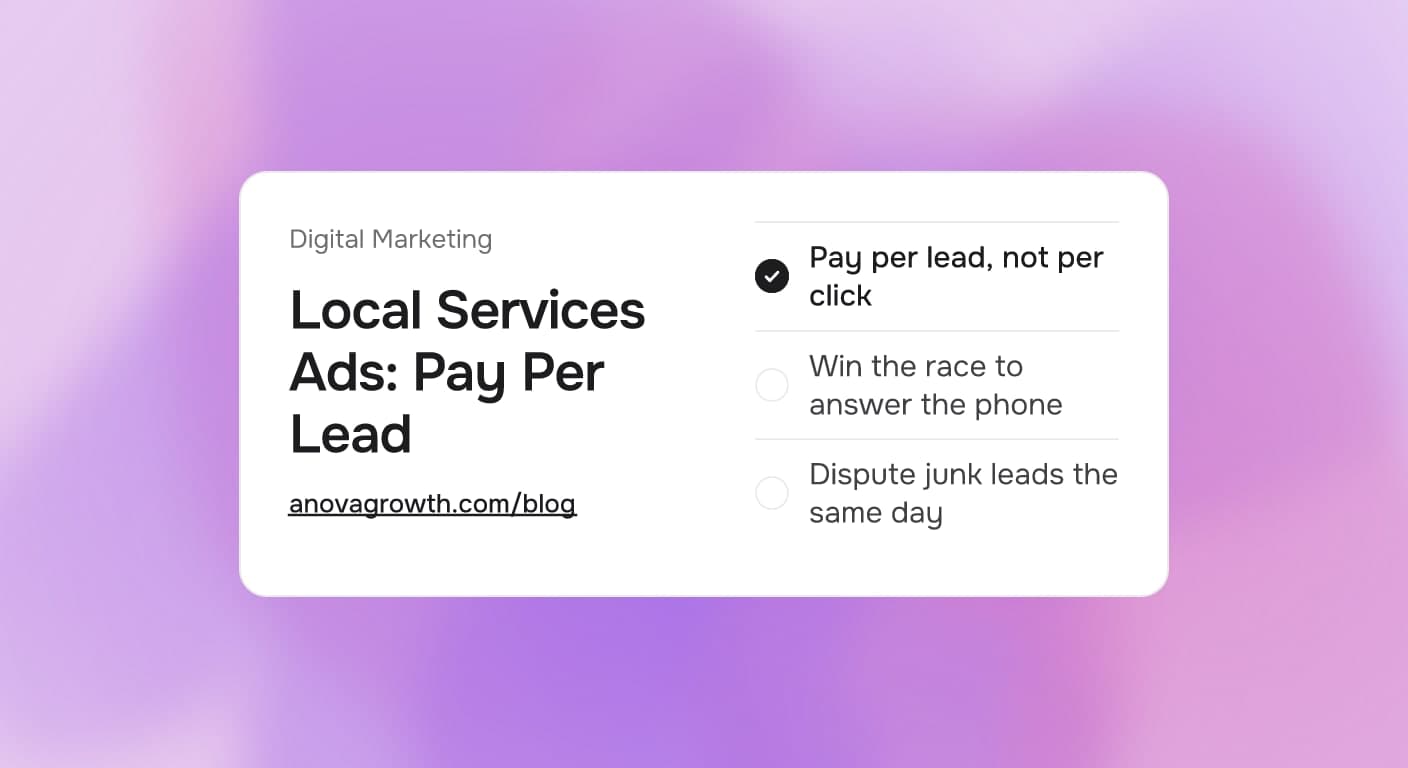
Google Local Services Ads for Service Businesses: How Pay Per Lead Works and When to Run Them
LSA charges you per lead, not per click. See how Local Services Ads work, when they beat Google Ads, and how to keep junk leads from eating your budget.
Read the article: Google Local Services Ads for Service Businesses: How Pay Per Lead Works and When to Run Them
