Google Ads Landing Pages for Service Businesses: What to Build and What to Skip
Sending paid clicks to your homepage splits attention and wastes budget. Learn what a service business landing page needs, what to skip, and how to ship one.

The Quick Answer
Paid clicks have one job: turn a visitor into a booked call or a submitted form. A homepage splits attention across services, staff pages, and blog posts, so much of that traffic leaves without acting. A purpose-built landing page matches the ad, states the offer in plain words, and removes every exit that does not lead to a booking. You need less copy than you think, and a working page can ship in days, not months.
Why Your Homepage Loses Paid Clicks
Your homepage has a hard job. It has to introduce the company, cover several services, link to the blog, and speak to job seekers and customers at the same time. That is fine for someone who typed your name into a search box.
Someone who clicked a paid ad is different. They searched for one specific problem a few minutes ago. If your page opens with a generic "welcome" message and a menu of ten services, the visitor has to do the work of figuring out whether you handle their problem. Most will not bother. They go back and click a competitor whose page answered the question immediately.
There is also a cost side. Ad platforms watch how visitors behave after the click. When people bounce quickly and never contact you, your results cost more over time because the platform sees a poor experience. A page that matches the ad and converts well tends to earn cheaper, steadier results on the same budget.
What a Strong Landing Page Includes
We build every paid-traffic page around the same short checklist:
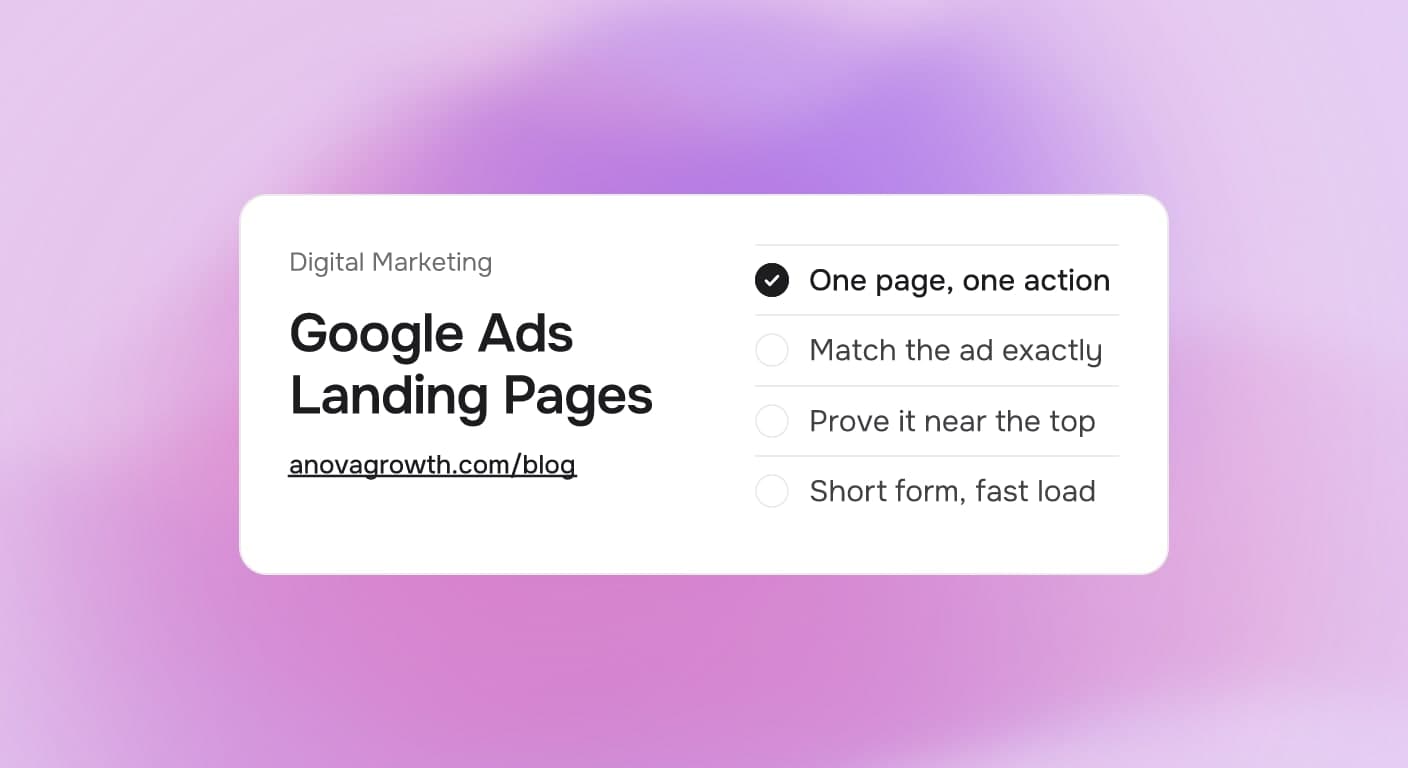
- A headline that repeats the promise in the ad. If the ad says "24/7 emergency water heater repair in Marietta," the headline should say nearly the same thing. Same words, same promise, no creative rewrite.
- One primary action. A form and a click-to-call button. Everything else, including chat and secondary links, stays quiet.
- Proof above the fold. License numbers, years in business, review ratings or quotes, and the service area. Keep every claim true and specific.
- A short form. Name, phone, zip code, and one line describing the job. Every extra field trades completions for data you rarely use.
- Speed on a phone. Most local service searches happen on mobile, often from the curb or a job site. A page that crawls loses visitors before your offer even renders. We hold every page we ship to the same speed budget. Our website speed guide covers the technical side.
- Tracking wired before launch. Form submissions, calls, and the thank-you page recorded as events so you can see cost per lead alongside click counts. The setup lives in our conversion tracking guide.
The Decision: Dedicated Page, Homepage, or Bigger Work
| Situation | Build this | Why |
|---|---|---|
| Running any paid traffic to your homepage | Dedicated landing page per campaign | One message, one action, easy to test |
| One service, one city, competitive bids | A page tuned to that job and market | Relevance is what earns the click and the call |
| Seasonal promo or storm-season rush | Small one-off page with its own calendar | Campaign ends, page pauses, nothing else breaks |
| Whole site is slow or confusing everywhere | Fix site fundamentals first | A landing page on a broken foundation still leaks leads |
The last row matters. If your whole site takes a dozen seconds to load on a phone, a single fast landing page helps the campaign but the rest of your traffic still suffers. Fix the foundation, then layer campaigns on top.
How We Build and Launch One Step by Step
- Pick one service and one intent. "AC repair" and "AC installation" are different customers with different urgency. One page each.
- Write the headline from the ad. Copy the promise, tighten the wording, keep the same meaning.
- Set the action. Form on the page, call button in the header and footer, and a plain thank-you page that confirms the submission worked.
- Add proof. Reviews, license, service area, and photos of your actual crews and trucks. Stock photos of smiling strangers do more harm than good in trades.
- Cut the exits. No full navigation menu. Footer links only, and a plain site link for visitors who want it.
- Hold the speed budget. Compress images, skip heavy scripts, test on a mid-range phone connection, not your office wifi.
- Wire the tracking. Form events, call events, and source data flowing into your CRM so the lead lands in one place with its history attached.
- Review weekly, edit one thing at a time. Cost per lead, form starts versus completions, and calls. Change one element, wait for enough volume to judge it, then decide.
What We Do in Our Own Shop
We hold our own pages to the same standard we hold client pages. Every AnovaGrowth campaign page does one job, repeats the ad promise in the headline, and sends every submission and call into our CRM with the source attached, so nothing sits in an inbox waiting for someone to check a form inbox. When we review results, we look at cost per lead and form starts before we look at anything else, and we change one element at a time so we know what actually moved the number. That same loop is what we set up for service business clients: the page is the easy part, the habit of reviewing and editing weekly is what compounds.
Common Fan-Out Questions
Can I just send Google Ads traffic to my homepage?
You can, and it usually wastes money. The homepage cannot match every ad promise at once, so most visitors bounce. If budget is tight, build one page for your best campaign rather than splitting the same budget across a site that was never designed to convert paid traffic.
Do I need one landing page or one per service?
One per service, and often one per market for your biggest ones. A page talking about drain clearing should not also sell water heaters. If that feels heavy, start with your two or three highest-intent services and grow from there. You can connect paid pages to the rest of your funnel with proper call tracking so you know which page produced which call.
Do landing pages help my regular SEO?
Not directly, and that is fine. A paid landing page is a conversion tool, not an organic asset. Organic visibility comes from indexed, genuinely useful pages such as your service pages and service area pages. Keep the two jobs separate: ad pages convert clicks, SEO pages earn free visitors over months.
What should the form ask for?
The minimum that lets you route the job: name, phone, zip code, and one free-text line. Every additional field lowers completions. If you truly need job details, ask them on the thank-you page or in a quick follow-up call, not as an obstacle before the submit button.
How long until we know if the page works?
Judgment needs volume, not a calendar date. Watch form starts versus completions from day one, since a big drop-off there means the form or the offer is the problem. Give the headline and the form at least a couple of review cycles before you redesign anything, and keep the measurement clean by pairing the page with the tracking setup in our conversion tracking guide.
Key Takeaways
- Paid traffic needs its own page. The homepage is built to serve everyone, which means it converts no one well.
- Match the ad promise in the headline and keep one action on the page.
- Proof belongs above the fold, and every claim on the page must be true.
- Short forms and fast phones beat long forms and heavy pages.
- Tracking decides whether you are marketing or guessing. Wire it before the campaign starts.
Next Steps
If you are paying for clicks right now and sending them to your homepage, that is the first thing to fix. Pick your highest-intent service, build one page, and wire the tracking honestly. We design and build landing pages, campaign tracking, and CRM handoffs as part of our web development work. Talk to us about the campaign you are running, and bring your current cost per lead if you have it.
Related articles

Lead Generation Without More Traffic: Conversion Fixes That Work
You may not need more traffic to get more leads. You may need a site and funnel that convert the traffic you already have.
Read the article: Lead Generation Without More Traffic: Conversion Fixes That Work
Why Rome, Georgia Businesses Need Digital Marketing That Actually Works
Rome GA businesses are discovering that generic marketing doesn't cut it. Here's what local companies need from a digital marketing partner.
Read the article: Why Rome, Georgia Businesses Need Digital Marketing That Actually Works
Service Area Pages for Local SEO: How Many to Build and What Makes Them Rank
How many service area pages to build, what each page needs to rank, and why thin doorway copies get ignored. A practical playbook for service businesses.
Read the article: Service Area Pages for Local SEO: How Many to Build and What Makes Them Rank
