Direct Mail for Service Businesses: When It Pays and When It Burns Cash
When direct mail pays for a service business, when it burns cash, and how to target, track, and test mailers so every piece traces to a booked job.

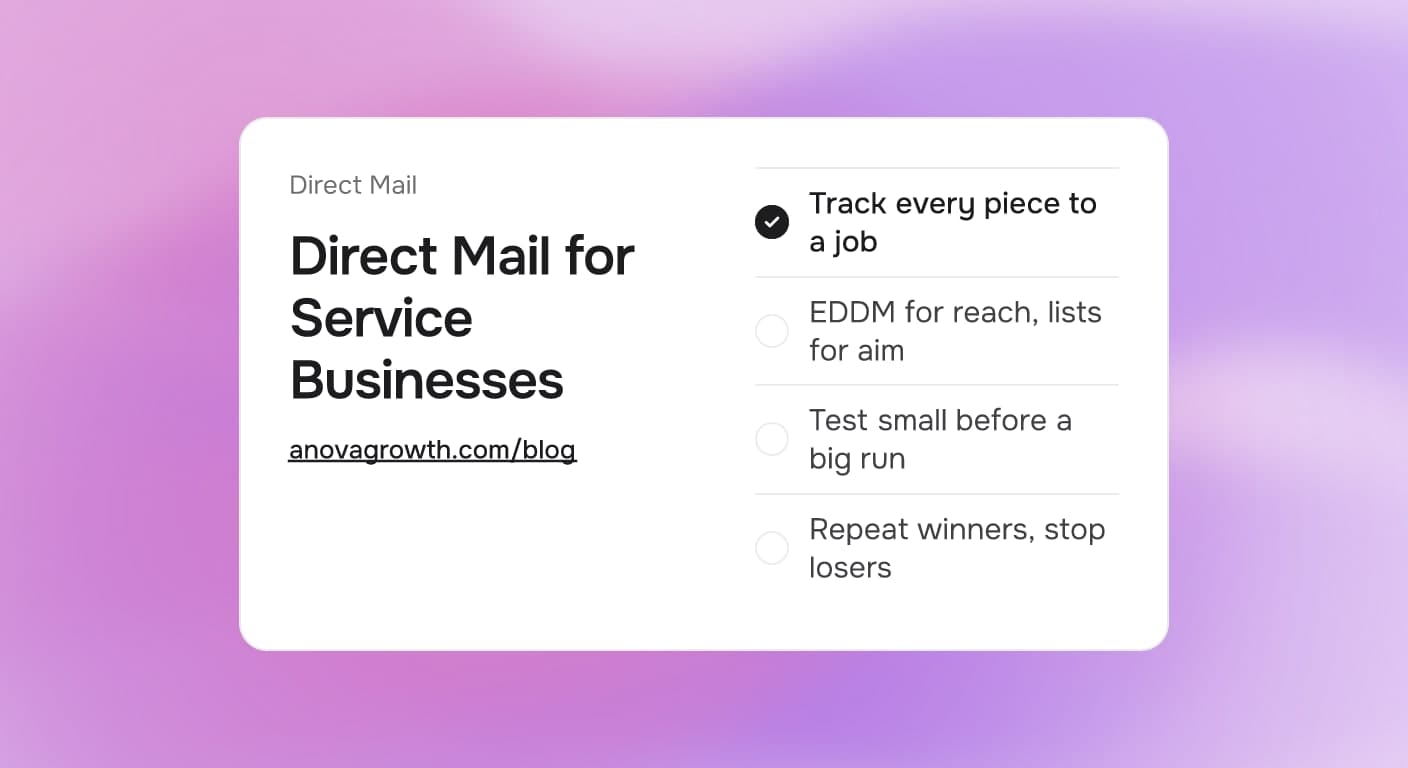
Every homeowner knows that mailbox pile: the same three contractor postcards, week after week, none of them remembered and none of them answered. Most service businesses have stood on the other side of it too. Someone sold them a big run of pieces, the phone stayed quiet, and direct mail became a dirty word in the owner's head.
The truth is less dramatic and more useful. Direct mail is a channel like any other: it works for some trades, at some ticket sizes, under some conditions, and it fails everywhere else. When it fails, the cause is usually one of three boring things. Nobody could tell which calls the mailer produced. The piece asked for the wrong job. Or the campaign was one drop instead of a pattern. This guide walks through when mail earns a spot in your budget, which mailer types fit which business, and how to run a test you can actually judge.
Quick answer
Direct mail pays for service businesses with a high job ticket and a real service area, when every piece carries its own tracking number or landing page, the list matches the job you want, and you test a few hundred pieces before any big run. It burns cash when the list is cheap, the ask is vague, and no one can tell which calls the mailer produced.
When direct mail earns a spot in the budget
Direct mail lives or dies on job economics. A roof replacement, a full HVAC swap, a kitchen remodel, or a sewer line replacement makes the math generous: a batch of mailers that produces even one booked job can cover itself several times over. The same batch promoting a low-dollar tune-up usually cannot, because print and postage land on every piece while the margin sits inside only a few of them. The mailer that fails is rarely the ugly one. It is the one carrying an offer your margins cannot support.
Mail also earns its keep by doing something digital ads do poorly in a tight service area. It puts your name in a physical spot, next to the magnet on the fridge and the other contractor's door hanger, and it keeps sitting there while the buyer slowly decides. That is exactly the timeline of a high-ticket home job. Some buyers decide in a weekend. Many stew for months after a leak or a breakdown, and the company that stayed visible in the mailbox during that stretch is often the one that gets the call.
None of that makes mail automatic money. The channel competes for budget against search, Local Services Ads, and everything else you run, and it should win or lose the same way they do: on cost per booked job. If you have not already built a monthly spending decision, our service business marketing budget allocation guide shows how to sort channels by what they actually produce before adding one more.
Which mailer types actually matter
Most of the direct mail confusion comes from mixing up five different things that get sold under one name. Use this table to pick the right one for your situation:
| Mailer type | Best use | Watch out for |
|---|---|---|
| EDDM carrier routes | Blanket reach around a recent big job when you have no mailing list and the ticket is big enough to pay for misses | Unqualified reach: every house gets the same offer, so a cheap-ticket service usually cannot support it |
| Targeted list mail | Trades that must filter by home age, home value, property type, or distance before spending a dollar | List quality varies wildly; make the vendor show the targeting criteria and remove duplicates before you buy |
| Your own customer list | Maintenance reminders, seasonal prep, and win-backs for people who already trusted you once | The list rots: addresses and numbers drift, so sync it from your CRM instead of a spreadsheet in a drawer |
| Job-site and neighbor cards | Cards that name real streets where you worked last month | Only true claims. Never print a neighbor reference you cannot verify on a job record |
| Big glossy brand pieces | Situational, for a mature brand with budget to spare | A first direct mail test should carry one direct offer, not an image campaign with no ask |
Two of these deserve a special note. EDDM, short for Every Door Direct Mail, lets you pick carrier routes and pay per piece without buying a mailing list at all. That is the cheapest way to saturate a radius, and it is the right answer when your offer fits nearly every home in the zone. A targeted purchased list costs more per piece worth of postage, but it aims: it can exclude rentals, condos, or homes too new or too old for your service. Your own customer list beats both, because those people already know who you are, and the card only has to remind them.
Rules that make or break a campaign
The mechanics are simple, which is exactly why they get skipped. Follow these and you will out-execute most of the mail arriving around yours:
- One offer, one job type per piece. A postcard that asks for maintenance, replacement, financing, and referrals all at once reads as noise. Give the reader one thing to want and one thing to do.
- Put a unique source on every piece. Print a phone number that exists only on mailers, and point the QR code at a page nobody else sends traffic to. That is what turns "mail felt slow" into a number you can act on. Our call tracking for service businesses guide covers the phone side, and our landing pages for Google Ads guide explains why a dedicated page beats a homepage link.
- Match the ask to the ticket. Big-ticket replacement jobs want a booked estimate. Maintenance offers want a low-friction step like a free inspection. Asking for a signed contract from a cold postcard is asking too much, too early.
- Mail in patterns, not one-shot drops. One drop rarely earns memory space. Three to six touches to the same routes across a season is the working rhythm for saturation mail, because buyers move on their own timeline, not yours.
- Judge booked jobs, not pieces printed. The printer's invoice is not evidence of marketing. Only calls, booked estimates, and closed revenue count, and they only count when you can attribute them to the mailer.
How to run a mailer test step by step
A first campaign should be small, measured, and boring. Here is the sequence:
- Pick one service and one tight area. One job type, one cluster of carrier routes or one filtered list. Testing two offers and three areas at once teaches you nothing.
- Keep the first run small. A few hundred pieces per segment is plenty for a first read. The goal is a signal, not a saturation campaign.
- Build the tracking before printing. Dedicated phone number, dedicated landing page, and a CRM that tags the source the moment a call or form arrives. If any of those three is missing, you are buying scenery.
- Mail, then wait a real window. Give the batch several weeks before judging, longer for high-ticket jobs where the decision cycle runs on months. A quiet first weekend means nothing.
- Log calls, booked estimates, and closed revenue by source. Track all three, because a mailer full of wrong-price calls looks worse than it is, and a mailer that books estimates nobody closes is worse than it looks.
- Make the call. Repeat a winning piece to a new area, fix the offer or the list and retest, or stop. Kill losers fast and never scale a piece you have not actually measured.
Do one more thing before design even starts: run the math with your own numbers. Suppose an all-in cost of about a dollar per piece once you add print, postage, and list. A 2,000 piece run then costs about two thousand dollars, and at a high average ticket, two booked jobs can cover the batch. At a couple hundred dollars per job, the same batch needs a response rate no honest printer would promise you. Nothing in that math is a fact about the industry. It is your ticket size and your close rate, which is why the numbers come off your books, not off a sales sheet.
How we handle direct mail at AnovaGrowth
We build websites, tracking, and automation for service companies, and our rule is simple: no mailer goes to the printer until its tracking exists. That means a dedicated phone number, a landing page the QR code points to, and a CRM that tags the source the moment a call or form arrives. When a company calls us after a failed mail campaign, the first thing we look for is what the mail produced, and the honest answer is almost always "nobody knows," because the pieces carried the office's main number and nothing that separated mail from word of mouth or search.
The fix is unglamorous. We treat mail as one measured channel inside one dashboard, next to search, ads, and the email newsletter. Once every piece has a source and every source lands in the CRM, the stop-or-scale decision takes minutes instead of months. Mail is not magic and it is not dead. It is a channel that pays the businesses that measure it, and it quietly taxes the ones that never do.
Related questions
Does direct mail still work when so much marketing is digital? Yes, in the trades where the ticket is big and the buyer is local. The mailbox holds fewer competitors than the inbox, and a physical piece survives in a kitchen drawer long after an ad impression disappears. It works only as measured spend, and only when the job value can carry the misses.
How many pieces make a fair test? The smallest batch that produces a real signal, usually a few hundred pieces to one segment, judged over several weeks. The fair test compares tracked calls and booked jobs against the batch cost, and it needs a unique source to mean anything at all.
What is EDDM, and is it right for me? Every Door Direct Mail lets you choose carrier routes and mail without buying a list, paying per piece at rates USPS publishes. It suits saturation offers with a ticket big enough to absorb misses. It is a poor fit for narrow, filtered offers, and rules and rates change, so check the current USPS terms before you print.
Should the mailer send people to the phone or the website? Open both doors. Print a mail-only phone number for buyers who would rather call, and a QR code to a dedicated landing page for everyone else. What never works is dumping mail traffic onto your homepage, where the visit and the lead lose their source.
How does direct mail fit with Google Ads and Local Services Ads? Search captures demand that already exists today. Mail builds awareness in a radius before the buyer searches, so the two channels support each other instead of competing. Fund whichever produces booked jobs at the better cost, using the same attribution for both.
What response rate should I expect? Refuse to buy from anyone who names a number before seeing your trade, offer, ticket size, and list. Response ranges run all over the map between industries and even between neighborhoods. The only rate worth planning around is the one your tracked test produces, which is why tracking comes before printing.
Key takeaways
- Direct mail earns budget only when the job ticket can absorb the misses, which puts big-ticket trades first and cheap one-off services last.
- Every piece needs a unique phone number or landing page, so calls and forms attribute to the mailer instead of disappearing into everything else.
- EDDM buys cheap radius reach with no list, targeted bought lists buy aim, and your own customer list usually outperforms both.
- A fair first test is a few hundred pieces to one segment, judged on booked jobs over several weeks, not on the printer's delivery date.
- Mail lives or dies inside the same discipline as your other channels: tracked sources in the CRM and decisions on cost per booked job.
Conclusion
Direct mail rewards the same discipline as every other channel you run. Pick a service your margins can support, target routes or a list that matches the buyer, give every piece its own source, and judge booked jobs over a real window. The shops that lose money on mail are not unlucky. They just never measured it, so the channel never got the chance to prove itself either way. Track it, and mail either earns its budget or it goes, and both answers are worth having.
Ready to make every lead traceable? Contact us about tracked mailers, landing pages, and reporting that shows what each channel really produces.
Related articles

Call Tracking for Service Businesses: Know Which Ads and Keywords Drive Phone Leads
Service businesses spend thousands on ads but can't track which calls convert. Call tracking connects phone leads back to the source so you know what's working.
Read the article: Call Tracking for Service Businesses: Know Which Ads and Keywords Drive Phone Leads
Website Conversion Tracking for Service Businesses: What to Measure and How to Set It Up
Most service businesses track visits but not conversions. Here is what to measure, how to set it up, and what the data means for your bottom line.
Read the article: Website Conversion Tracking for Service Businesses: What to Measure and How to Set It Up
Google Analytics 4: 6 Events That Actually Matter for Lead Generation
Stop drowning in GA4 data. Track these 6 events to measure real lead generation performance, form submissions, calls, and actual conversions.
Read the article: Google Analytics 4: 6 Events That Actually Matter for Lead Generation
