AI Chatbots in 2026: The Business Owner's Complete Guide
AI chatbots now resolve 70% of customer inquiries instantly. Here's what that means for your business, and why waiting is costing you leads.

Introduction
Your website gets 50 visitors a day. Maybe 100. Most of them land on your contact page, ask a question, and then bounce. They don't wait. They move on to the next business that answers faster.
The gap between "interested" and "converted" used to be a phone call away. Now it's a chat window. And if that chat window doesn't respond in under 30 seconds, you've lost them.
AI chatbots have been "coming" for years. In 2026, they're finally good enough to matter, and businesses that are using them are pulling dramatically ahead of those that aren't.
This guide covers what AI chatbots actually do for businesses in 2026, what to look for, and how to get one that doesn't embarrass you.
What AI Chatbots Can Actually Do in 2026
The chatbot of 2026 is not the chatbot of 2020. Those were glorified FAQs with buttons. The new generation runs on large language models, understands context, handles nuance, and integrates directly with your CRM, calendar, and email tools.
Here's what that looks like in practice:
Instant answers, 24/7. Your chatbot responds in under two seconds, at 2am, on Christmas, whenever a prospect shows up. No staff required. No "we'll get back to you Monday."
Qualifying leads automatically. Instead of just collecting a name and email, the chatbot asks the right questions, understands what the prospect needs, and routes qualified leads directly to your sales team, or books a call on the spot.
Scheduling without back-and-forth. When a prospect is ready to talk, the chatbot checks your calendar and books the appointment. No email tag. No lost leads.
Handling objections in real time. "How much does this cost?" "Do you service my area?" "Can I get a custom solution?", Good chatbots answer these directly and naturally, not with a generic "please contact sales."
Escalating to humans when needed. The best chatbots know when they're out of their depth and hand off to a human with full context, so the customer doesn't have to repeat themselves.
Why Most Chatbots Still Fail (And How to Avoid It)
A bad chatbot is worse than no chatbot. It gives wrong information, frustrates users, and makes your business look unprepared.
The most common failure points:
No integration with your tools. A chatbot that can't access your calendar, CRM, or product database is just an expensive FAQ bot.
Training on generic data. If your chatbot wasn't trained on your specific business, your services, pricing, processes, it'll give answers that sound plausible but are wrong.
No escalation path. When the chatbot hits a question it can't answer, it either loops or sends the user into a void. There needs to be a clear handoff to a human.
Ignoring conversation quality. A chatbot that talks like a robot tells prospects you're not paying attention to detail.
What a Good AI Chatbot Implementation Actually Costs
Business owners often assume chatbots are only for big companies with big budgets. That's outdated.
In 2026, AI chatbot platforms have matured enough that a well-built chatbot for a small-to-mid-size business starts at a few hundred dollars per month, not thousands. The ROI typically shows up fast: one additional qualified lead per week from chatbot conversations often covers the cost.
The real investment isn't money, it's configuration. Getting the chatbot trained on your business, integrated with your tools, and tuned to handle your specific customer conversations takes upfront work. That's why most businesses work with a partner who knows both the technology and the business context.
Key Takeaways
-
AI chatbots in 2026 are fundamentally different from earlier generations, they handle nuanced conversations, integrate with your tools, and qualify leads automatically.
-
Speed is the competitive advantage. Responding in under two seconds vs. 24 hours is the difference between winning and losing most inbound prospects.
-
A poorly configured chatbot is worse than none. Invest in proper training, integration, and escalation design, or your chatbot will cost you trust.
-
ROI is measurable and fast. Most businesses see positive return within the first 30-60 days through recovered leads and booked appointments.
Conclusion
The businesses winning in 2026 aren't the ones with the biggest websites or the most staff. They're the ones that respond fastest, follow up most consistently, and make it easiest for prospects to say yes.
An AI chatbot is the most direct way to build that into your business, around the clock, at scale, without burning out your team.
If you're tired of watching leads disappear because you couldn't answer fast enough, it's worth having a real conversation about what's possible.
Ready to see what an AI chatbot could do for your business? Talk to our team about building one trained on your specific business.
Related articles
AI Phone Answering for Service Businesses: Stop Missing Calls, Start Booking Jobs
Service businesses miss 30-50% of inbound calls. AI phone answering handles after-hours, peak times, and overflow without hiring more receptionists.
Read the article: AI Phone Answering for Service Businesses: Stop Missing Calls, Start Booking Jobs
The Maintenance Revenue Leak HVAC Companies Don't See
Most HVAC companies barely touch their maintenance list. AI re-engagement automation brings customers back on schedule.
Read the article: The Maintenance Revenue Leak HVAC Companies Don't See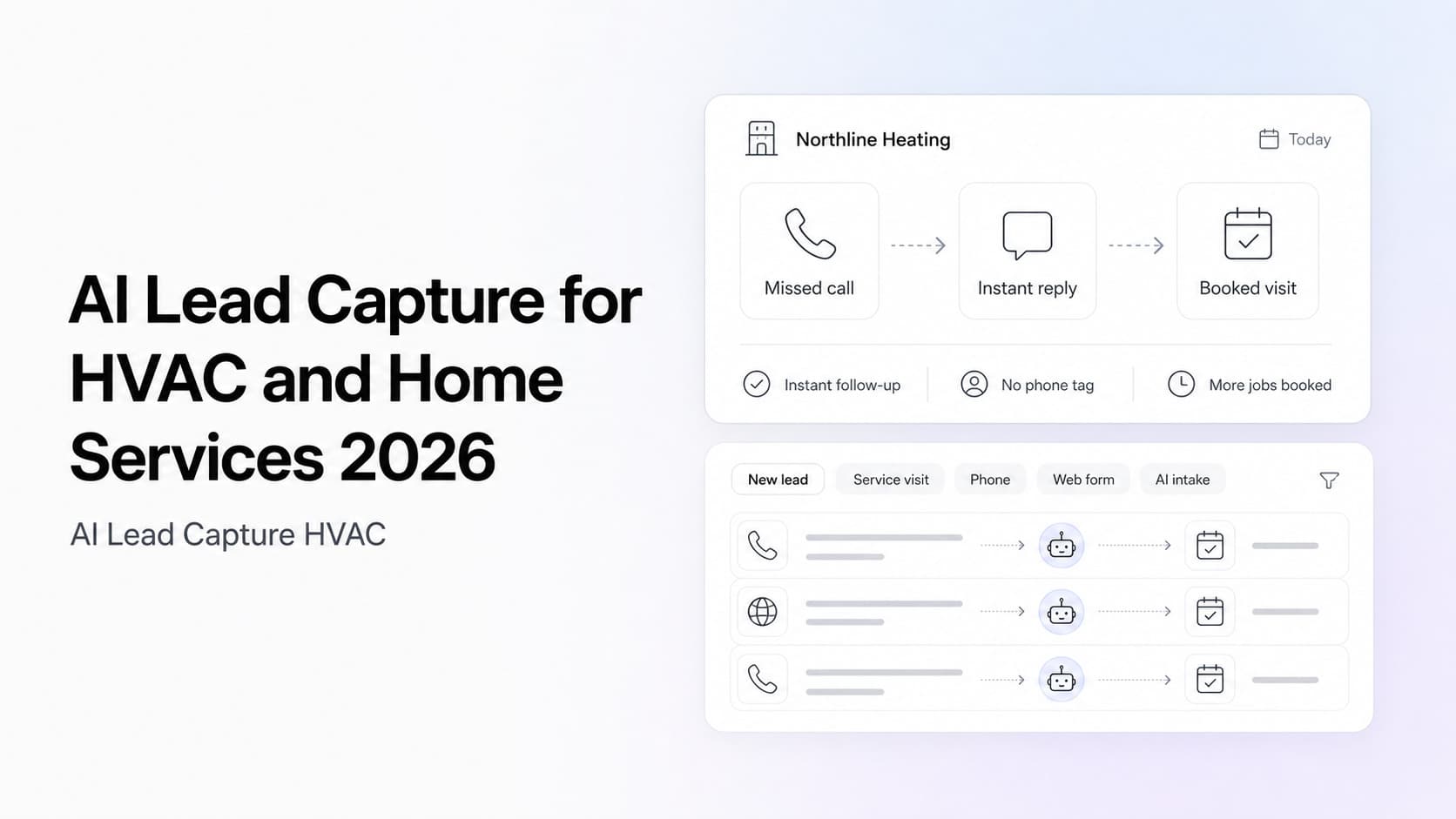
How HVAC Companies Lose Leads (And What AI Does About It)
Most HVAC companies lose half their leads to phone tag and slow follow-up. AI intake automation fixes both without adding staff.
Read the article: How HVAC Companies Lose Leads (And What AI Does About It)
