Custom vs Off-the-Shelf Software for Service Businesses: When Each Actually Pays Off
Most service business owners buy software hoping it will fix their operations. Sometimes it does. Sometimes the spreadsheet they replaced is the floor mat under the new app. Here is how to tell which one you actually need.

Most service business owners have been here. You buy software to solve a problem. Six months later you are paying for the software, paying for three integrations to make it work, and still exporting data to a spreadsheet to get the report you actually need.
That is not a software problem. That is a fit problem.
The custom vs off-the-shelf decision is not about budget. It is about what your operations actually require versus what the software was designed to handle. Here is how to work through it.
What Off-the-Shelf Software Does Well
Off-the-shelf software gets you to baseline fast. You sign up, configure some settings, and your team is running in a week. For standard workflows that look like everyone else's workflows, this works fine.
Where off-the-shelf wins for service businesses:
- Your workflow matches the software's built-in assumptions closely
- You have a small team that cannot absorb disruption
- You need to move fast on a new capability
- The software has an ecosystem of integrations that covers your gaps
- You are early stage and do not know what you will need in two years
QuickBooks, ServiceTitan, Housecall Pro, and similar platforms exist because most field service businesses have similar core needs. They handle scheduling, invoicing, and basic CRM. If your operation is close to that mold, the fit is good enough.
AnovaGrowth operating insight: We have worked with dozens of service businesses running off-the-shelf software. The ones who get real value from it are the ones who accept the software's workflow and build their process around it, rather than trying to force the software into their existing way of working. The companies that fight their software end up paying for it in productivity and data quality.
What Custom Software Does Well
Custom software exists because some workflows are genuinely different. A pool route optimizer, a specialty fabrication shop, a medical equipment service company with complex regulatory requirements, a job costing model that has nothing in common with standard job costing. These operations do not fit a mold. No shelf product handles them well.
Where custom wins:
- Your core workflow is materially different from how the software thinks
- You have specific compliance or documentation requirements the software cannot meet
- The software would require more integrations and workarounds than a clean build
- You are losing measurable revenue or efficiency because of the gap
- You have data that no off-the-shelf product can actually use
Custom software is not about having unique preferences. It is about having unique constraints that directly cost you money.
Proof block: A regional HVAC company we worked with had spent three years forcing their operations into a popular field service platform. They had 14 integrations, a part-time IT person managing workarounds, and still ran a weekly Excel reconciliation to close their books. The platform cost them $38,000 a year plus $22,000 in integration and IT time. A custom build that matched their actual dispatch and job-costing logic cost $75,000 to build and $1,800 a year to maintain. First-year ROI was positive by month four.
The Decision Framework
Use this when you are weighing options:
Go off-the-shelf when:
- Your process is close to standard and you can adapt to the software
- The cost of switching in the future is acceptable
- You need a solution in days or weeks, not months
- The software covers 80% or more of what you need with acceptable workarounds
- Your team will not tolerate a disruptive transition
Consider custom when:
- You have quantified the cost of the workflow gap and it exceeds build cost within 18 months
- Your data or process has genuine proprietary elements
- You have tried the leading off-the-shelf options and they all fail at the same point
- You are planning for scale and the software's limits will become a bottleneck
- You have a long-term operator who will maintain and evolve the system
The key question is not "can we make this work?" It is "what does it cost us per month to make this work, and what does the gap cost us per month, and how long until the custom build pays for itself?"
Common Mistake: Building Custom Because Off-the-Shelf Feels Limiting
The frustration of learning new software feels like proof that it does not fit. It usually is not. The learning curve is real but finite. Most service businesses that abandon off-the-shelf software after three months would have been fine at six months if they had committed to learning it.
Before you decide custom, ask: have you actually given the off-the-shelf option a real try? Not a two-week surface test, but a three-month honest attempt with proper training for your team?
What Happens After You Decide
Once you decide custom, the scoping question determines everything. Most failed custom software projects failed at scoping, not at coding. Before you build:
- Map the actual workflow end-to-end, including exceptions and edge cases
- Identify the three things the software must do that it must do correctly
- Define what "done" looks like with real acceptance criteria
- Plan for data migration from day one, not as an afterthought
- Account for ongoing maintenance and who will own it
We use a 90-day build cycle at AnovaGrowth for service business software. First 30 days is discovery and scoping with the owner. Days 31-60 is core build. Days 61-90 is integration, testing, and data migration. Anything that claims to build your entire system in two weeks is cutting corners that will cost you later.
Quick Answer
Off-the-shelf software is the right choice when your workflow is close to standard and you can adapt to the software's approach. Custom software is worth the investment when the workflow gap has a measurable dollar cost that exceeds build cost within 18 months and the gap cannot be solved by integrations or configuration. The decision is financial, not philosophical.
Ready to evaluate your options? Contact us to discuss whether custom software or an off-the-shelf platform makes more sense for your operation. We will tell you honestly either way.
Related articles

Custom Software Maintenance and Support for Service Businesses: The Hidden Costs Most Owners Never See
Custom software for service businesses does not stop costing money after launch. Here is what maintenance actually costs, who pays for it, and how to build a support plan that keeps your system alive.
Read the article: Custom Software Maintenance and Support for Service Businesses: The Hidden Costs Most Owners Never See
Custom Software Replacement: A 90-Day Migration Playbook for Service Businesses
Replace custom software in 90 days without losing data or breaking operations. A six-step playbook for service businesses ready to move on.
Read the article: Custom Software Replacement: A 90-Day Migration Playbook for Service Businesses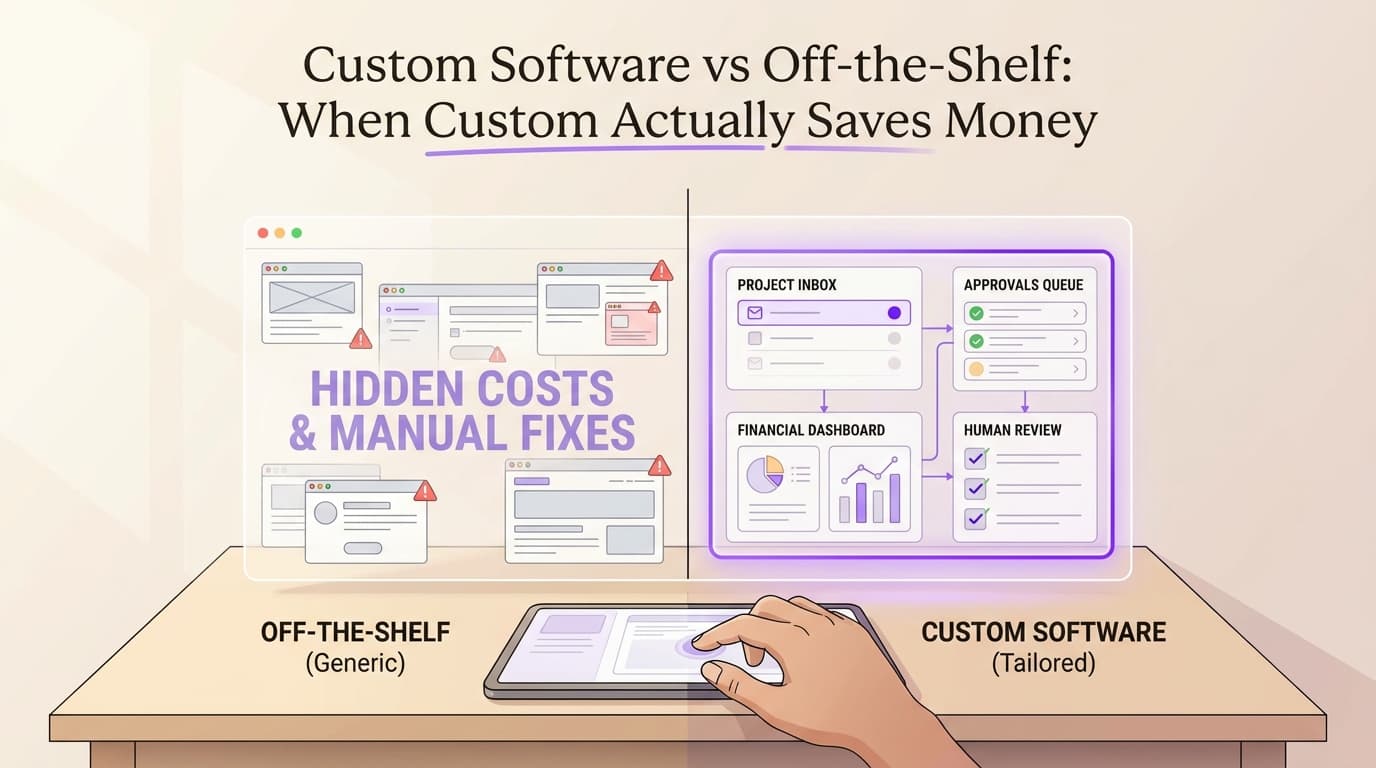
Custom Software vs Off-the-Shelf: When Custom Actually Saves Money
Learn how custom software ROI can transform your business operations and bottom line.
Read the article: Custom Software vs Off-the-Shelf: When Custom Actually Saves Money
