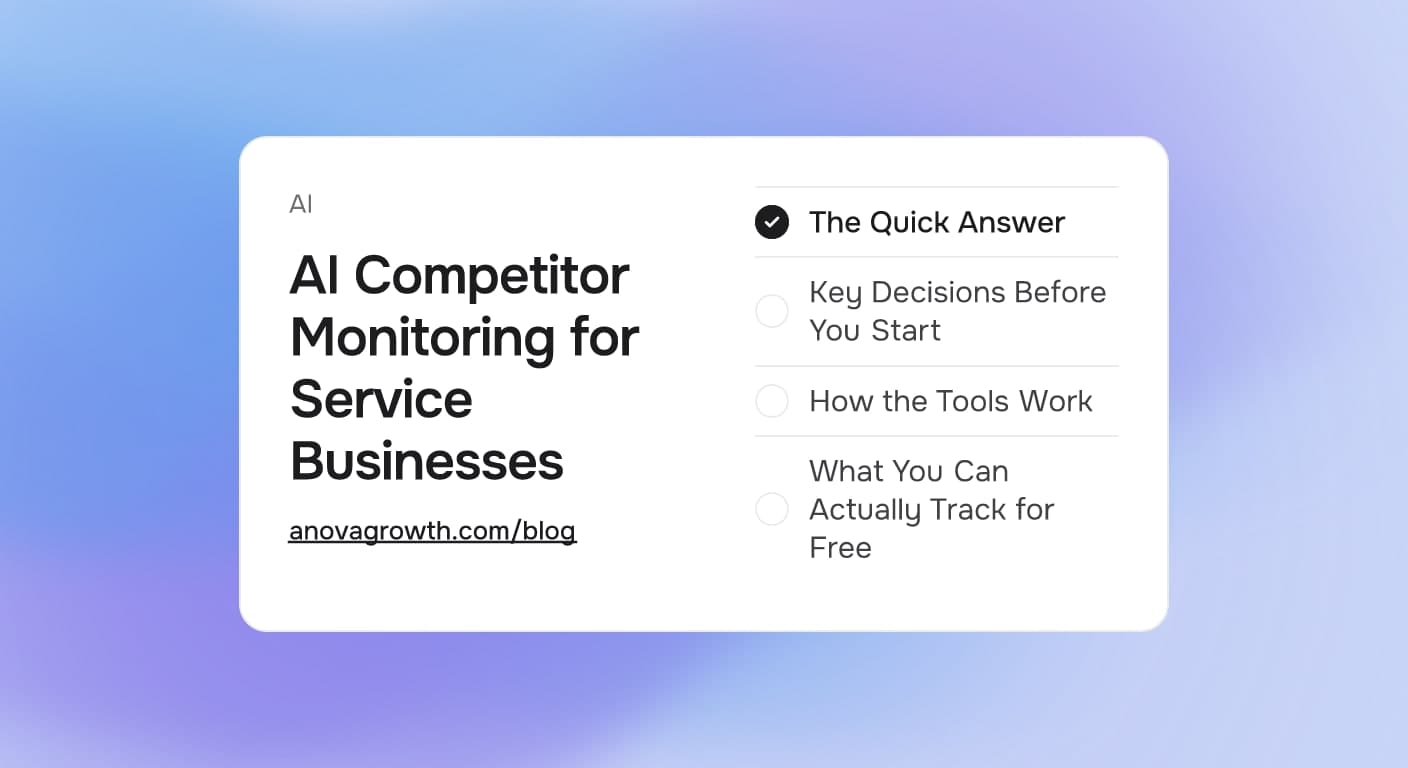
AI Competitor Monitoring for Service Businesses: Track Public Signals Without Hiring an Analyst
AI competitor monitoring scrapes public data so service businesses can track competitor pricing, services, reviews, and marketing in real time without manual research.

Most service business owners know what their competitors charge because a customer told them at some point. That is not a strategy. That is word of mouth working slowly and unevenly.
AI competitor monitoring changes the source of that information. Instead of waiting for customers to spill what the competitor down the street is charging, you pull it directly from public data, automatically, on a schedule.
Here is what that actually looks like for a service business, what it costs, and where it breaks down.
What AI Competitor Monitoring Actually Tracks
The word "monitoring" covers a lot of ground. For service businesses specifically, the useful signals fall into a few categories.
Pricing signals. Your competitors publish pricing on their websites, sometimes in service pages, sometimes buried in a pricing calculator. AI tools can scrape those pages on a schedule and log changes. A competitor who suddenly drops the price on a common service is signaling something. You want to know that before your next customer brings it up.
Service offering changes. New services, new certifications, new equipment, new areas served. If a competitor adds solar installation to their HVAC business, that is a real shift worth knowing about.
Review volume and sentiment. Not just the star rating, but the language customers use. AI can track whether a competitor's reviews are trending positive or negative and flag the specific complaints showing up most often.
Marketing activity. New Google Business Profile posts, website content updates, social media cadence. A competitor who starts publishing daily is either running a promotion or building something bigger.
Review responses. How fast a competitor replies to reviews, and how they word those responses, tells you something about their operations and their customer stance.
The Quick Answer
AI competitor monitoring uses automated scraping and AI analysis to track what competitors publish publicly. Service businesses use it to catch pricing changes, new service offerings, review trends, and marketing moves before they lose customers to them. It replaces manual research that nobody has time to do consistently.
Key Decisions Before You Start
Before you buy anything, answer these honestly:
What are you actually hunting? Pricing? Service mix? Reviews? Marketing? All four require different tools and different attention levels. Tracking everything creates noise. Tracking one thing deeply often wins.
Who owns this data? The monitoring runs. Someone has to look at the output and make a decision. If nobody is assigned, the dashboard fills up and nobody looks at it.
What will you do with a negative signal? If you find out a competitor dropped their price, what is the actual response? Compete on price? Emphasize value? Ignore it? Knowing this upfront matters more than the monitoring itself.
How the Tools Work
Most AI competitor monitoring stacks together three layers.
Scraping layer. Tools like Apify, PhantomBuster, or custom scripts pull data from competitor websites, Google Business Profile, Yelp, and social channels on a schedule. The schedule matters. A weekly scrape catches big moves. A daily scrape catches fast changes.
AI analysis layer. Raw data is noisy. A pile of competitor review text is not useful until something summarizes the themes and flags patterns. AI does that summarization and flags anomalies.
Dashboard and alert layer. The output needs to go somewhere. Slack, email, or a BI tool like Looker or even a shared Google Sheet. The alert threshold matters: if everything triggers an alert, you tune it out.
What You Can Actually Track for Free
A lot of competitor intelligence requires no paid tool if you are willing to set up the automation yourself.
Google Alerts on competitor names catches new website content, news mentions, and review activity that Google indexes. It is slow and broad but free.
Google Business Profile posts are public. A simple scheduled scrape of a competitor's GBP posts tells you what promotions they are running right now.
Yelp and Google review pages are public. Review volume and star rating are trackable on a schedule without a paid tool.
Website pricing pages are public. A weekly check on three to five competitor service pages takes twenty minutes and tells you whether anyone has moved.
The paid tools get you speed, scale, and AI summarization. But a service business owner who checks competitor pricing manually once a week is already ahead of most of the market.
Proof This Matters
A regional HVAC company we worked with discovered through basic competitor monitoring that a national franchise had entered their service area and was running a $49 inspection special on Google Ads. They found out through the ad itself, not through any monitoring system, and by then three of their regular customers had already mentioned it. By the time they heard it from customers, the competitor had already run the promotion for two weeks.
The company that had a monitoring system in place would have seen the new competitor website, the new GBP listing, and the ad launch in the first 48 hours. That lead time matters in a service business where switching costs are low.
Common Mistakes
Monitoring everything, acting on nothing. The dashboard becomes a data museum. Pick two or three signals maximum and track those religiously.
No response protocol. Finding out a competitor dropped prices is only useful if you have already decided whether and how to respond. Otherwise you spend energy on anxiety, not action.
Ignoring local signals. A competitor's national pricing does not tell you what they charge in your zip code. Local market data is what matters for service businesses.
Setting alerts too narrow. If your alert fires only when a competitor changes their homepage headline, you miss the slow buildup. Sometimes the signal is in a pattern over 90 days, not a single event.
What AnovaGrowth Operating Insight Looks Like
We run competitor monitoring for our own marketing and for clients in highly competitive local markets. The pattern that shows up most often is not a dramatic pricing move. It is a slow accumulation of new review responses, a steady increase in posting frequency, or a gradual website update cadence. The competitors who are quietly building something almost never announce it. They just post more, respond faster, and update their GBP more often. That pattern is a stronger signal than any single event.
Related Fan-Out Questions
- How does AI track competitor pricing changes automatically?
- What free tools track competitor Google Business Profile posts?
- How do service businesses use AI to analyze competitor reviews?
- What is the best competitor monitoring tool for small service businesses?
- How often should service businesses check competitor pricing?
- How do AI alerts work for competitor marketing tracking?
Internal Links
If you are thinking about what your business should look like operationally as it grows, AI business intelligence for service businesses covers how to turn data into decisions that actually drive revenue.
For the operational side of tracking what is working in your own business versus competitors, AI analytics and reporting for service businesses walks through building dashboards that matter.
If the competitor move you are tracking is a pricing change, AI pricing intelligence for service businesses covers how to set your own prices intelligently instead of reactively.
The data only matters if it feeds a decision. Competitor monitoring tells you what the market is doing. The next step is deciding what you do with that information before the next customer walks in and tells you about it.
Ready to build a monitoring system that actually gets used? Contact us to discuss how AnovaGrowth sets up automated competitor intelligence for service businesses.
Related articles
AI Customer Lifetime Value Prediction for Service Businesses: Stop Guessing Who Is Worth Keeping
AI CLV prediction uses your CRM and job history to score every account by projected revenue over 12 to 36 months. Know which customers to protect.
Read the article: AI Customer Lifetime Value Prediction for Service Businesses: Stop Guessing Who Is Worth Keeping
AI Operations Dashboard for Service Businesses: See Your Whole Business in One Place
Most service businesses run five or more software tools that never talk to each other. AI operations dashboards connect the dots and surface what matters in real time.
Read the article: AI Operations Dashboard for Service Businesses: See Your Whole Business in One Place
Live Operations Intelligence for Service Businesses: Run Your Company on Real-Time Data
Most service business owners run on gut feel and end-of-day reports. Live operations intelligence gives you real-time data. Here is how to see everything and decide faster.
Read the article: Live Operations Intelligence for Service Businesses: Run Your Company on Real-Time Data
