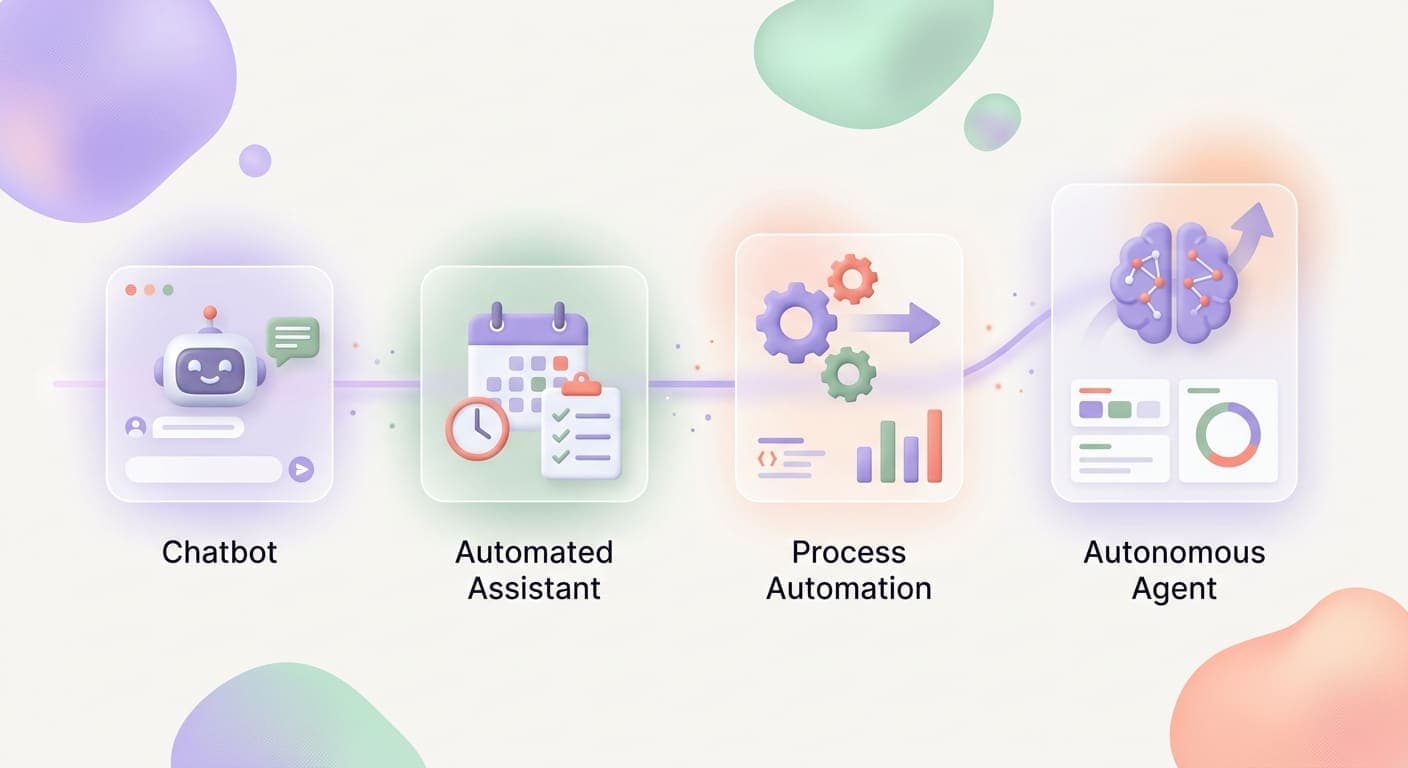
Most businesses using AI in 2026 are still using it as a fancy autocomplete.
They're asking ChatGPT to draft an email. Running prompts to summarize a report. Using Copilot to fill in a spreadsheet faster. That's not bad, but it's also not what the leading edge looks like anymore.
There's a shift happening right now, and it's worth paying attention to before you end up a full cycle behind.
Assistants Help. Agents Execute.
An AI assistant waits for you to ask. You prompt it, it responds, you take action.
An AI agent has a goal, a set of tools, and the ability to work through a multi-step task without you holding its hand at every stage.
The difference sounds subtle. It isn't.
An assistant can help you write a follow-up email. An agent can monitor your pipeline, identify leads that haven't been contacted in 14 days, draft personalized outreach for each one, and queue them for your review, without you touching it.
That's not a future demo. That's what teams are deploying right now.
Why This Shift Is Happening in 2026
Analyst firms including Gartner and IDC have been consistent: 2026 is the year AI agents move from pilot projects to production workflows. The tech infrastructure caught up. The cost dropped. The tooling matured.
At the enterprise level, the moves are visible. Adecco, one of the world's largest staffing firms, just signed an unlimited agentic AI agreement, targeting AI-driven processes for half their revenue by end of year. UiPath and Deloitte launched what they're calling an "agentic ERP," combining AI agents with robotic process automation to replace manual workflows inside core business systems.
These aren't moonshot bets. They're production commitments from companies that run on tight margins and can't afford experiments that don't work.
What This Actually Means for Small Businesses
Here's the honest take: most small businesses don't need enterprise-scale agent infrastructure. But they do need to stop thinking about AI as a tool you use and start thinking about it as a system that runs.
A few areas where this is practical right now:
Lead follow-up. An agent connected to your CRM can monitor new leads, trigger timed follow-up sequences, and escalate anything that looks hot, without manual review.
Client onboarding. New client signs? An agent can kick off your onboarding checklist, send intake forms, schedule kickoff calls, and update your project management system automatically.
Reporting. Instead of pulling reports manually each week, an agent can pull the data, format the summary, and deliver it to your inbox or Slack on schedule.
None of these require a big budget or a tech team. They require the right setup.
The Real Cost Is Doing Nothing
The businesses that are moving on this aren't doing it because they love technology. They're doing it because the people who work there are drowning in low-value repetitive work, and they can't hire their way out of it.
If you're a business owner handling things that could be systematized, every week you don't automate them is a week you're paying full-time attention for part-time output.
The shift from assistant to agent isn't about replacing people. It's about giving the people you have leverage they don't currently have.
Where to Start
Start with one workflow. Pick the thing that happens the most often, takes the most consistent steps, and currently lives in someone's head or inbox. Map it out. Then ask whether each step actually requires a human decision, or just a human who showed up.
Most of the time, the ratio surprises people.
Want help identifying which workflows make sense to automate first? Let's talk, no commitment, no pitch deck, just a straightforward look at what's worth building.