AI Employee Handbooks and Policy Automation for Service Businesses
AI-powered employee handbooks automate policy creation and updates for service businesses: boost compliance, save time, and empower staff instantly.

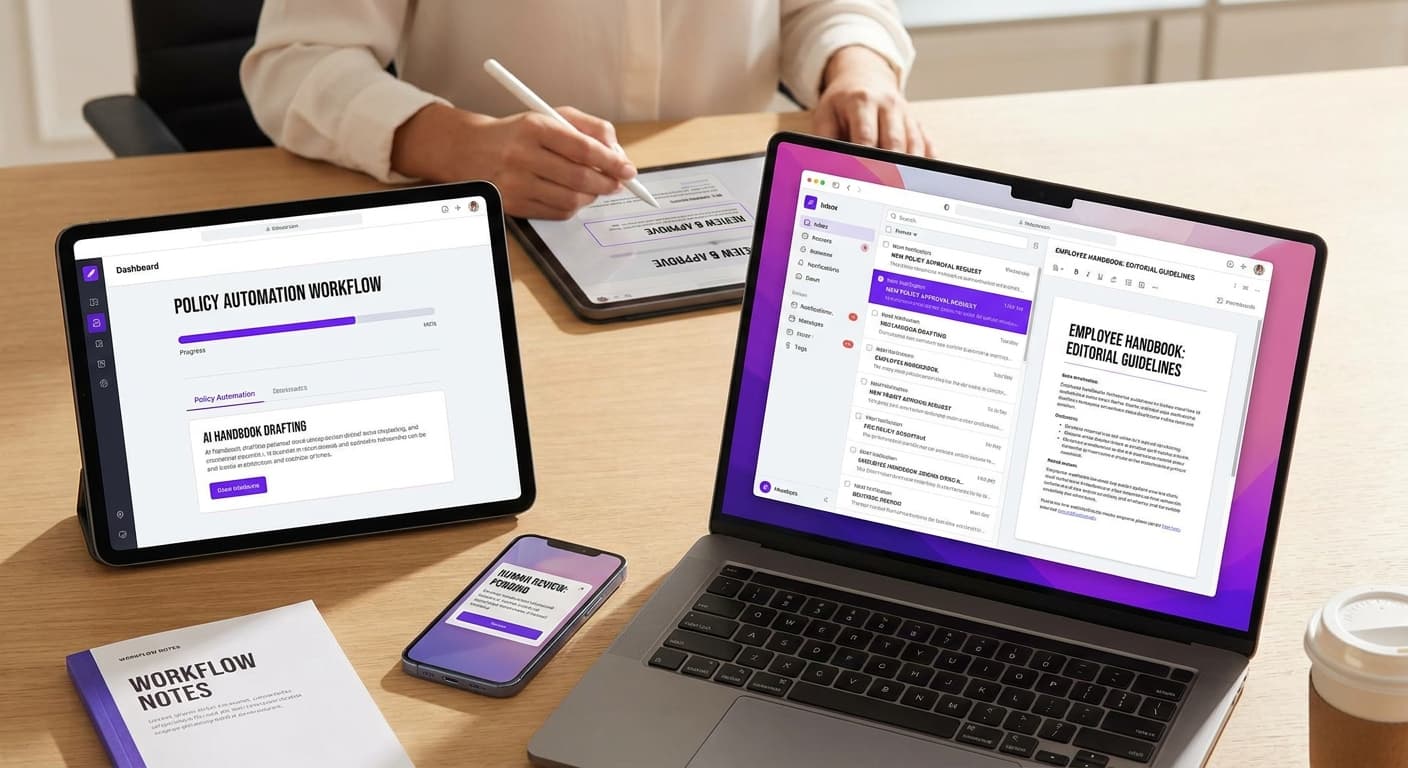
Keeping your employee handbook current feels like a full-time job. New labor laws. Updated leave policies. Shifting overtime rules. You rewrite sections, send memos, and still wonder if everyone read the latest version. For service businesses, where your workforce is your product, this problem hits harder than most. High turnover means constant onboarding. Regulatory changes hit hourly workers first. And when your managers juggle delivery routes, service calls, or client meetings, policy documentation falls to the bottom of the stack.
That's where AI employee handbook automation changes the equation. Instead of treating your handbook as a static document you update once a year, you can build a living system that drafts policy changes, flags compliance gaps, and generates training materials automatically. This post walks through how HR policy automation actually works for service businesses, not in theory, but in the workflows you run every day.
What AI Employee Handbook Automation Actually Does
AI employee handbook automation uses language models to draft, update, and distribute policy documents based on your input and real-time regulatory data. The system doesn't just format your existing text. It generates new sections when you describe a policy change, flags language that conflicts with current labor law, and creates onboarding checklists tied directly to your handbook content.
For a service business, this matters because your HR documents serve two audiences at once: your desk workers who understand policy language, and your field staff who need clear, simple explanations. AI tools can generate both versions from a single source, reducing the gap between what HR writes and what employees actually understand.
The technology connects to compliance databases (state labor boards, federal agencies, industry regulators) and monitors changes that affect your policies. When a minimum wage increase takes effect in your state, the system alerts you and suggests updated language for your overtime and overtime calculation sections.
Why Service Businesses Face Higher HR Documentation Costs
Service businesses spend disproportionate time on HR policy work compared to their revenue per employee. Here's the math: a 50-person landscaping company might experience 40% annual turnover, meaning 20 onboarding cycles per year. Each cycle requires handbook review, acknowledgment signatures, and policy training. Multiply that across sick leave laws, workers' comp requirements, and client-specific safety protocols, and your managers spend hours weekly on documentation that doesn't grow revenue.
Traditional approaches make this worse. You hire an HR consultant to draft your initial handbook, then pay hourly rates for updates whenever laws change. By the time you approve the changes, distribute them to staff, and collect acknowledgments, you've spent more time managing the document than improving the policies themselves.
AI employee handbook automation breaks this cycle. Instead of reactive updates, you get proactive monitoring. Instead of consultant hours, you pay a subscription that handles document generation, compliance checking, and version control in one system. For service businesses running lean, that shift from cost center to operational efficiency matters more than the technology itself.
How HR Policy Automation Handles Compliance Updates
Labor law compliance isn't optional, but tracking every change across federal, state, and local levels requires resources most service businesses don't have. HR policy automation solves this by integrating compliance monitoring directly into your document workflow.
When you describe a policy topic to the AI system (say, your company's approach to bereavement leave), the tool checks current legal requirements for your locations and flags gaps between what you have and what's required. It then drafts compliant language you can review and approve. This works faster than waiting for a consultant to research the same information.
The compliance layer catches common service business pain points:
- Overtime calculation methods that vary by state
- Paid sick leave accrual rates and carryover rules
- Workers' compensation reporting timelines
- Anti-harassment training requirements and frequencies
- DOT regulations for businesses with delivery drivers
You still make the policy decisions. The AI handles the research, drafts the language, and tracks which version each employee acknowledged. This separates the judgment calls from the administrative work, letting you focus on decisions rather than document formatting.
Onboarding Use Cases: From First Day to Role-Specific Training
Your employee handbook sets expectations. Your onboarding process reinforces them. AI employee handbook automation connects these two workflows so new hires get consistent information without managers repeating the same explanations twenty times per year.
The system generates role-specific onboarding packets from your core handbook. A new HVAC technician receives the general policies plus modules covering safety protocols, customer interaction standards, and equipment handling procedures. A front desk receptionist gets the same base policies with added sections on scheduling software, phone etiquette, and client confidentiality.
This approach reduces the training gap between experienced staff and new hires. Instead of hoping your best employee remembers to cover every important topic during the first week, you deliver a structured packet that hits every required point. Managers still review content with new hires, but the baseline information stays consistent across every onboarding cycle.
The U.S. Department of Labor reports that businesses with structured onboarding improve new hire retention by 50% and productivity by 62% compared to informal approaches. For service businesses where every hired employee represents recruitment and training investment, those numbers translate directly to your bottom line.
Implementing Policy Automation Without Disrupting Operations
You don't need to overhaul your entire HR system to start using AI employee handbook automation. The practical path starts with one document, the employee handbook, and builds from there.
Begin by feeding your current handbook into the AI system. The tool analyzes your existing policies, identifies gaps against current compliance requirements, and suggests updates. You review and approve each change before it goes live. This gives you immediate value while keeping you in control of final decisions.
Next, connect the system to your onboarding workflow. New hires receive the updated handbook digitally, sign acknowledgments electronically, and complete role-specific training modules. Your managers get reports showing completion rates and any sections requiring follow-up discussion.
As you gain confidence in the system, expand to other HR documents: safety manuals, benefits summaries, code of conduct updates. Each addition builds on the foundation you've established, multiplying the time savings without multiplying the implementation effort.
Our guide on AI vendor selection for service businesses covers the evaluation criteria that matter most when choosing any AI tool, including what questions to ask about data security, contract terms, and support quality before you commit.
What to Look for in an AI Handbook Tool
Not all AI employee handbook tools deliver the same value. The features that matter most for service businesses differ from those important to large corporations with dedicated HR departments.
Compliance coverage matters more than feature count. Look for tools that explicitly list the jurisdictions they monitor (federal, state, and local levels) and update automatically when laws change. A feature-rich system that misses your state's new predictive scheduling law creates more problems than it solves.
Integration with your existing tools ranks second. If you use QuickBooks for payroll, BambooHR for HRIS, or any other platform, your AI handbook tool should connect without custom development. Check whether the system supports electronic signatures, learning management tracking, and the document formats your team already uses.
Finally, review the human oversight requirements. The best tools draft and flag, but you approve. If a system claims full automation with no human review, dig deeper into how it handles errors or misinterprets your instructions. For compliance-sensitive documents like employee handbooks, a human-in-the-loop approach balances efficiency with accountability.
Service businesses also benefit from tools designed for distributed workforces. Your field staff may not have regular computer access, so mobile-friendly document delivery and acknowledgment tracking matter more than they would for office-based teams.
Key Takeaways
-
AI employee handbook automation handles document drafting, compliance monitoring, and policy updates, replacing consultant hours with ongoing software subscriptions.
-
Service businesses benefit most from the compliance layer, which tracks labor law changes across jurisdictions and flags policy gaps before they become problems.
-
Onboarding automation generates role-specific training materials from your core handbook, improving consistency and reducing manager workload during high-turnover periods.
-
Implementation starts with one document, not a full system overhaul. Feed your current handbook in, review AI suggestions, and expand as you gain confidence.
-
Choose tools based on compliance coverage and integration options, not feature counts. The right tool connects to your existing workflows without requiring custom development.
Ready to Build a Better Handbook System?
Your employee handbook shouldn't be a document you dread updating. With the right approach to HR policy automation, you can maintain compliance, improve onboarding, and free your managers to focus on the work that actually grows your business.
If you're ready to explore how AI employee handbook automation fits your specific operations, we can walk through your current workflow and identify where automation delivers the fastest return.
Ready to get started? Contact us to discuss how we can help your business.
Related articles
AI Agent Use Cases for Small Business Operations: What Actually Works in 2026
Most small business owners hear AI agents described as a concept and never see a real example. Here are six use cases that actually run in operations today.
Read the article: AI Agent Use Cases for Small Business Operations: What Actually Works in 2026
AI for Recurring Service Billing and Subscription Management: Get Paid On Time, Every Time
Service businesses lose 15-30% of recurring revenue to billing gaps, late invoices, and manual chase sequences. AI billing automation closes that loop.
Read the article: AI for Recurring Service Billing and Subscription Management: Get Paid On Time, Every Time
AI Service Dispatch and Routing Intelligence: Stop Burning Hours on Bad Routes
Most service businesses lose 2-4 hours per technician per day to routing mistakes. AI dispatch intelligence fixes route order, technician assignment, and drive time before your crew ever leaves the lot.
Read the article: AI Service Dispatch and Routing Intelligence: Stop Burning Hours on Bad Routes
